• 文献检索
  • 文档翻译
  • 深度研究
  • 学术资讯
  • Suppr Zotero 插件Zotero 插件
  • 邀请有礼
  • 套餐&价格
  • 历史记录
应用&插件
Suppr Zotero 插件Zotero 插件浏览器插件Mac 客户端Windows 客户端微信小程序
定价
高级版会员购买积分包购买API积分包
服务
文献检索文档翻译深度研究API 文档MCP 服务
关于我们
关于 Suppr公司介绍联系我们用户协议隐私条款
关注我们

Suppr 超能文献

核心技术专利:CN118964589B侵权必究
粤ICP备2023148730 号-1Suppr @ 2026

文献检索

告别复杂PubMed语法,用中文像聊天一样搜索,搜遍4000万医学文献。AI智能推荐,让科研检索更轻松。

立即免费搜索

文件翻译

保留排版,准确专业,支持PDF/Word/PPT等文件格式,支持 12+语言互译。

免费翻译文档

深度研究

AI帮你快速写综述,25分钟生成高质量综述,智能提取关键信息,辅助科研写作。

立即免费体验

临床基因组测序的次要发现:来自多中心研究的患病率、患者观点、家族史评估和医疗保健成本。

Secondary findings from clinical genomic sequencing: prevalence, patient perspectives, family history assessment, and health-care costs from a multisite study.

机构信息

Department of Medicine (Medical Genetics), University of Washington, Seattle, WA, USA.

Clinical Sequencing Exploratory Research Coordinating Center, University of Washington, Seattle, WA, USA.

出版信息

Genet Med. 2019 May;21(5):1100-1110. doi: 10.1038/s41436-018-0308-x. Epub 2018 Oct 5.

DOI:10.1038/s41436-018-0308-x
PMID:30287922
原文链接:https://pmc.ncbi.nlm.nih.gov/articles/PMC6450774/
Abstract

PURPOSE

Clinical sequencing emerging in health care may result in secondary findings (SFs).

METHODS

Seventy-four of 6240 (1.2%) participants who underwent genome or exome sequencing through the Clinical Sequencing Exploratory Research (CSER) Consortium received one or more SFs from the original American College of Medical Genetics and Genomics (ACMG) recommended 56 gene-condition pair list; we assessed clinical and psychosocial actions.

RESULTS

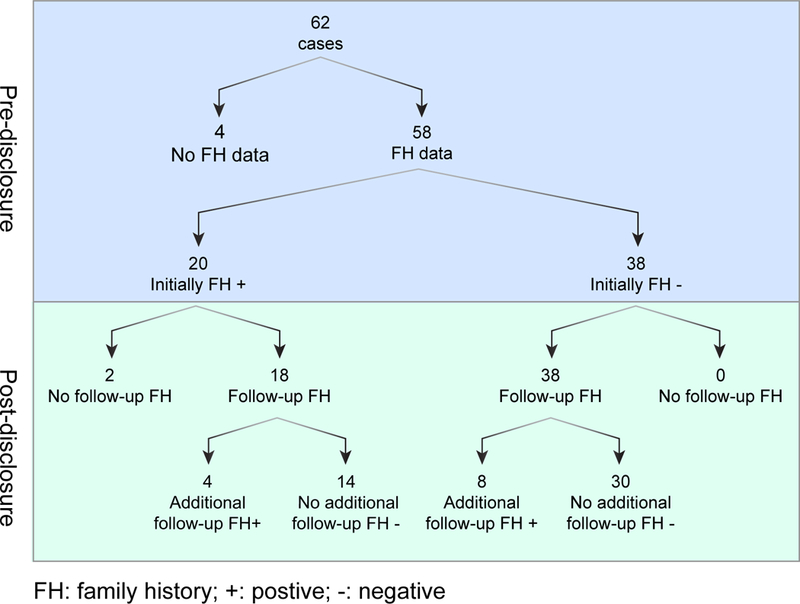
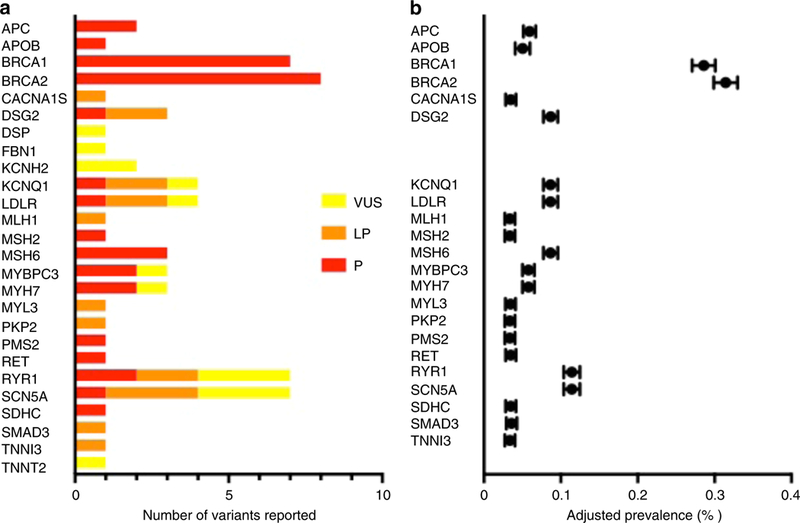
The overall adjusted prevalence of SFs in the ACMG 56 genes across the CSER consortium was 1.7%. Initially 32% of the family histories were positive, and post disclosure, this increased to 48%. The average cost of follow-up medical actions per finding up to a 1-year period was $128 (observed, range: $0-$678) and $421 (recommended, range: $141-$1114). Case reports revealed variability in the frequency of and follow-up on medical recommendations patients received associated with each SF gene-condition pair. Participants did not report adverse psychosocial impact associated with receiving SFs; this was corroborated by 18 participant (or parent) interviews. All interviewed participants shared findings with relatives and reported that relatives did not pursue additional testing or care.

CONCLUSION

Our results suggest that disclosure of SFs shows little to no adverse impact on participants and adds only modestly to near-term health-care costs; additional studies are needed to confirm these findings.

摘要

目的

医疗保健中新兴的临床测序可能会产生次要发现(SFs)。

方法

通过临床测序探索研究(CSER)联盟对 6240 名参与者中的 74 名进行了基因组或外显子测序,他们从最初的美国医学遗传学和基因组学学院(ACMG)推荐的 56 个基因-病症对列表中获得了一个或多个 SFs;我们评估了临床和心理社会行动。

结果

在 CSER 联盟中,ACMG 56 个基因的总体调整后的 SFs 患病率为 1.7%。最初 32%的家族史呈阳性,披露后增加到 48%。在 1 年的随访期间,每个发现的医疗后续行动的平均费用为 128 美元(观察到的,范围为 0-678 美元)和 421 美元(推荐的,范围为 141-1114 美元)。病例报告揭示了与每个 SF 基因-病症对相关的医疗建议的频率和后续行动的差异。参与者没有报告因收到 SFs 而产生的不良心理社会影响;这得到了 18 名参与者(或家长)访谈的证实。所有接受采访的参与者都与亲属分享了发现,并报告说亲属没有进行额外的测试或治疗。

结论

我们的结果表明,SFs 的披露对参与者几乎没有不良影响,并且仅略微增加了近期的医疗保健成本;需要进一步的研究来证实这些发现。
https://cdn.ncbi.nlm.nih.gov/pmc/blobs/7daa/6450774/4b932dfaa778/nihms-1003191-f0002.jpg
https://cdn.ncbi.nlm.nih.gov/pmc/blobs/7daa/6450774/d6c95cb208e2/nihms-1003191-f0001.jpg
https://cdn.ncbi.nlm.nih.gov/pmc/blobs/7daa/6450774/4b932dfaa778/nihms-1003191-f0002.jpg
https://cdn.ncbi.nlm.nih.gov/pmc/blobs/7daa/6450774/d6c95cb208e2/nihms-1003191-f0001.jpg
https://cdn.ncbi.nlm.nih.gov/pmc/blobs/7daa/6450774/4b932dfaa778/nihms-1003191-f0002.jpg

相似文献

1
Secondary findings from clinical genomic sequencing: prevalence, patient perspectives, family history assessment, and health-care costs from a multisite study.临床基因组测序的次要发现:来自多中心研究的患病率、患者观点、家族史评估和医疗保健成本。
Genet Med. 2019 May;21(5):1100-1110. doi: 10.1038/s41436-018-0308-x. Epub 2018 Oct 5.
2
Factors influencing NCGENES research participants' requests for non-medically actionable secondary findings.影响 NCGENES 研究参与者对非医学可操作性次要发现请求的因素。
Genet Med. 2019 May;21(5):1092-1099. doi: 10.1038/s41436-018-0294-z. Epub 2018 Sep 21.
3
Secondary ACMG and non-ACMG genetic findings in a multiethnic cohort of 16,713 pediatric participants.在一个由 16713 名儿科参与者组成的多民族队列中发现次要 ACMG 和非 ACMG 遗传结果。
Genet Med. 2024 Nov;26(11):101225. doi: 10.1016/j.gim.2024.101225. Epub 2024 Jul 31.
4
The who, what, and why of research participants' intentions to request a broad range of secondary findings in a diagnostic genomic sequencing study.研究参与者在诊断性基因组测序研究中请求广泛的次要发现的意图的来龙去脉。
Genet Med. 2018 Jul;20(7):760-769. doi: 10.1038/gim.2017.176. Epub 2017 Oct 26.
5
Disclosure of secondary findings in exome sequencing of 2480 Japanese cancer patients.2480 例日本癌症患者外显子组测序中二级发现的披露。
Hum Genet. 2021 Feb;140(2):321-331. doi: 10.1007/s00439-020-02207-6. Epub 2020 Jul 24.
6
Exploring and Expanding Secondary Findings Through Exome Sequencing in the Turkish Population.通过外显子组测序在土耳其人群中探索和扩展次要发现
Ann Hum Genet. 2025 May;89(2-3):106-113. doi: 10.1111/ahg.12592. Epub 2025 Feb 26.
7
Actionable secondary findings following exome sequencing of 836 non-obstructive azoospermia cases and their value in patient management.对 836 例非梗阻性无精子症病例进行外显子组测序后的可操作的次要发现及其在患者管理中的价值。
Hum Reprod. 2022 Jun 30;37(7):1652-1663. doi: 10.1093/humrep/deac100.
8
Understanding variations in secondary findings reporting practices across U.S. genome sequencing laboratories.了解美国基因组测序实验室次要发现报告实践的差异。
AJOB Empir Bioeth. 2018 Jan-Mar;9(1):48-57. doi: 10.1080/23294515.2017.1405095. Epub 2017 Dec 21.
9
Secondary genomic findings in the 2020 China Neonatal Genomes Project participants.2020 年中国新生儿基因组计划参与者的二级基因组发现。
World J Pediatr. 2022 Oct;18(10):687-694. doi: 10.1007/s12519-022-00558-w. Epub 2022 Jun 21.
10
Psychological outcomes related to exome and genome sequencing result disclosure: a meta-analysis of seven Clinical Sequencing Exploratory Research (CSER) Consortium studies.外显子组和基因组测序结果披露相关的心理结果:七项临床测序探索性研究(CSER)联盟研究的荟萃分析。
Genet Med. 2019 Dec;21(12):2781-2790. doi: 10.1038/s41436-019-0565-3. Epub 2019 Jun 13.

引用本文的文献

1
Medically Actionable Secondary Findings from Whole-Exome Sequencing (WES) Data in a Sample of 3972 Individuals.对3972名个体样本的全外显子组测序(WES)数据进行的具有医学可操作性的次要发现
Int J Mol Sci. 2025 Apr 9;26(8):3509. doi: 10.3390/ijms26083509.
2
Secondary findings in hereditary cancer genes after germline genetic testing - systematic review of literature.生殖系基因检测后遗传性癌症基因的次要发现——文献系统综述
Hum Genet. 2025 Apr 28. doi: 10.1007/s00439-025-02746-w.
3
Advancing precision care in pregnancy through a treatable fetal findings list.

本文引用的文献

1
The NCGENES project: exploring the new world of genome sequencing.NCGENES项目:探索基因组测序的新世界。
N C Med J. 2013 Nov-Dec;74(6):500-4.
通过一份可治疗的胎儿检查结果清单推进孕期精准护理。
Am J Hum Genet. 2025 Jun 5;112(6):1251-1269. doi: 10.1016/j.ajhg.2025.03.011. Epub 2025 Apr 9.
4
A Just Genomics Needs an ELSI of Translation.公正的基因组学需要转化的伦理、法律和社会影响研究。
Hastings Cent Rep. 2024 Dec;54 Suppl 2:S126-S135. doi: 10.1002/hast.4938.
5
Opportunistic genomic screening has clinical utility: An interventional cohort study.机会性基因组筛查具有临床实用性:一项干预性队列研究。
Genet Med. 2025 Feb;27(2):101323. doi: 10.1016/j.gim.2024.101323. Epub 2024 Nov 9.
6
Actionability and familial uptake following opportunistic genomic screening in a pediatric cancer cohort.在儿科癌症队列中进行机会性基因组筛查后的可操作性和家族性接受度。
Eur J Hum Genet. 2024 Jul;32(7):846-857. doi: 10.1038/s41431-024-01618-7. Epub 2024 May 13.
7
Precision Child Health: an Emerging Paradigm for Paediatric Quality and Safety.精准儿童健康:儿科质量与安全的新兴范式
Curr Treat Options Pediatr. 2020;6(4):317-324. doi: 10.1007/s40746-020-00207-2. Epub 2020 Aug 25.
8
A framework for the evaluation and reporting of incidental findings in clinical genomic testing.临床基因组检测中偶然发现的评估和报告框架。
Eur J Hum Genet. 2024 Jun;32(6):665-672. doi: 10.1038/s41431-024-01575-1. Epub 2024 Apr 2.
9
Hope, but never expect? Comparing parents' pre- and post-disclosure attitudes toward return of results from diagnostic exome sequencing for their child.抱有希望,但不要期望过高?比较父母在对孩子进行外显子组测序诊断后披露结果前后的态度。
Mol Genet Genomic Med. 2024 Mar;12(3):e2341. doi: 10.1002/mgg3.2341. Epub 2024 Feb 17.
10
The Role of the Ophthalmic Genetics Multidisciplinary Team in the Management of Inherited Retinal Degenerations-A Case-Based Review.眼科遗传学多学科团队在遗传性视网膜变性管理中的作用——基于病例的综述
Life (Basel). 2024 Jan 9;14(1):107. doi: 10.3390/life14010107.