Oh Felix, Todhunter Deborah, Taras Elizabeth, Vallera Daniel A, Borgatti Antonella
Department of Therapeutic Radiology-Radiation Oncology, Masonic Cancer Center, University of Minnesota, Minneapolis, MN, USA,
Animal Cancer Care and Research (ACCR) Program, University of Minnesota, St. Paul, MN, USA,
Clin Pharmacol. 2018 Sep 26;10:113-121. doi: 10.2147/CPAA.S160262. eCollection 2018.
Human sarcomas are rare and difficult to treat cancerous tumors typically arising from soft tissue or bone. Conversely, carcinomas are the most common cancer subtype in humans and the primary cause of mortality across all cancer patients. While conventional therapeutic modalities can prolong disease-free intervals and survival in some cases, treatment of refractory or recurrent solid tumors is challenging, and tumor-related mortality remains unacceptably high. The identification of overexpressed cell surface receptors on sarcoma and carcinoma cells has provided a valuable tool to develop targeted toxins as an alternative anticancer strategy. Recent investigation of recombinant protein-linked toxins that specifically target these cancer receptors has led to the development of highly specific, cytotoxic, and deimmunized drugs that can kill cancer cells.
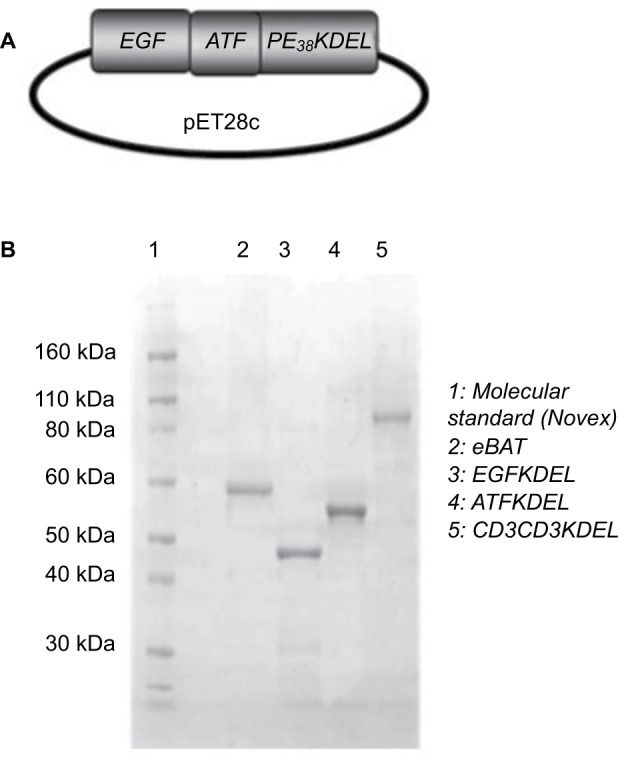
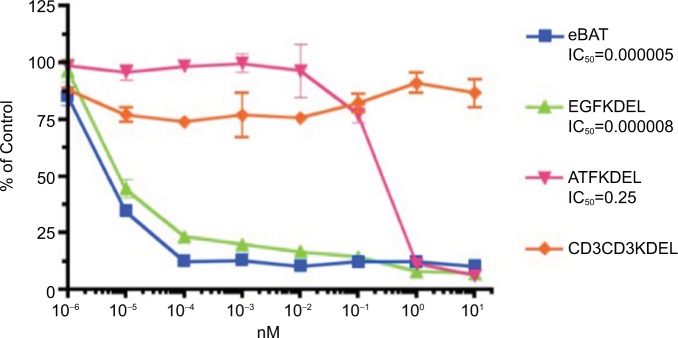
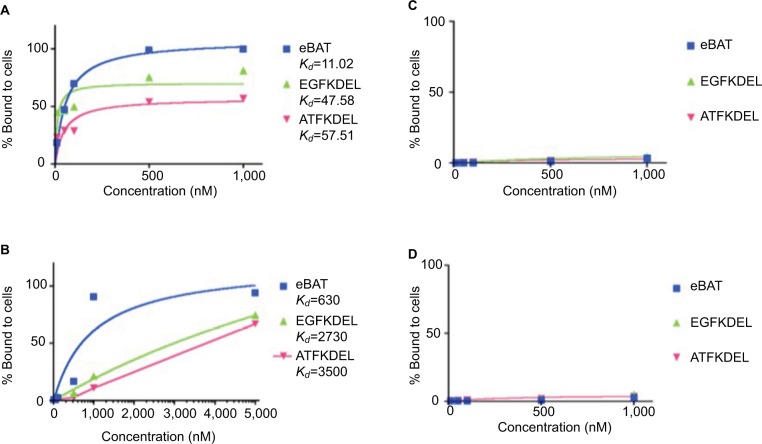
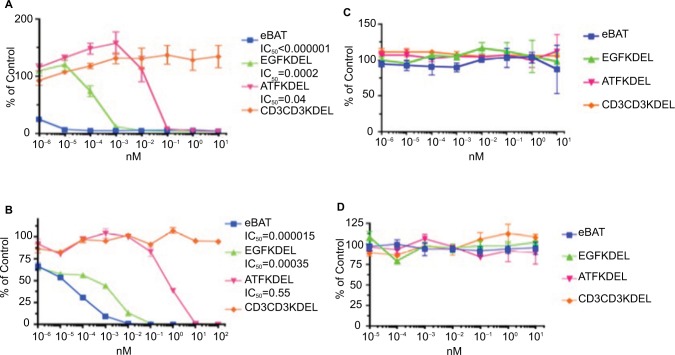
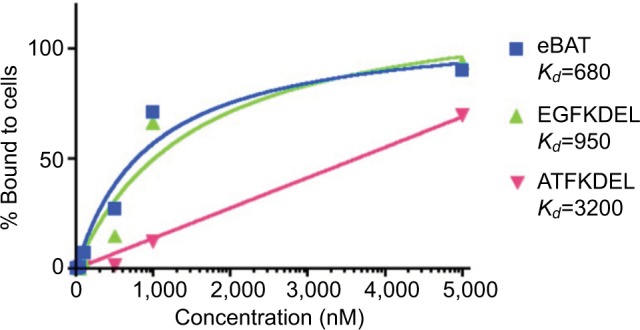
This study investigated a recombinant protein called epidermal growth factor bispecific angiotoxin (eBAT), which is designed to target the epidermal growth factor receptor (EGFR) on cancer cells and the urokinase plasminogen activator receptor (uPAR) on cancer cells and associated tumor vasculature. Both receptors are expressed by a variety of human sarcomas and carcinomas. Flow cytometry techniques were used to determine binding affinity of eBAT to cancer cells, and proliferation assays were performed to calculate tumor killing ability based on half-maximal inhibitory concentrations.
eBAT demonstrated cytotoxicity against a variety of sarcoma and carcinoma cells that overexpress EGFR and uPAR in vitro and showed greater cell killing ability and binding affinity to cancer cells compared with its monospecific counterparts.
The results of our study are promising, and further studies will be necessary to confirm the applicability of eBAT as a supplementary therapy for a variety of sarcomas, carcinomas, and possibly other refractory malignancies that express EGFR and uPAR.
人类肉瘤是罕见且难以治疗的癌性肿瘤,通常起源于软组织或骨骼。相反,癌是人类最常见的癌症亚型,也是所有癌症患者死亡的主要原因。虽然传统治疗方式在某些情况下可以延长无病间期和生存期,但治疗难治性或复发性实体瘤具有挑战性,且肿瘤相关死亡率仍然高得令人无法接受。肉瘤和癌细胞上过度表达的细胞表面受体的鉴定为开发靶向毒素作为替代抗癌策略提供了有价值的工具。最近对特异性靶向这些癌症受体的重组蛋白连接毒素的研究已导致开发出能杀死癌细胞的高度特异性、细胞毒性和去免疫化药物。
本研究调查了一种名为表皮生长因子双特异性血管毒素(eBAT)的重组蛋白,其设计用于靶向癌细胞上的表皮生长因子受体(EGFR)以及癌细胞和相关肿瘤脉管系统上的尿激酶型纤溶酶原激活剂受体(uPAR)。这两种受体在多种人类肉瘤和癌中均有表达。使用流式细胞术技术确定eBAT与癌细胞的结合亲和力,并进行增殖试验以根据半数最大抑制浓度计算肿瘤杀伤能力。
eBAT在体外对多种过度表达EGFR和uPAR的肉瘤和癌细胞表现出细胞毒性,并且与其单特异性对应物相比,对癌细胞显示出更强的细胞杀伤能力和结合亲和力。
我们的研究结果很有前景,需要进一步研究以确认eBAT作为多种肉瘤、癌以及可能其他表达EGFR和uPAR的难治性恶性肿瘤的辅助治疗的适用性。