Grady Mike, Katz Laurence Barry, Strunk Christine Simone, Cameron Hilary, Levy Brian Leonard
LifeScan Scotland, Inverness, United Kingdom.
LifeScan Inc, Wayne, PA, United States.
JMIR Diabetes. 2017 Oct 2;2(2):e24. doi: 10.2196/diabetes.8299.
Many patients struggle to interpret and respond appropriately to the numerical blood glucose results displayed on their meter, with many regularly taking no action or self-care adjustment for out-of-range results. We recently reported that a glucose meter that provides automatic onscreen information using a color range indicator (ColorSure Technology) improved the ability of patients to categorize their blood glucose results.
The objective of this study was to examine how ColorSure Technology (or color) affected patient decision making on blood glucose results and how patient numeracy levels influenced such decisions.
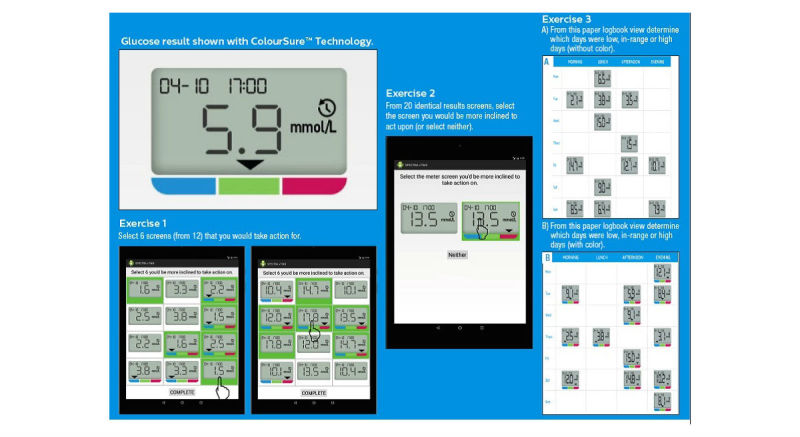
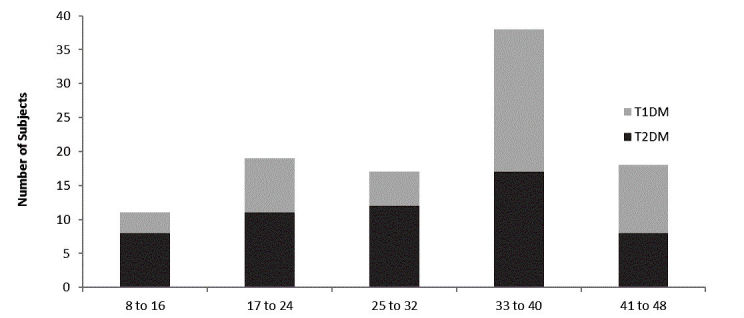
We invited 103 subjects (56 with type 2 diabetes and 47 with type 1 diabetes) to a face-to-face in-clinic visit in a diabetes care center and showed them glucose results with or without color via interactive computer or paper logbook exercises. Before participating in these exercises, subjects completed surveys on numeracy and their understanding of blood glucose information.
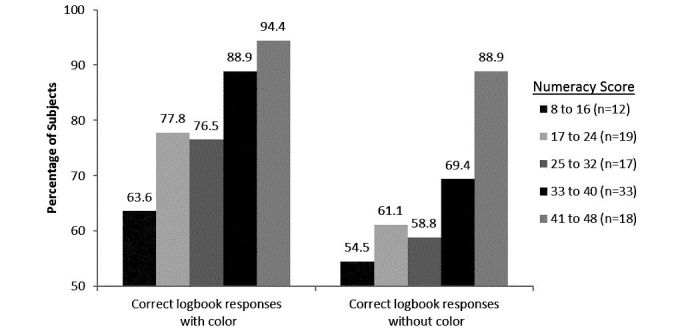
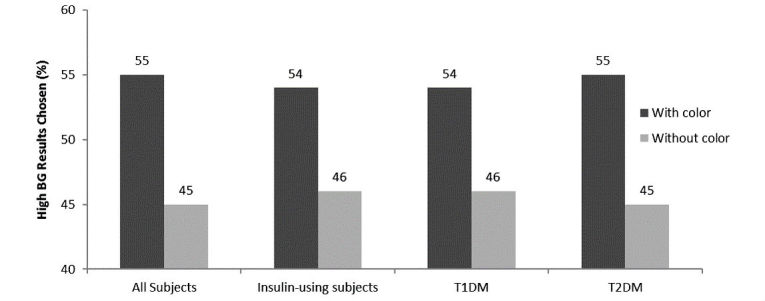
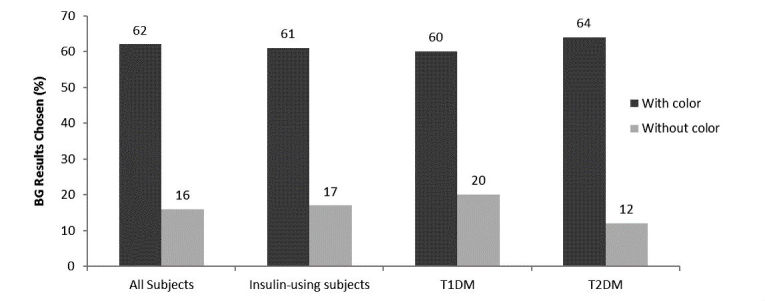
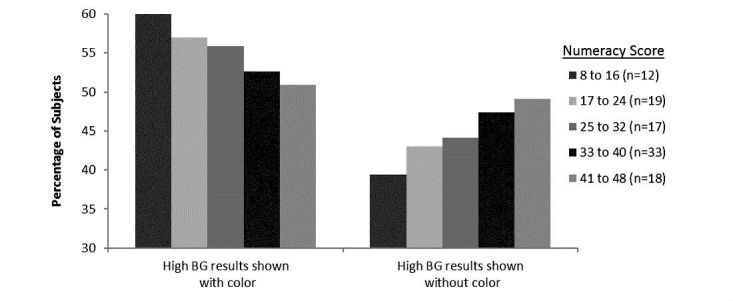
Subjects preferentially acted on high glucose results shown with color (55%, 57/103) compared to results without color (45%, 46/103; P=.001). When shown identical pairs of results, subjects preferentially acted on results shown with color (62%, 64/103) compared to results without color (16%, 16/103) (P<.001). Subjects more accurately identified days of the week in which results were low, in range, or high when reviewing logbooks with color (83%, 85/103) than without color (68%, 70/103; P=.012). Subjects with lower numeracy were more likely to consider taking action for high glucose results shown with color (59%, 18/31) than without color (41%, 13/31) and preferentially would take action on results shown with color (71%, 22/31) compared to results without color (16%, 5/31).
Insulin- and noninsulin-using subjects were each more inclined to act when glucose results were shown with color, and associating glucose results with color was viewed as particularly beneficial by subjects with lower numeracy.
许多患者难以解读血糖仪上显示的血糖数值并做出恰当反应,很多人对超出范围的结果常常不采取任何行动或进行自我护理调整。我们最近报告称,一种使用颜色范围指示器提供自动屏幕信息的血糖仪(ColorSure技术)提高了患者对血糖结果进行分类的能力。
本研究的目的是探讨ColorSure技术(或颜色)如何影响患者对血糖结果的决策,以及患者的数字运算能力水平如何影响此类决策。
我们邀请了103名受试者(56名2型糖尿病患者和47名1型糖尿病患者)到糖尿病护理中心进行面对面的门诊就诊,并通过交互式计算机或纸质日志练习向他们展示有颜色或无颜色的血糖结果。在参与这些练习之前,受试者完成了关于数字运算能力及其对血糖信息理解的调查。
与无颜色的结果(45%,46/103)相比,受试者对有颜色显示的高血糖结果更倾向于采取行动(55%,57/103;P = 0.001)。当展示相同的结果对时,与无颜色的结果(16%,16/103)相比,受试者对有颜色显示的结果更倾向于采取行动(62%,64/103)(P < 0.001)。与无颜色的日志(68%,70/103)相比,受试者在查看有颜色的日志时能更准确地识别结果为低、在范围内或高的星期几(83%,85/103;P = 0.012)。数字运算能力较低的受试者更有可能考虑对有颜色显示的高血糖结果采取行动(59%,18/31),而不是无颜色的结果(41%,13/31),并且与无颜色的结果(16%,5/31)相比,他们更倾向于对有颜色显示的结果采取行动(71%,22/31)。
使用胰岛素和不使用胰岛素的受试者在血糖结果有颜色显示时都更倾向于采取行动,并且数字运算能力较低的受试者认为将血糖结果与颜色关联特别有益。