• 文献检索
  • 文档翻译
  • 深度研究
  • 学术资讯
  • Suppr Zotero 插件Zotero 插件
  • 邀请有礼
  • 套餐&价格
  • 历史记录
应用&插件
Suppr Zotero 插件Zotero 插件浏览器插件Mac 客户端Windows 客户端微信小程序
定价
高级版会员购买积分包购买API积分包
服务
文献检索文档翻译深度研究API 文档MCP 服务
关于我们
关于 Suppr公司介绍联系我们用户协议隐私条款
关注我们

Suppr 超能文献

核心技术专利:CN118964589B侵权必究
粤ICP备2023148730 号-1Suppr @ 2026

文献检索

告别复杂PubMed语法,用中文像聊天一样搜索,搜遍4000万医学文献。AI智能推荐,让科研检索更轻松。

立即免费搜索

文件翻译

保留排版,准确专业,支持PDF/Word/PPT等文件格式,支持 12+语言互译。

免费翻译文档

深度研究

AI帮你快速写综述,25分钟生成高质量综述,智能提取关键信息,辅助科研写作。

立即免费体验

使用移动应用程序促进1型糖尿病青少年的血糖监测:单受试者非随机临床试验。

Use of a Mobile App to Facilitate Blood Glucose Monitoring in Adolescents With Type 1 Diabetes: Single-Subject Nonrandomized Clinical Trial.

作者信息

Bellfield Edward J, Sharp Lisa K, Xia Yinglin, Gerber Ben S

机构信息

Department of Pediatrics, University of Illinois at Chicago, Chicago, IL, United States.

Institute for Health Research and Policy, University of Illinois at Chicago, Chicago, IL, United States.

出版信息

JMIR Diabetes. 2018 Feb 7;3(1):e3. doi: 10.2196/diabetes.8357.

DOI:10.2196/diabetes.8357
PMID:30291085
原文链接:https://pmc.ncbi.nlm.nih.gov/articles/PMC6238847/
Abstract

BACKGROUND

Cloud-based glucose monitoring programs allow users with diabetes to wirelessly synchronize their glucometers to their mobile phones. They also provide visualization and remote access of their data through its mobile app. There have been very few studies evaluating their effectiveness in managing diabetes among adolescents with type 1 diabetes (T1D).

OBJECTIVE

The purpose of this study was to assess the feasibility of using a mobile app to improve daily average blood glucose (BG) levels and increase BG monitoring frequency.

METHODS

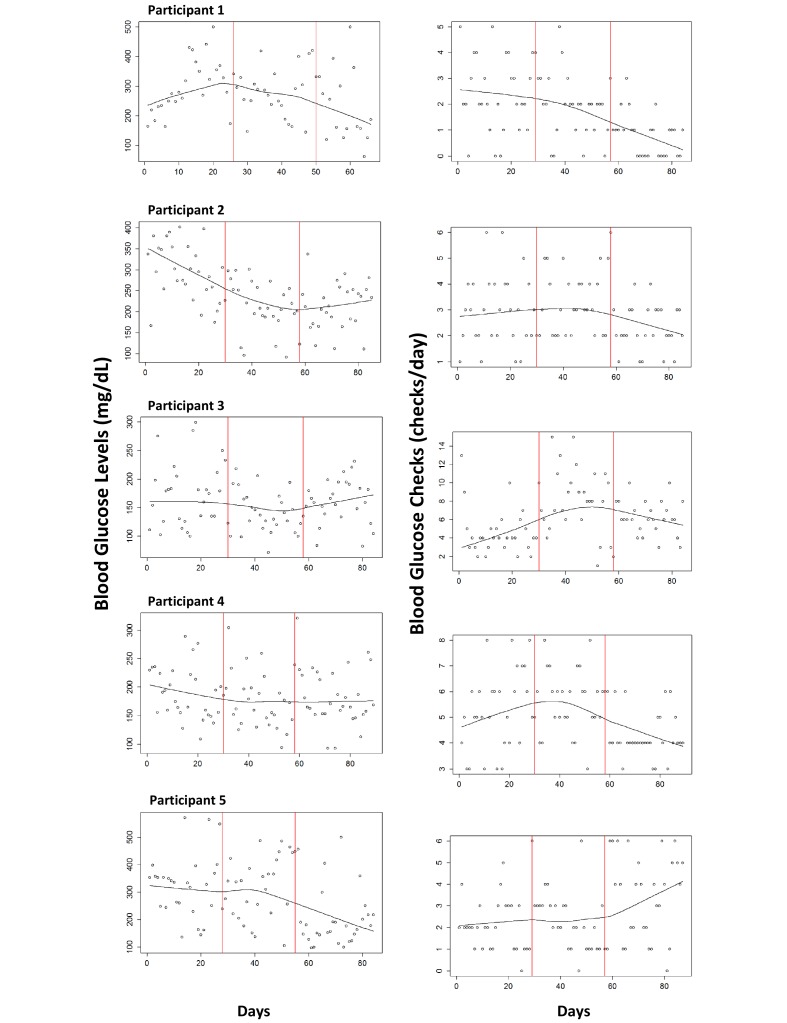
We used an ABA single-subject prospective study design. We recruited five participants aged 13 to 17 years with uncontrolled T1D, glycated hemoglobin A1c 9.0%-10.7%, self-monitoring behavior of ≤5 checks/day, and on multiple daily insulin injections. The study consisted of 4-week intervals of three phases: (1) phase A: usual glucose monitoring log (fax); (2) phase B: mobile app; and (3) phase A': second phase A. A certified diabetes educator and endocrinologist reviewed logs and provided recommendations weekly. Data were analyzed using a quasi-Poisson model to adjust for overdispersion among individual participants, and a generalized estimating equation model for overall intervention effect in aggregate.

RESULTS

For mean daily BG (mg/dL) levels, participant 1 had decreased values on the mobile app (298 to 281, P=.03) and maintained in phase A'. Participant 4 had an increase in mean daily BG in phase A' (175 to 185, P=.01), whereas participant 5 had a decrease in mean daily BG in phase A' (314 to 211, P=.04). For daily monitoring (checks/day), participant 3 increased in phase B (4.6 to 8.3, P=.01) and maintained in phase A'. Participant 5 also had increased daily monitoring at each phase (2.1 to 2.4, P=.01; 2.4 to 3.4, P=.02). For the five participants combined, the overall mean BG and BG checks per day in phase A were mean 254.8 (SD 99.2) and mean 3.6 (SD 2.0), respectively, mean 223.1 (SD 95.7) and mean 4.5 (SD 3.0) in phase B, and mean 197.5 (SD 81.3) and mean 3.7 (SD 2.1) in phase A'. Compared to phase A, mean glucose levels declined during phase B and remained lower during phase A' (P=.002). There was no overall change in BG checks by phase (P=.25). However, mean BG levels negatively correlated with daily BG checks (r=-.47, P<.001). Although all participants had positive opinions about the app, its utilization was highly variable.

CONCLUSIONS

We demonstrated modest feasibility of adolescents with uncontrolled T1D utilizing a glucose monitoring mobile app. Further study is needed to better determine its effects on BG level and monitoring frequency. Psychosocial factors and motivational barriers likely influence adoption and continuous use of technology for diabetes management.
https://cdn.ncbi.nlm.nih.gov/pmc/blobs/0d7c/6238847/832f908cea90/diabetes_v3i1e3_fig1.jpg
摘要

背景

基于云的血糖监测程序允许糖尿病患者将血糖仪与手机进行无线同步。它们还通过其移动应用程序提供数据的可视化和远程访问。很少有研究评估其在1型糖尿病(T1D)青少年中管理糖尿病的有效性。

目的

本研究的目的是评估使用移动应用程序改善每日平均血糖(BG)水平并增加BG监测频率的可行性。

方法

我们采用ABA单受试者前瞻性研究设计。我们招募了5名年龄在13至17岁之间、T1D控制不佳、糖化血红蛋白A1c为9.0%-10.7%、自我监测行为≤每天5次检查且每天多次注射胰岛素的参与者。该研究包括三个阶段,每个阶段为期4周:(1)A阶段:常规血糖监测日志(传真);(2)B阶段:移动应用程序;(3)A'阶段:第二阶段A。一名认证的糖尿病教育者和内分泌学家每周审查日志并提供建议。使用准泊松模型分析数据以调整个体参与者之间的过度离散,并使用广义估计方程模型分析总体干预效果。

结果

对于每日平均BG(mg/dL)水平,参与者1在移动应用程序上的值有所下降(从298降至281,P=0.03),并在A'阶段保持。参与者4在A'阶段的每日平均BG有所增加(从175升至185,P=0.01),而参与者5在A'阶段每日平均BG有所下降(从314降至211,P=0.04)。对于每日监测(检查次数/天),参与者3在B阶段增加(从4.6增至8.3,P=0.01),并在A'阶段保持。参与者5在每个阶段的每日监测也有所增加(从2.1增至2.4,P=0.01;从2.4增至3.4,P=0.02)。对于5名参与者的综合情况,A阶段的总体平均BG和每日BG检查次数分别为平均254.8(标准差99.2)和平均3.6(标准差2.0),B阶段为平均223.1(标准差95.7)和平均4.5(标准差3.0),A'阶段为平均197.5(标准差81.3)和平均3.7(标准差2.1)。与A阶段相比,B阶段的平均血糖水平下降,且在A'阶段保持较低水平(P=0.002)。各阶段的BG检查次数没有总体变化(P=0.25)。然而,平均BG水平与每日BG检查次数呈负相关(r=-0.47,P<0.001)。尽管所有参与者对该应用程序都有积极的看法,但其利用率差异很大。

结论

我们证明了T1D控制不佳的青少年使用血糖监测移动应用程序具有一定的可行性。需要进一步研究以更好地确定其对BG水平和监测频率的影响。心理社会因素和动机障碍可能会影响糖尿病管理技术的采用和持续使用。

相似文献

1
Use of a Mobile App to Facilitate Blood Glucose Monitoring in Adolescents With Type 1 Diabetes: Single-Subject Nonrandomized Clinical Trial.使用移动应用程序促进1型糖尿病青少年的血糖监测:单受试者非随机临床试验。
JMIR Diabetes. 2018 Feb 7;3(1):e3. doi: 10.2196/diabetes.8357.
2
Impact of Use Frequency of a Mobile Diabetes Management App on Blood Glucose Control: Evaluation Study.移动糖尿病管理应用程序使用频率对血糖控制的影响:评估研究。
JMIR Mhealth Uhealth. 2019 Mar 7;7(3):e11933. doi: 10.2196/11933.
3
An mHealth-Based Intervention for Adolescents With Type 1 Diabetes and Their Parents: Pilot Feasibility and Efficacy Single-Arm Study.基于移动医疗的 1 型糖尿病青少年及其父母干预措施:单臂试验可行性和疗效初步研究。
JMIR Mhealth Uhealth. 2021 Sep 14;9(9):e23916. doi: 10.2196/23916.
4
Development and Evaluation of a Mobile Personalized Blood Glucose Prediction System for Patients With Gestational Diabetes Mellitus.妊娠期糖尿病患者移动个性化血糖预测系统的开发与评估
JMIR Mhealth Uhealth. 2018 Jan 9;6(1):e6. doi: 10.2196/mhealth.9236.
5
A Mobile App for Synchronizing Glucometer Data: Impact on Adherence and Glycemic Control Among Youths With Type 1 Diabetes in Routine Care.一款用于同步血糖仪数据的移动应用程序:对常规护理中1型糖尿病青少年的依从性和血糖控制的影响。
J Diabetes Sci Technol. 2017 May;11(3):461-467. doi: 10.1177/1932296817691302. Epub 2017 Feb 9.
6
Glucose Control, Disease Burden, and Educational Gaps in People With Type 1 Diabetes: Exploratory Study of an Integrated Mobile Diabetes App.1型糖尿病患者的血糖控制、疾病负担及教育差距:一款综合性移动糖尿病应用程序的探索性研究
JMIR Diabetes. 2018 Nov 23;3(4):e17. doi: 10.2196/diabetes.9531.
7
One Drop | Mobile: An Evaluation of Hemoglobin A1c Improvement Linked to App Engagement.一滴 | 移动应用:与应用程序参与度相关的糖化血红蛋白改善情况评估
JMIR Diabetes. 2017 Aug 24;2(2):e21. doi: 10.2196/diabetes.8039.
8
Feasibility and Impact of Remote Glucose Monitoring Among Patients With Newly Diagnosed Type 1 Diabetes: Single-Center Pilot Study.新诊断1型糖尿病患者远程血糖监测的可行性及影响:单中心试点研究
JMIR Diabetes. 2022 Jan 17;7(1):e33639. doi: 10.2196/33639.
9
A Mobile Health Intervention for Self-Management and Lifestyle Change for Persons With Type 2 Diabetes, Part 2: One-Year Results From the Norwegian Randomized Controlled Trial RENEWING HEALTH.移动健康干预对 2 型糖尿病患者的自我管理和生活方式改变,第 2 部分:挪威随机对照试验 RENEWING HEALTH 的一年结果。
JMIR Mhealth Uhealth. 2014 Dec 11;2(4):e57. doi: 10.2196/mhealth.3882.
10
Mobile Momentary Assessment and Biobehavioral Feedback for Adolescents with Type 1 Diabetes: Feasibility and Engagement Patterns.移动即时评估和生物行为反馈在青少年 1 型糖尿病中的应用:可行性和参与模式。
Diabetes Technol Ther. 2018 Jul;20(7):465-474. doi: 10.1089/dia.2018.0064. Epub 2018 Jun 8.

引用本文的文献

1
Limitations of Using Mobile Phones for Managing Type 1 Diabetes (T1D) Among Youth in Low and Middle-Income Countries: Implications for mHealth.低收入和中等收入国家青少年使用手机管理1型糖尿病(T1D)的局限性:对移动健康的启示
Proc ACM Hum Comput Interact. 2024 Nov;8(CSCW2). doi: 10.1145/3687045. Epub 2024 Nov 8.
2
Effects of Digitization of Self-Monitoring of Blood Glucose Records Using a Mobile App and the Cloud System on Outpatient Management of Diabetes: Single-Armed Prospective Study.使用移动应用程序和云系统对血糖记录进行自我监测数字化对糖尿病门诊管理的影响:单臂前瞻性研究。
JMIR Diabetes. 2024 Jan 19;9:e48019. doi: 10.2196/48019.
3

本文引用的文献

1
A Mobile App for Synchronizing Glucometer Data: Impact on Adherence and Glycemic Control Among Youths With Type 1 Diabetes in Routine Care.一款用于同步血糖仪数据的移动应用程序:对常规护理中1型糖尿病青少年的依从性和血糖控制的影响。
J Diabetes Sci Technol. 2017 May;11(3):461-467. doi: 10.1177/1932296817691302. Epub 2017 Feb 9.
2
6. Glycemic Targets.6. 血糖目标。
Diabetes Care. 2017 Jan;40(Suppl 1):S48-S56. doi: 10.2337/dc17-S009.
3
Glycemic Variability Is Associated with Frequency of Blood Glucose Testing and Bolus: Post Hoc Analysis Results from the ProAct Study.
Fabry App: the value of a portable technology in recording day-to-day patient monitored information in patients with Fabry disease.
法布瑞 APP:在记录法布瑞病患者日常监测信息方面,便携式技术的价值。
Orphanet J Rare Dis. 2024 Jan 11;19(1):13. doi: 10.1186/s13023-023-02999-6.
4
Developing and testing an integrated patient mHealth and provider dashboard application system for type 2 diabetes management among Medicaid-enrolled pregnant individuals based on a user-centered approach: Mixed-methods study.基于以用户为中心的方法,为医疗补助计划登记的孕妇开发并测试一个用于2型糖尿病管理的集成患者移动健康和医疗服务提供者仪表板应用系统:混合方法研究。
Digit Health. 2023 Jan 9;9:20552076221144181. doi: 10.1177/20552076221144181. eCollection 2023 Jan-Dec.
5
Technological Ecological Momentary Assessment Tools to Study Type 1 Diabetes in Youth: Viewpoint of Methodologies.用于研究青少年1型糖尿病的技术生态瞬时评估工具:方法论视角
JMIR Diabetes. 2021 Jun 3;6(2):e27027. doi: 10.2196/27027.
6
"Counting Carbs to Be in Charge": A Comparison of an Internet-Based Education Module With In-Class Education in Adolescents With Type 1 Diabetes.“计算碳水化合物摄入量以掌控病情”:针对 1 型糖尿病青少年的基于互联网的教育模块与课堂教育的比较
Clin Diabetes. 2021 Jan;39(1):80-87. doi: 10.2337/cd20-0060.
血糖变异性与血糖检测频率和大剂量胰岛素注射有关:ProAct研究的事后分析结果
Diabetes Technol Ther. 2015 Jun;17(6):392-7. doi: 10.1089/dia.2014.0278. Epub 2015 Mar 3.
4
Mobile phone health apps for diabetes management: current evidence and future developments.用于糖尿病管理的手机健康应用程序:当前证据与未来发展
QJM. 2013 Dec;106(12):1067-9. doi: 10.1093/qjmed/hct203. Epub 2013 Oct 8.
5
Opportunities and challenges for smartphone applications in supporting health behavior change: qualitative study.智能手机应用在支持健康行为改变方面的机遇与挑战:定性研究
J Med Internet Res. 2013 Apr 18;15(4):e86. doi: 10.2196/jmir.2583.
6
Mobile applications for diabetes self-management: status and potential.用于糖尿病自我管理的移动应用程序:现状与潜力。
J Diabetes Sci Technol. 2013 Jan 1;7(1):247-62. doi: 10.1177/193229681300700130.
7
Single-case experimental designs to evaluate novel technology-based health interventions.用于评估基于新技术的健康干预措施的单病例实验设计。
J Med Internet Res. 2013 Feb 8;15(2):e22. doi: 10.2196/jmir.2227.
8
Evidence of a strong association between frequency of self-monitoring of blood glucose and hemoglobin A1c levels in T1D exchange clinic registry participants.在 T1D 交换诊所注册参与者中,自我监测血糖频率与血红蛋白 A1c 水平之间存在很强关联的证据。
Diabetes Care. 2013 Jul;36(7):2009-14. doi: 10.2337/dc12-1770. Epub 2013 Feb 1.
9
The T1D Exchange clinic registry.T1D 交换诊所注册。
J Clin Endocrinol Metab. 2012 Dec;97(12):4383-9. doi: 10.1210/jc.2012-1561. Epub 2012 Sep 20.
10
Design of an mHealth app for the self-management of adolescent type 1 diabetes: a pilot study.一款用于青少年1型糖尿病自我管理的移动健康应用程序的设计:一项试点研究。
J Med Internet Res. 2012 May 8;14(3):e70. doi: 10.2196/jmir.2058.