Provincial Health Division of Ituri, Ministry of Health, Bunia, Democratic Republic of Congo.
Global Health Institute, University of Antwerp, Antwerp, Belgium.
Infect Dis Poverty. 2018 Oct 8;7(1):79. doi: 10.1186/s40249-018-0465-9.
A high prevalence of epilepsy has been observed in onchocerciasis endemic areas in the Democratic Republic of Congo (DRC). With this study we aimed to investigate whether Onchocerca volvulus infection is a risk factor for developing epilepsy in onchocerciasis endemic regions in the DRC.
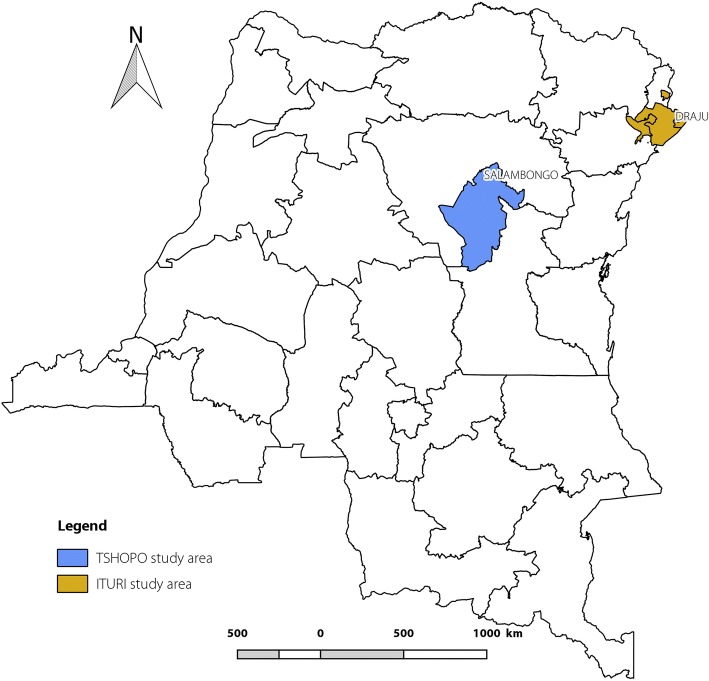
Between October and December 2015, a multi-centre case control study was performed in onchocerciasis endemic health zones (HZ) in the DRC: one study site was situated in Tshopo Province in the HZ of Wanierukula (village of Salambongo) where there had been 13 annual community distributions of treatment with ivermectin (CDTI), a second was situated in Ituri Province in the HZ of Logo (village of Draju) where ivermectin had never been distributed and in the HZ of Rethy (village of Rassia) where there had been THREE CDTI annual campaigns before the study. Individuals with unprovoked convulsive epilepsy of unknown etiology were enrolled as cases (n = 175). Randomly selected healthy members of families without epilepsy cases from the same village and age-groups and were recruited as controls (n = 170).
Onchocerciasis associated symptoms (e.g., itching and abnormal skin) were more often present in cases compared to controls (respectively, OR = 2.63, 95% CI: 1.63-4.23, P < 0.0001 and OR = 3.23, 95% CI: 1.48-7.09, P = 0.0034). A higher number of cases was found to present with microfilariae in skin snips and with O. volvulus IgG4 antibodies in the blood compared to controls. Moreover, the microfilariae load in skin snips was 3-10 times higher in cases than controls.
This case control study confirms that O. volvulus is a risk factor for developing epilepsy in onchocerciasis endemic regions in the DRC.
在刚果民主共和国(DRC)的盘尾丝虫病流行地区,观察到癫痫的高患病率。本研究旨在调查是否旋盘尾丝虫感染是刚果民主共和国盘尾丝虫病流行地区发生癫痫的危险因素。
2015 年 10 月至 12 月,在刚果民主共和国的盘尾丝虫病流行卫生区(HZ)进行了一项多中心病例对照研究:一个研究地点位于 Tshopo 省的 Wanierukula HZ(Salambongo 村),那里已经进行了 13 次年度社区伊维菌素治疗分发(CDTI);另一个研究地点位于伊图里省的 Logo HZ(Draju 村),那里从未分发过伊维菌素,而在研究之前,Rethy HZ(Rassia 村)已经进行了三次年度 CDTI 活动。患有原因不明的无诱因惊厥性癫痫的个体被纳入病例(n=175)。从同一村庄和年龄组中随机选择无癫痫家族的健康成员作为对照(n=170)。
与对照组相比,病例组更常出现盘尾丝虫病相关症状(例如瘙痒和异常皮肤)(分别为 OR=2.63,95%CI:1.63-4.23,P<0.0001 和 OR=3.23,95%CI:1.48-7.09,P=0.0034)。与对照组相比,更多的病例在皮肤切片中发现微丝蚴,在血液中发现旋盘尾丝虫 IgG4 抗体。此外,病例组皮肤切片中的微丝蚴负荷比对照组高 3-10 倍。
这项病例对照研究证实,在刚果民主共和国的盘尾丝虫病流行地区,旋盘尾丝虫是发生癫痫的危险因素。