Verbeek Joost, Eriksson Jonas, Syvänen Stina, Huisman Marc, Schuit Robert C, Molthoff Carla F M, Voskuyl Rob A, de Lange Elizabeth C, Lammertsma Adriaan A, Windhorst Albert D
1Department of Radiology & Nuclear Medicine, VU University Medical Center, P.O. box 7057, 1007 MB Amsterdam, The Netherlands.
3Present Address: Department of Public Health and Caring Sciences, Uppsala University, Uppsala, Sweden.
EJNMMI Radiopharm Chem. 2018 Sep 21;3:11. doi: 10.1186/s41181-018-0046-z. eCollection 2018 Dec.
Several P-glycoprotein (P-gp) substrate tracers are available to assess P-gp function in vivo, but attempts to develop a tracer for measuring expression levels of P-gp have not been successful. Recently, (Z)-2-(5-fluoro-2-oxoindolin-3-ylidene)--(4-methoxyphenyl)hydrazine-carbothioamide was described as a potential selective P-gp inhibitor that is not transported by P-gp. Therefore, the purpose of this study was to radiolabel two of its analogues and to assess their potential for imaging P-gp expression using PET.
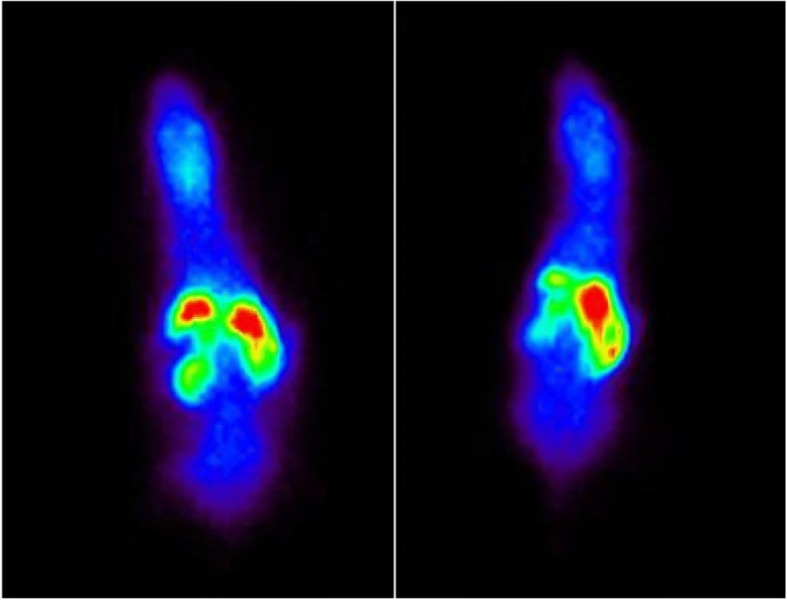
[F]2-(4-fluoro-2-oxoindolin-3-ylidene)--(4-methoxyphenyl)hydrazine-carbothioamide ([F]) and [F]2-(6-fluoro-2-oxoindolin-3-ylidene)-N-(4-methoxyphenyl)hydrazine-carbothioamide ([F]) were synthesized and both their biodistribution and metabolism were evaluated in rats. In addition, PET scans were acquired in rats before and after tariquidar (P-gp inhibitor) administration as well as in P-gp knockout (KO) mice.Both [F] and [F] were synthesized in 2-3% overall yield, and showed high brain uptake in ex vivo biodistribution studies. [F] appeared to be metabolically unstable in vivo, while [F] showed moderate stability with limited uptake of radiolabelled metabolites in the brain. PET studies showed that transport of [F] across the blood-brain barrier was not altered by pre-treatment with the P-gp inhibitor tariquidar, and uptake was significantly lower in P-gp KO than in wild-type animals and indeed transported across the BBB or bound to P-gp in endothelial cells.
In conclusion, [F] and [F] were successfully and reproducibly synthesized, albeit with low radiochemical yields. [F] appears to be a radiotracer that binds to P-gp, as showed in P-gp knock-out animals, but is not a substrate for P-gp.
有几种P-糖蛋白(P-gp)底物示踪剂可用于评估体内P-gp功能,但开发一种用于测量P-gp表达水平的示踪剂的尝试尚未成功。最近,(Z)-2-(5-氟-2-氧代吲哚-3-亚基)-N-(4-甲氧基苯基)肼基硫代酰胺被描述为一种潜在的选择性P-gp抑制剂,它不会被P-gp转运。因此,本研究的目的是对其两种类似物进行放射性标记,并评估它们使用正电子发射断层扫描(PET)成像P-gp表达的潜力。
合成了[¹⁸F]2-(4-氟-2-氧代吲哚-3-亚基)-N-(4-甲氧基苯基)肼基硫代酰胺([¹⁸F])和[¹⁸F]2-(6-氟-2-氧代吲哚-3-亚基)-N-(4-甲氧基苯基)肼基硫代酰胺([¹⁸F]),并在大鼠中评估了它们的生物分布和代谢。此外,在给予 tariquidar(P-gp抑制剂)之前和之后对大鼠以及在P-gp基因敲除(KO)小鼠中进行了PET扫描。[¹⁸F]和[¹⁸F]的总合成产率均为2 - 3%,并且在离体生物分布研究中显示出高脑摄取。[¹⁸F]在体内似乎代谢不稳定,而[¹⁸F]显示出中等稳定性,脑内放射性标记代谢物的摄取有限。PET研究表明,用P-gp抑制剂tariquidar预处理不会改变[¹⁸F]穿过血脑屏障的转运,并且在P-gp基因敲除小鼠中的摄取明显低于野生型动物,实际上它穿过血脑屏障或在内皮细胞中与P-gp结合。
总之,[¹⁸F]和[¹⁸F]已成功且可重复地合成,尽管放射化学产率较低。如在P-gp基因敲除动物中所示,[¹⁸F]似乎是一种与P-gp结合的放射性示踪剂,但不是P-gp的底物。