Drzayich Antol Dana, Waldman Casebeer Adrianne, Khoury Raya, Michael Todd, Renda Andrew, Hopson Sari, Parikh Aparna, Stein Alisha, Costantino Mary, Stemkowski Stephen, Bunce Mikele
, Louisville, Kentucky, USA.
, South San Francisco, California, USA.
J Patient Rep Outcomes. 2018 Jul 4;2:29. doi: 10.1186/s41687-018-0057-2. eCollection 2018 Dec.
Studies have demonstrated that comorbidities compound the adverse influence of cancer on health-related quality of life (HRQoL). Comorbidities adversely impact adherence to cancer treatment. Additionally, adherence to medications for comorbidities is positively associated with HRQoL for various diseases. This study used the Center for Disease Control and Prevention's Healthy Days measure of HRQoL to explore the association between HRQoL and adherence to comorbidity medication for elderly patients with cancer and at least one comorbid condition.
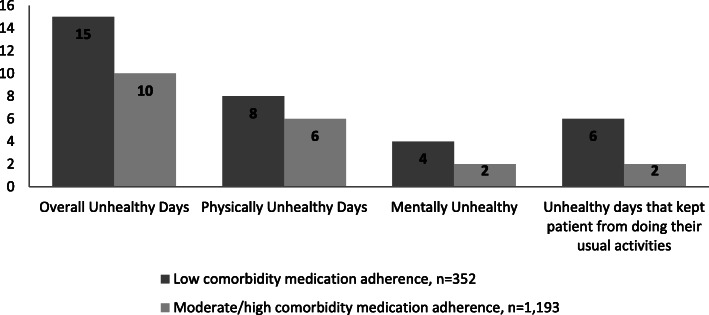
We conducted a cross-sectional survey combined with retrospective claims data. Patients with metastatic breast, lung or colorectal cancer were surveyed regarding their HRQoL, comorbidity medication adherence and cancer-related symptoms. Patients reported the number of physical, mental and total unhealthy days in the prior month. The Morisky Medication Adherence 8-point scale was differentiated into moderate/high (> 6) and low (≤ 6) comorbidity medication adherence.
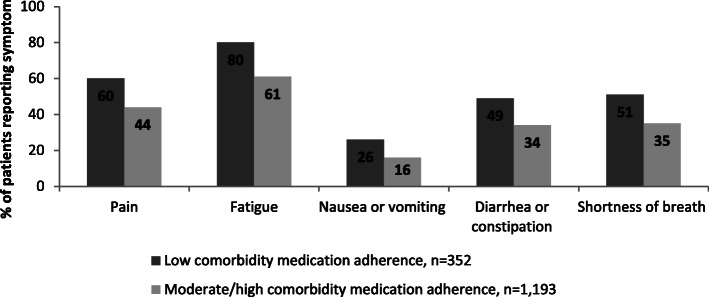
Of the 1847 respondents, the mean age was 69.2 years, most were female (66.8%) and the majority of the sample had Medicare coverage (88.2%). Low comorbidity medication adherence was associated with significantly more total, mental and physical unhealthy days. Low comorbidity medication adherence was associated with the presence of patient-reported cancer-related symptoms. Patients reporting low, as compared to moderate/high, comorbidity medication adherence had 23.4% more unhealthy days in adjusted analysis, = 0.007.
The positive association between low comorbidity medication adherence and the number of unhealthy days suggests that addressing barriers to comorbidity medication adherence during cancer treatment may be an avenue for improving or maintaining HRQoL for older patients with cancer and comorbid conditions.
研究表明,合并症会加重癌症对健康相关生活质量(HRQoL)的不利影响。合并症会对癌症治疗的依从性产生不利影响。此外,合并症药物的依从性与各种疾病的HRQoL呈正相关。本研究使用美国疾病控制与预防中心的HRQoL健康日测量方法,探讨HRQoL与老年癌症患者及至少一种合并症患者合并症药物依从性之间的关联。
我们进行了一项横断面调查,并结合回顾性索赔数据。对转移性乳腺癌、肺癌或结直肠癌患者进行了关于其HRQoL、合并症药物依从性和癌症相关症状的调查。患者报告了前一个月身体、精神和总的不健康天数。将Morisky药物依从性8分制分为中度/高度(>6)和低度(≤6)合并症药物依从性。
在1847名受访者中,平均年龄为69.2岁,大多数为女性(66.8%),样本中的大多数人有医疗保险(88.2%)。合并症药物依从性低与总的、精神和身体方面明显更多的不健康天数相关。合并症药物依从性低与患者报告的癌症相关症状的存在有关。在调整分析中,报告合并症药物依从性低的患者与中度/高度依从性患者相比,不健康天数多23.4%,P = 0.007。
合并症药物依从性低与不健康天数之间的正相关表明,在癌症治疗期间解决合并症药物依从性的障碍可能是改善或维持老年癌症合并症患者HRQoL的一条途径。