Laboratoire de Bactériologie, Grenoble-Alpes University Hospital, Grenoble, France.
Service de Maladies infectieuses, Grenoble-Alpes University Hospital, Grenoble, France.
PLoS One. 2018 Oct 9;13(10):e0204977. doi: 10.1371/journal.pone.0204977. eCollection 2018.
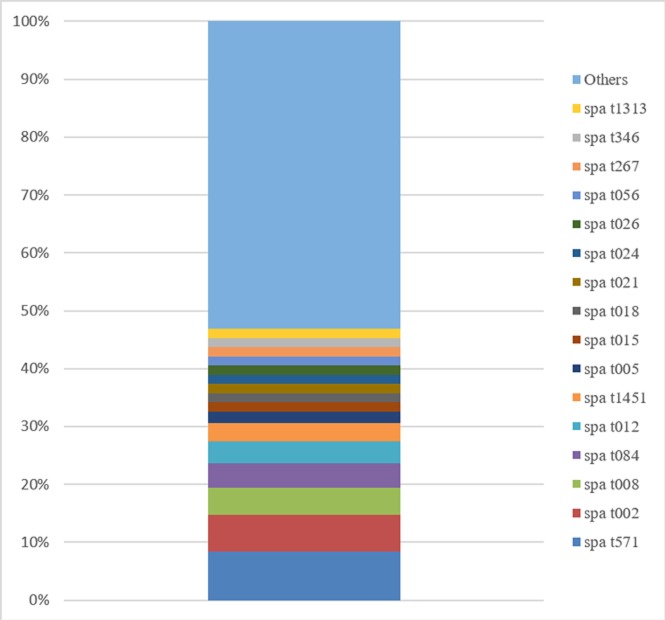
Staphylococcus aureus bacteremia is one of the most frequent severe bacterial infections worldwide, with an associated mortality of about 20-40% in developed countries. In 2013, we noted an increase in this infection in the teaching hospital in Grenoble, France, compared to 2012. The mean incidence of S. aureus bacteremia was 0.28 per 1,000 patient-days in 2012 and 0.35 per 1,000 patient-days in 2013. This trend was confirmed in 2014 (0.35 per 1,000 patient-days). In the present work we aimed to study the population of patients presenting with S. aureus bacteremia in 2013 and to genotype the corresponding S. aureus strains in order to identify a successful and/or virulent genotype to design a specific infection control program. One hundred ninety-one S. aureus isolates (including 9 methicillin-resistant) out of 199 corresponding cases of bacteremia were characterized with the spa typing method. Among 108 spa types, t571, t002, t008 and t084 were the most prevalent. Although not widely prevalent, t571 was the most frequently identified clone (8.4% of all isolates). Spa type t571 has been described in previous studies as belonging to the clonal complex CC398, which is consistent with the recent emergence of methicillin-susceptible S. aureus CC398 reported in blood cultures in Europe.
金黄色葡萄球菌菌血症是全球最常见的严重细菌感染之一,在发达国家的死亡率约为 20-40%。2013 年,我们注意到法国格勒诺布尔教学医院的这种感染病例与 2012 年相比有所增加。2012 年,金黄色葡萄球菌菌血症的平均发病率为每 1000 个患者日 0.28 例,2013 年为每 1000 个患者日 0.35 例。这一趋势在 2014 年得到了证实(每 1000 个患者日 0.35 例)。在本研究中,我们旨在研究 2013 年金黄色葡萄球菌菌血症患者的人群,并对相应的金黄色葡萄球菌菌株进行基因分型,以确定一种成功和/或毒力的基因型,从而设计一个特定的感染控制方案。从 199 例菌血症病例中分离出 191 株金黄色葡萄球菌(包括 9 株耐甲氧西林金黄色葡萄球菌),采用 spa 分型方法进行鉴定。在 108 种 spa 型中,t571、t002、t008 和 t084 最为常见。尽管 t571 并不广泛流行,但它是最常被识别的克隆(所有分离株的 8.4%)。spa 型 t571 之前的研究曾被描述为属于克隆复合体 CC398,这与最近在欧洲血液培养物中报告的耐甲氧西林金黄色葡萄球菌 CC398 的出现一致。