Nakamura Shiro, Imaeda Hirotsugu, Nishikawa Hiroki, Iimuro Masaki, Matsuura Minoru, Oka Hideo, Oku Junsuke, Miyazaki Takako, Honda Hirohito, Watanabe Kenji, Nakase Hiroshi, Andoh Akira
Division of Internal Medicine, Department of Inflammatory Bowel Disease, Hyogo College of Medicine, Nishinomiya, Japan.
Department of Medicine, Shiga University of Medical Science, Otsu, Japan.
Intest Res. 2018 Oct;16(4):554-562. doi: 10.5217/ir.2018.00027. Epub 2018 Oct 10.
BACKGROUND/AIMS: Noninvasive objective monitoring is advantageous for optimizing treatment strategies in patients inflammatory bowel disease (IBD). Fecal calprotectin (FCP) is superior to traditional biomarkers in terms of assessing the activity in patients with IBD. However, there are the differences among several FCP assays in the dynamics of FCP. In this prospective multicenter trial, we investigated the usefulness of fecal FCP measurements in adult Japanese patients with IBD by reliable enzyme immunoassay using a monoclonal antibody.
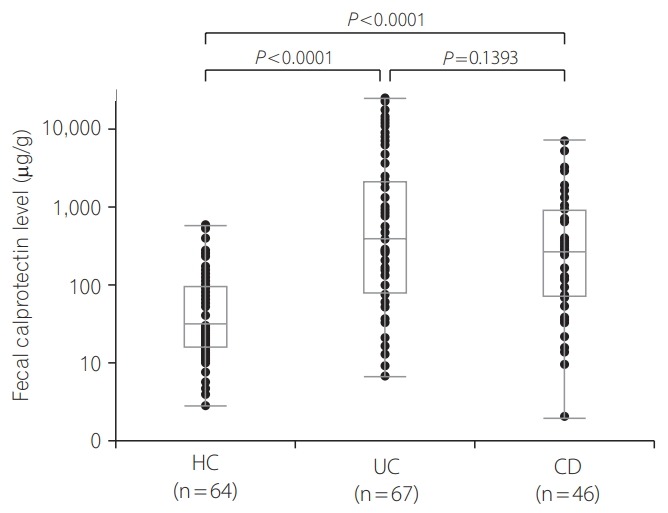
We assessed the relationship between FCP levels and disease or endoscopic activity in patients with ulcerative colitis (UC, n=64) or Crohn's disease (CD, n=46) compared with healthy controls (HCs, n=64).
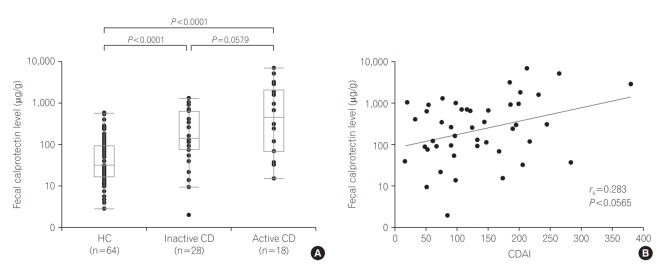
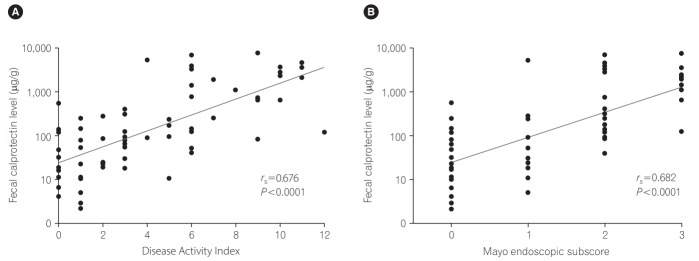
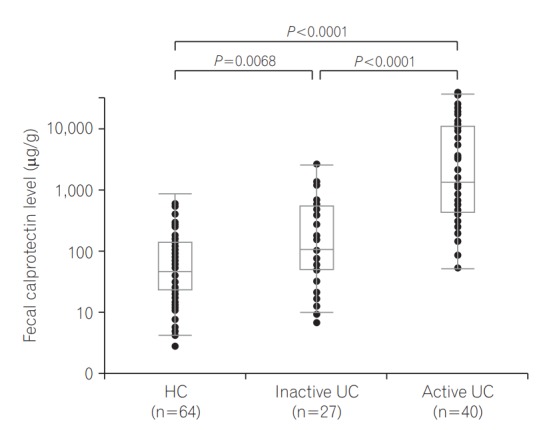
FCP levels in UC patients strongly correlated with the Disease Activity Index (rs=0.676, P<0.0001) and Mayo endoscopic subscore (MES; rs=0.677, P<0.0001). FCP levels were significantly higher even in patients with inactive UC or CD compared with HCs (P=0.0068, P<0.0001). The optimal cutoff value between MES 1 and 2 exhibited higher sensitivity (94.1%). FCP levels were significantly higher in active UC patients than in inactive patients (P<0.001), except those with proctitis. The Crohn's Disease Activity Index tended to correlate with the FCP level (rs=0.283, P=0.0565).
Our testing method using a monoclonal antibody for FCP was well-validated and differentiated IBD patients from HCs. FCP may be a useful biomarker for objective assessment of disease activity in adult Japanese IBD patients, especially those with UC.
背景/目的:非侵入性客观监测有利于优化炎症性肠病(IBD)患者的治疗策略。粪便钙卫蛋白(FCP)在评估IBD患者的病情活动方面优于传统生物标志物。然而,几种FCP检测方法在FCP动态变化方面存在差异。在这项前瞻性多中心试验中,我们使用单克隆抗体通过可靠的酶免疫测定法研究了粪便FCP检测在成年日本IBD患者中的实用性。
我们评估了溃疡性结肠炎(UC,n = 64)或克罗恩病(CD,n = 46)患者与健康对照者(HCs,n = 64)的FCP水平与疾病或内镜活动之间的关系。
UC患者的FCP水平与疾病活动指数(rs = 0.676,P < 0.0001)和梅奥内镜亚评分(MES;rs = 0.677,P < 0.0001)密切相关。与HCs相比,即使是病情不活动的UC或CD患者,其FCP水平也显著更高(P = 0.0068,P < 0.0001)。MES 1和2之间的最佳截断值显示出更高的敏感性(94.1%)。除直肠炎患者外,活动期UC患者的FCP水平显著高于非活动期患者(P < 0.001)。克罗恩病活动指数与FCP水平呈弱相关(rs = 0.283,P = 0.0565)。
我们使用单克隆抗体检测FCP的方法经过了充分验证,能够区分IBD患者和HCs。FCP可能是客观评估成年日本IBD患者,尤其是UC患者疾病活动的有用生物标志物。