• 文献检索
  • 文档翻译
  • 深度研究
  • 学术资讯
  • Suppr Zotero 插件Zotero 插件
  • 邀请有礼
  • 套餐&价格
  • 历史记录
应用&插件
Suppr Zotero 插件Zotero 插件浏览器插件Mac 客户端Windows 客户端微信小程序
定价
高级版会员购买积分包购买API积分包
服务
文献检索文档翻译深度研究API 文档MCP 服务
关于我们
关于 Suppr公司介绍联系我们用户协议隐私条款
关注我们

Suppr 超能文献

核心技术专利:CN118964589B侵权必究
粤ICP备2023148730 号-1Suppr @ 2026

文献检索

告别复杂PubMed语法,用中文像聊天一样搜索,搜遍4000万医学文献。AI智能推荐,让科研检索更轻松。

立即免费搜索

文件翻译

保留排版,准确专业,支持PDF/Word/PPT等文件格式,支持 12+语言互译。

免费翻译文档

深度研究

AI帮你快速写综述,25分钟生成高质量综述,智能提取关键信息,辅助科研写作。

立即免费体验

优化抽样方案和数据收集,为沙眼控制监测提供信息。

Optimising sampling regimes and data collection to inform surveillance for trachoma control.

机构信息

Department of Public Health and Preventative Medicine, Monash University, Melbourne, Victoria, Australia.

Big Data Institute, Li Ka Shing Centre for Health Informatics, University of Oxford, Oxford, United Kingdom.

出版信息

PLoS Negl Trop Dis. 2018 Oct 11;12(10):e0006531. doi: 10.1371/journal.pntd.0006531. eCollection 2018 Oct.

DOI:10.1371/journal.pntd.0006531
PMID:30307939
原文链接:https://pmc.ncbi.nlm.nih.gov/articles/PMC6181273/
Abstract

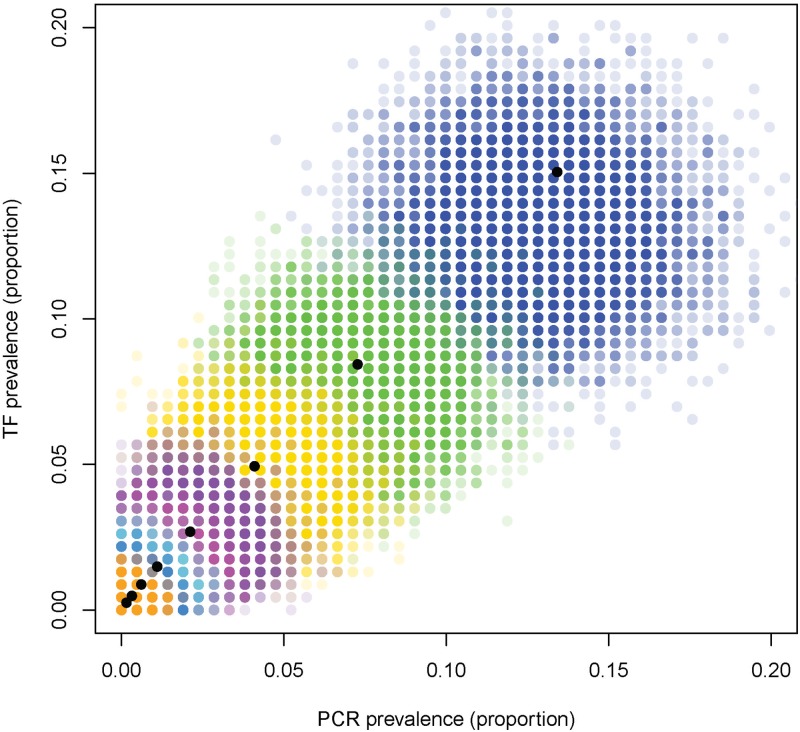
It is estimated that 190 million individuals are at risk of blindness from trachoma, and that control by mass drug administration (MDA) is reducing this risk in many populations. Programs are monitored using prevalence of follicular trachoma disease (TF) in children. However, as programs progress to low prevalence there are challenges interpreting this indirect measure of infection. PCR and sero-surveillance are being considered as complementary tools to monitor low-level transmission, but there are questions on how they can be most effectively used. We use a previously-published, mathematical model to explore the dynamic relationship between TF and PCR throughout a control program and a sero-catalytic model to evaluate the utility of two cross-sectional sero-surveys for estimating sero-conversion rates. The simulations show that whilst PCR is more sensitive than TF at detecting infection, the probability of detecting at least one positive individual declines during an MDA program more quickly for PCR than for TF (for the same sample size). Towards the end of a program there is a moderate chance of a random sample showing both low PCR prevalence and higher TF prevalence, which may contribute to the lack of correlation observed in epidemiological studies. We also show that conducting two cross-sectional sero-surveys 10 years apart can provide more precise and accurate estimation of epidemiological parameters than a single survey, supporting previous findings that whilst serology holds great promise, multiple cross-sections from the same community are needed to generate the most valuable information about transmission. These results highlight that the quantitative dynamics of infection and disease should be included alongside the many logistical and practical factors to be considered in designing a monitoring and evaluation strategy at the operational research level, in order to help subsequently inform data collection for individual country programs. Whilst our simulations provide some insight, they also highlight that some level of longitudinal, individual-level data on reinfection and disease may be needed to monitor elimination progress.

摘要

据估计,有 1.9 亿人面临沙眼致盲的风险,大规模药物治疗(MDA)正在降低许多人群的这种风险。该计划通过儿童滤泡性沙眼疾病(TF)的患病率进行监测。然而,随着计划进展到低患病率,解释这种感染的间接衡量标准具有挑战性。聚合酶链反应(PCR)和血清监测被认为是监测低水平传播的补充工具,但对于如何最有效地使用它们存在疑问。我们使用之前发表的数学模型来探索控制计划中 TF 和 PCR 之间的动态关系,并使用血清催化模型来评估两项横断面血清调查估计血清转化率的效用。模拟结果表明,虽然 PCR 在检测感染方面比 TF 更敏感,但在 MDA 计划中,PCR 检测至少一个阳性个体的概率比 TF 更快下降(对于相同的样本量)。在计划结束时,随机样本显示低 PCR 流行率和较高 TF 流行率的可能性适中,这可能导致流行病学研究中观察到的缺乏相关性。我们还表明,进行两次相隔 10 年的横断面血清调查比单次调查更能提供更准确和准确的流行病学参数估计,支持以前的研究结果,即虽然血清学具有很大的前景,但需要从同一社区获得多个横断面才能提供关于传播的最有价值的信息。这些结果表明,在设计操作研究层面的监测和评估策略时,应将感染和疾病的定量动态与许多后勤和实际因素一起考虑,以帮助随后为个别国家方案提供数据收集。虽然我们的模拟提供了一些见解,但它们也强调,可能需要一定程度的关于再感染和疾病的纵向、个体水平数据来监测消除进展。
https://cdn.ncbi.nlm.nih.gov/pmc/blobs/082b/6181273/e9773b0d176c/pntd.0006531.g006.jpg
https://cdn.ncbi.nlm.nih.gov/pmc/blobs/082b/6181273/afb0328ce894/pntd.0006531.g001.jpg
https://cdn.ncbi.nlm.nih.gov/pmc/blobs/082b/6181273/0906b600bb48/pntd.0006531.g002.jpg
https://cdn.ncbi.nlm.nih.gov/pmc/blobs/082b/6181273/d6c548799622/pntd.0006531.g003.jpg
https://cdn.ncbi.nlm.nih.gov/pmc/blobs/082b/6181273/ce3fad1b0e67/pntd.0006531.g004.jpg
https://cdn.ncbi.nlm.nih.gov/pmc/blobs/082b/6181273/e530fc23da72/pntd.0006531.g005.jpg
https://cdn.ncbi.nlm.nih.gov/pmc/blobs/082b/6181273/e9773b0d176c/pntd.0006531.g006.jpg
https://cdn.ncbi.nlm.nih.gov/pmc/blobs/082b/6181273/afb0328ce894/pntd.0006531.g001.jpg
https://cdn.ncbi.nlm.nih.gov/pmc/blobs/082b/6181273/0906b600bb48/pntd.0006531.g002.jpg
https://cdn.ncbi.nlm.nih.gov/pmc/blobs/082b/6181273/d6c548799622/pntd.0006531.g003.jpg
https://cdn.ncbi.nlm.nih.gov/pmc/blobs/082b/6181273/ce3fad1b0e67/pntd.0006531.g004.jpg
https://cdn.ncbi.nlm.nih.gov/pmc/blobs/082b/6181273/e530fc23da72/pntd.0006531.g005.jpg
https://cdn.ncbi.nlm.nih.gov/pmc/blobs/082b/6181273/e9773b0d176c/pntd.0006531.g006.jpg

相似文献

1
Optimising sampling regimes and data collection to inform surveillance for trachoma control.优化抽样方案和数据收集,为沙眼控制监测提供信息。
PLoS Negl Trop Dis. 2018 Oct 11;12(10):e0006531. doi: 10.1371/journal.pntd.0006531. eCollection 2018 Oct.
2
Serology for trachoma surveillance after cessation of mass drug administration.大规模药物给药停止后用于沙眼监测的血清学检测
PLoS Negl Trop Dis. 2015 Feb 25;9(2):e0003555. doi: 10.1371/journal.pntd.0003555. eCollection 2015 Feb.
3
Improving our forecasts for trachoma elimination: What else do we need to know?改进我们对沙眼消除的预测:我们还需要了解什么?
PLoS Negl Trop Dis. 2017 Feb 9;11(2):e0005378. doi: 10.1371/journal.pntd.0005378. eCollection 2017 Feb.
4
Elimination of trachoma as a public health problem in Ghana: Providing evidence through a pre-validation survey.在加纳消除沙眼这一公共卫生问题:通过预验证调查提供证据
PLoS Negl Trop Dis. 2017 Dec 12;11(12):e0006099. doi: 10.1371/journal.pntd.0006099. eCollection 2017 Dec.
5
Population-based prevalence survey of follicular trachoma and trachomatous trichiasis in the Casamance region of Senegal.塞内加尔卡萨芒斯地区基于人群的滤泡性沙眼和沙眼性倒睫患病率调查。
BMC Public Health. 2017 Jul 26;18(1):62. doi: 10.1186/s12889-017-4605-0.
6
Comparing the performance of cluster random sampling and integrated threshold mapping for targeting trachoma control, using computer simulation.运用计算机模拟比较群组随机抽样与综合阈值绘图在沙眼防治目标定位中的表现。
PLoS Negl Trop Dis. 2013 Aug 22;7(8):e2389. doi: 10.1371/journal.pntd.0002389. eCollection 2013.
7
Surveillance and Azithromycin Treatment for Newcomers and Travelers Evaluation (ASANTE) Trial: Design and Baseline Characteristics.新移民和旅行者评估的监测与阿奇霉素治疗(ASANTE)试验:设计与基线特征
Ophthalmic Epidemiol. 2016 Dec;23(6):347-353. doi: 10.1080/09286586.2016.1238947. Epub 2016 Nov 7.
8
The utility of serology for elimination surveillance of trachoma.用于消除沙眼的血清学监测的实用性。
Nat Commun. 2018 Dec 21;9(1):5444. doi: 10.1038/s41467-018-07852-0.
9
Surveillance for peri-elimination trachoma recrudescence: Exploratory studies in Ghana.消除后沙眼复发监测:加纳的探索性研究。
PLoS Negl Trop Dis. 2021 Sep 20;15(9):e0009744. doi: 10.1371/journal.pntd.0009744. eCollection 2021 Sep.
10
The distribution of the prevalence of ocular chlamydial infection in communities where trachoma is disappearing.沙眼正在消失的社区中眼部衣原体感染患病率的分布情况。
Epidemics. 2015 Jun;11:85-91. doi: 10.1016/j.epidem.2015.03.003. Epub 2015 Mar 21.

引用本文的文献

1
Strengthening data collection for neglected tropical diseases: What data are needed for models to better inform tailored intervention programmes?加强对被忽视热带病的数据收集:模型需要哪些数据才能更好地为量身定制的干预方案提供信息?
PLoS Negl Trop Dis. 2021 May 13;15(5):e0009351. doi: 10.1371/journal.pntd.0009351. eCollection 2021 May.
2
Modelling trachoma post-2020: opportunities for mitigating the impact of COVID-19 and accelerating progress towards elimination.建模沙眼 2020 年后:减轻 COVID-19 影响和加速消除进展的机会。
Trans R Soc Trop Med Hyg. 2021 Mar 6;115(3):213-221. doi: 10.1093/trstmh/traa171.
3

本文引用的文献

1
The cost of mapping trachoma: Data from the Global Trachoma Mapping Project.沙眼测绘的成本:来自全球沙眼测绘项目的数据。
PLoS Negl Trop Dis. 2017 Oct 18;11(10):e0006023. doi: 10.1371/journal.pntd.0006023. eCollection 2017 Oct.
2
Population-based prevalence survey of follicular trachoma and trachomatous trichiasis in the Casamance region of Senegal.塞内加尔卡萨芒斯地区基于人群的滤泡性沙眼和沙眼性倒睫患病率调查。
BMC Public Health. 2017 Jul 26;18(1):62. doi: 10.1186/s12889-017-4605-0.
3
WHO Alliance for the Global Elimination of Trachoma by 2020: progress report on elimination of trachoma, 2014–2016.
Lessons learned for surveillance strategies for trachoma elimination as a public health problem, from the evaluation of approaches utilised by Guinea worm and onchocerciasis programmes: A literature review.
从评估麦地那龙线虫和盘尾丝虫病规划所采用的方法中吸取的消除作为公共卫生问题的沙眼的监测战略经验教训:文献综述。
PLoS Negl Trop Dis. 2021 Jan 28;15(1):e0009082. doi: 10.1371/journal.pntd.0009082. eCollection 2021 Jan.
世界卫生组织2020年全球消除沙眼联盟:2014 - 2016年沙眼消除进展报告
Wkly Epidemiol Rec. 2017 Jun 30;92(26):359-68.
4
Improving our forecasts for trachoma elimination: What else do we need to know?改进我们对沙眼消除的预测:我们还需要了解什么?
PLoS Negl Trop Dis. 2017 Feb 9;11(2):e0005378. doi: 10.1371/journal.pntd.0005378. eCollection 2017 Feb.
5
The Relationship between Active Trachoma and Ocular Chlamydia trachomatis Infection before and after Mass Antibiotic Treatment.大规模抗生素治疗前后活动性沙眼与眼部沙眼衣原体感染的关系
PLoS Negl Trop Dis. 2016 Oct 26;10(10):e0005080. doi: 10.1371/journal.pntd.0005080. eCollection 2016 Oct.
6
Control of Trachoma from Achham District, Nepal: A Cross-Sectional Study from the Nepal National Trachoma Program.尼泊尔阿查姆地区沙眼防治:来自尼泊尔国家沙眼项目的横断面研究
PLoS Negl Trop Dis. 2016 Feb 12;10(2):e0004462. doi: 10.1371/journal.pntd.0004462. eCollection 2016 Feb.
7
Prevalence of sexually transmitted infections in female clinic attendees in Honiara, Solomon Islands.所罗门群岛霍尼亚拉女性门诊就诊者性传播感染的患病率
BMJ Open. 2015 Apr 28;5(4):e007276. doi: 10.1136/bmjopen-2014-007276.
8
Sample size determination for estimating antibody seroconversion rate under stable malaria transmission intensity.在稳定的疟疾传播强度下估计抗体血清转化率的样本量确定
Malar J. 2015 Apr 3;14:141. doi: 10.1186/s12936-015-0661-z.
9
Control of trachoma in Australia: a model based evaluation of current interventions.澳大利亚沙眼的防控:基于模型对当前干预措施的评估
PLoS Negl Trop Dis. 2015 Apr 10;9(4):e0003474. doi: 10.1371/journal.pntd.0003474. eCollection 2015 Apr.
10
Mass drug administration for trachoma: how long is not long enough?沙眼群体服药:多久才算不够长?
PLoS Negl Trop Dis. 2015 Mar 23;9(3):e0003610. doi: 10.1371/journal.pntd.0003610. eCollection 2015 Mar.