Laboratory of Neuroscience, Torcuato di Tella University, Buenos Aires, Argentina.
Institute of Translational and Cognitive Neuroscience (INCYT), INECO Foundation, Favaloro University, Buenos Aires, Argentina.
PLoS One. 2018 Oct 11;13(10):e0205595. doi: 10.1371/journal.pone.0205595. eCollection 2018.
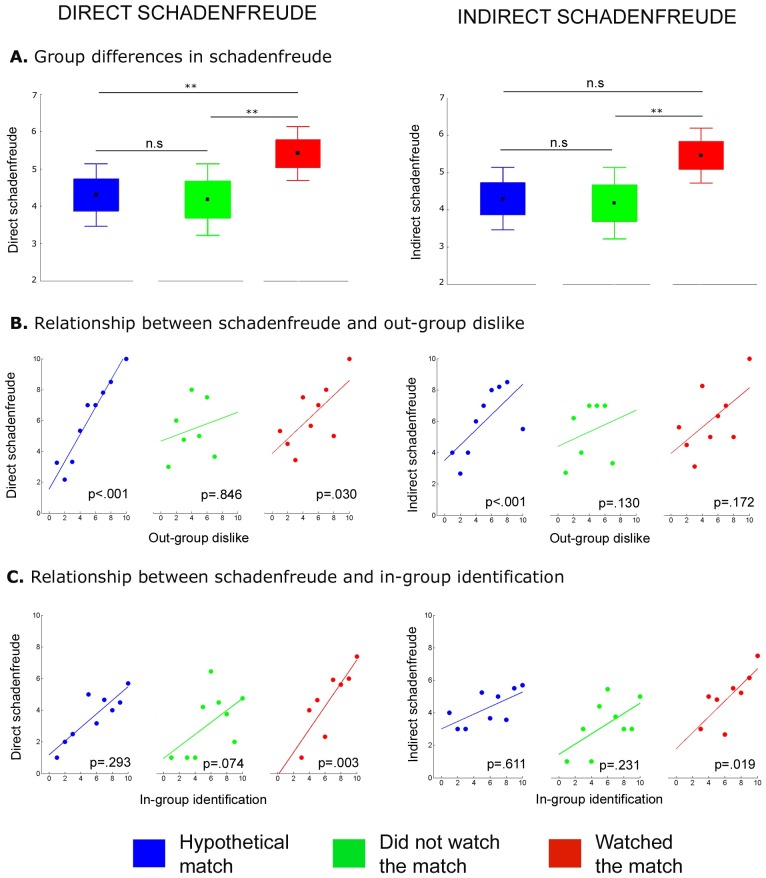
Schadenfreude (i.e., the pleasure derived from another's misfortune) has been widely studied by having participants imagine how they would feel in hypothetical scenarios describing another person's pain or misfortune. However, research on affective forecasting shows that self-judgments of emotions are inaccurate in hypothetical situations. Here we show a study in which we first presented a hypothetical schadenfreude situation and few months later, due to an exceptional circumstance, the situation turned out to happen in reality. This fortuitous circumstance allowed us to compare people's imagined emotional reactions with their actual feelings. Results showed that schadenfreude was higher in the real situation than in the hypothetical one. More importantly, participants used different proxies to predict their emotional reaction: while out-group dislike served as a proxy of schadenfreude in both types of scenario, the degree of in-group identification also increased schadenfreude in those who had experienced the real event, arguably a mechanism to promote positive self-evaluation. These results highlight the importance of assessing schadenfreude in the heat of the moment.
幸灾乐祸(即从他人的不幸中获得的乐趣)已被广泛研究,其方法是让参与者想象自己在描述他人痛苦或不幸的假设情景中会有何感受。然而,情感预测研究表明,在假设情况下,自我判断情绪并不准确。在这里,我们展示了一项研究,其中我们首先呈现了一个假设的幸灾乐祸的情况,几个月后,由于一个特殊的情况,这个情况在现实中发生了。这种偶然的情况使我们能够将人们想象中的情绪反应与实际感受进行比较。结果表明,在现实情况下,幸灾乐祸的程度高于假设情况。更重要的是,参与者使用不同的代理来预测他们的情绪反应:虽然在两种情况下,对外群体的厌恶都可以作为幸灾乐祸的代理,但在经历真实事件的参与者中,内群体认同程度也会增加幸灾乐祸的程度,这可以说是一种促进积极自我评价的机制。这些结果强调了在关键时刻评估幸灾乐祸的重要性。