Kim Mimi, Merrill Joan T, Kalunian Kenneth, Hanrahan Leslie, Izmirly Peter
Division of Biostatistics, Albert Einstein College of Medicine, New York City, New York, USA.
Department of Medicine, Oklahoma Medical Research Foundation, Oklahoma City, Oklahoma, USA.
Lupus Sci Med. 2018 Aug 6;5(1):e000266. doi: 10.1136/lupus-2018-000266. eCollection 2018.
To evaluate response duration and identify predictors of transitioning into and out of the response state in patients with SLE receiving standard of care (SoC) in 52-week clinical trials.
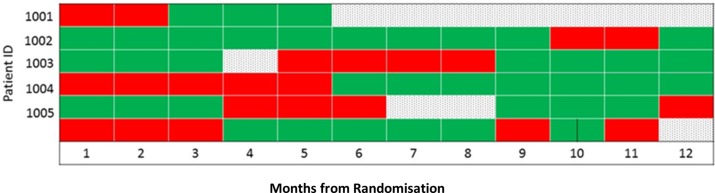
A multistate model (MSM) allowing for bidirectional transitions between response and non-response states was fit to data on 759 patients with SLE with active disease randomised to SoC. The probability of being in response at 52 weeks, average duration of response (sojourn time) and mean total time in response for SLE Responder Index (SRI-4, SRI-5, SRI-6) and BILAG-based Composite Lupus Assessment (BICLA) were estimated. Predictors of attainment and loss of SRI-5 response were also assessed.
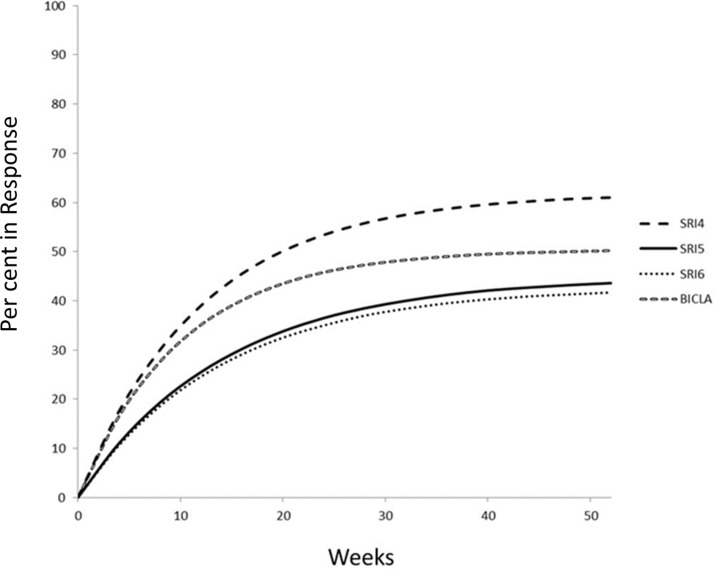
The MSM estimated probability of being in response at 52 weeks ranged from 42% (SRI-6) to 61% (SRI-4). Mean duration of response ranged from 20.4 weeks (BICLA) to 31.5 weeks (SRI-4). Mean total time in response was 16.4-24.8 weeks. Baseline characteristics predictive of shorter SRI-5 response duration were African descent (p=0.005), longer history of disease (p=0.03), higher anti-dsDNA antibody titres (p=0.039), lower lymphocyte count (p=0.008) and lower haemoglobin (p=0.006). Younger age (p<0.001) and higher protein/creatinine ratio (p<0.001) were associated with higher likelihood of achieving SRI-5 but also shorter response duration.
Factors associated with disease severity were more predictive of shorter response duration than of 52-week response status. Analysing landmark response rates and response duration using MSM may be a more powerful way to distinguish effective investigational treatments from background SoC, although this remains to be evaluated in future trials.
在一项为期52周的临床试验中,评估接受标准治疗(SoC)的系统性红斑狼疮(SLE)患者的缓解持续时间,并确定进入和退出缓解状态的预测因素。
采用多状态模型(MSM),该模型允许在缓解和未缓解状态之间进行双向转换,对759例随机接受SoC治疗的活动性SLE患者的数据进行拟合。估计了52周时处于缓解状态的概率、平均缓解持续时间(停留时间)以及SLE缓解者指数(SRI-4、SRI-5、SRI-6)和基于BILAG的综合狼疮评估(BICLA)的平均总缓解时间。还评估了达到和失去SRI-5缓解的预测因素。
MSM估计52周时处于缓解状态的概率范围为42%(SRI-6)至61%(SRI-4)。平均缓解持续时间范围为20.4周(BICLA)至31.5周(SRI-4)。平均总缓解时间为16.4 - 24.8周。预测SRI-5缓解持续时间较短的基线特征包括非洲裔(p = 0.005)、疾病史较长(p = 0.03)、抗双链DNA抗体滴度较高(p = 0.039)、淋巴细胞计数较低(p = 0.008)和血红蛋白较低(p = 0.006)。年龄较小(p < 0.001)和蛋白/肌酐比值较高(p < 0.001)与实现SRI-5的可能性较高相关,但缓解持续时间也较短。
与疾病严重程度相关的因素对较短缓解持续时间的预测性比对52周缓解状态的预测性更强。使用MSM分析标志性缓解率和缓解持续时间可能是一种更有效的方法,以区分有效的研究性治疗与背景SoC,尽管这仍有待在未来试验中进行评估。