Geyer Natalie, Ridzewski Rosalie, Bauer Julia, Kuzyakova Maria, Dittmann Kai, Dullin Christian, Rosenberger Albert, Schildhaus Hans-Ulrich, Uhmann Anja, Fulda Simone, Hahn Heidi
Institute for Human Genetics, University Medical Center Goettingen, Goettingen, Germany.
Institute for Celluar and Molecular Immunology, University Medical Center Goettingen, Goettingen, Germany.
Front Oncol. 2018 Sep 25;8:396. doi: 10.3389/fonc.2018.00396. eCollection 2018.
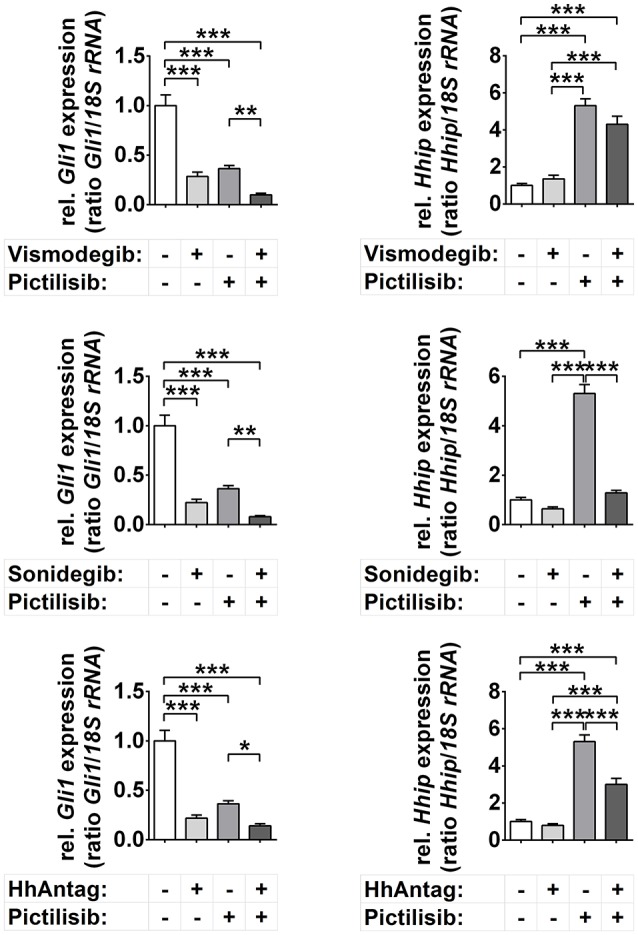
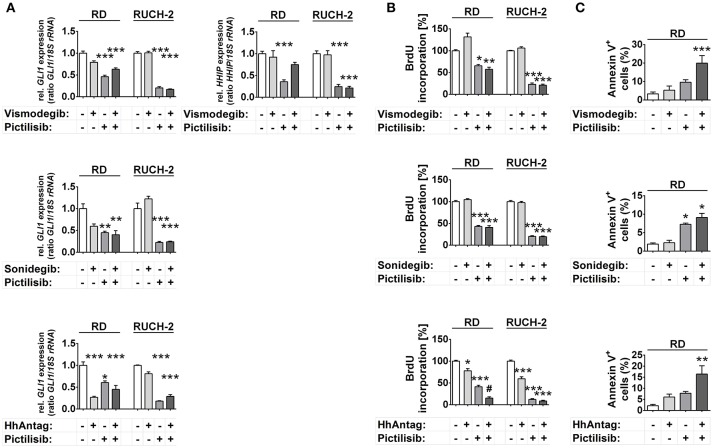
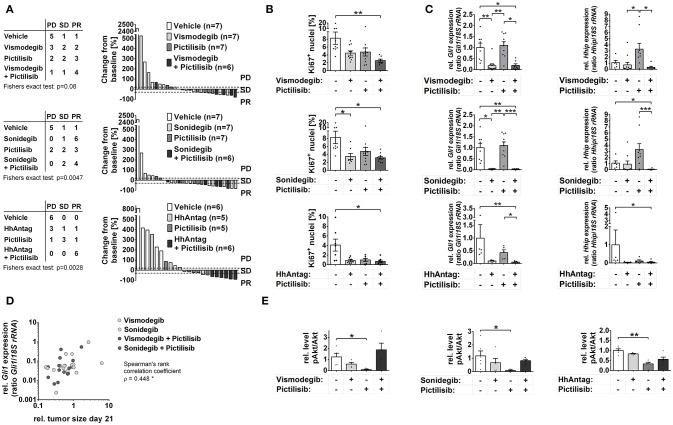
Rhabdomyosarcoma (RMS) is the most common pediatric soft tissue sarcoma with poor prognosis. RMS frequently show Hedgehog (HH) pathway activity, which is predominantly seen in the embryonal subtype (ERMS). They also show activation of Phosphatidylinositol-4,5-bisphosphate 3-kinase (PI3K) signaling. Here we compared the therapeutic effectiveness and the impact on HH target gene expression of Smoothened (SMO) antagonists with those of the PI3K inhibitor pictilisib in ERMS with and without mutations in the HH receptor (). Our data demonstrate that growth of ERMS showing canonical Hh signaling activity due to germline mutations is efficiently reduced by SMO antagonists. This goes along with strong downregulation of the Hh target . Likewise mutant tumors are highly responsive toward the PI3K inhibitor pictilisib, which involves modulation of AKT and caspase activity. Pictilisib also modulates Hh target gene expression, which, however, is rather not correlated with its antitumoral effects. In contrast, sporadic ERMS, which usually express HH target genes without having mutation, apparently lack canonical HH signaling activity. Thus, stimulation by Sonic HE (SHH) or SAG (Smoothened agonist) or inhibition by SMO antagonists do not modulate HH target gene expression. In addition, SMO antagonists do not provoke efficient anticancer effects and rather exert off-target effects. In contrast, pictilisib and other PI3K/AKT/mTOR inhibitors potently inhibit cellular growth. They also efficiently inhibit HH target gene expression. However, of whether this is correlated with their antitumoral effects it is not clear. Together, these data suggest that PI3K inhibitors are a good and reliable therapeutic option for all ERMS, whereas SMO inhibitors might only be beneficial for ERMS driven by mutations.
横纹肌肉瘤(RMS)是最常见的小儿软组织肉瘤,预后较差。RMS常表现出Hedgehog(HH)信号通路活性,这在胚胎型亚型(ERMS)中最为常见。它们还表现出磷脂酰肌醇-4,5-二磷酸3-激酶(PI3K)信号传导的激活。在此,我们比较了平滑肌瘤(SMO)拮抗剂与PI3K抑制剂pictilisib在HH受体有无突变的ERMS中对HH靶基因表达的治疗效果及影响。我们的数据表明,由于种系突变而显示出经典Hh信号传导活性的ERMS的生长可被SMO拮抗剂有效降低。这伴随着Hh靶标的强烈下调。同样,突变型肿瘤对PI3K抑制剂pictilisib高度敏感,这涉及AKT和半胱天冬酶活性的调节。Pictilisib还调节Hh靶基因的表达,然而,这与其抗肿瘤作用并无明显关联。相比之下,通常表达HH靶基因但无突变的散发性ERMS显然缺乏经典的HH信号传导活性。因此,音猬因子(SHH)或SAG(平滑肌瘤激动剂)的刺激或SMO拮抗剂的抑制均不会调节HH靶基因的表达。此外,SMO拮抗剂不会引发有效的抗癌作用,反而会产生脱靶效应。相比之下,pictilisib和其他PI3K/AKT/mTOR抑制剂可有效抑制细胞生长。它们还能有效抑制HH靶基因的表达。然而,这是否与其抗肿瘤作用相关尚不清楚。总之,这些数据表明,PI3K抑制剂对所有ERMS都是一种良好且可靠的治疗选择,而SMO抑制剂可能仅对由 突变驱动的ERMS有益。