Spathas Nikolaos, Economopoulou Panagiota, Cheila Myrto, Kotsantis Ioannis, Fanouriakis Antonis, Kassara Dimitra, Psyrri Amanda
Section of Medical Oncology, Department of Internal Medicine, Faculty of Medicine, National and Kapodistrian University of Athens, Attikon University Hospital, Athens, Greece.
4th Department of Internal Medicine, Rheumatology and Clinical Immunology, Faculty of Medicine, National and Kapodistrian University of Athens, Attikon University Hospital, Athens, Greece.
Front Oncol. 2018 Sep 26;8:409. doi: 10.3389/fonc.2018.00409. eCollection 2018.
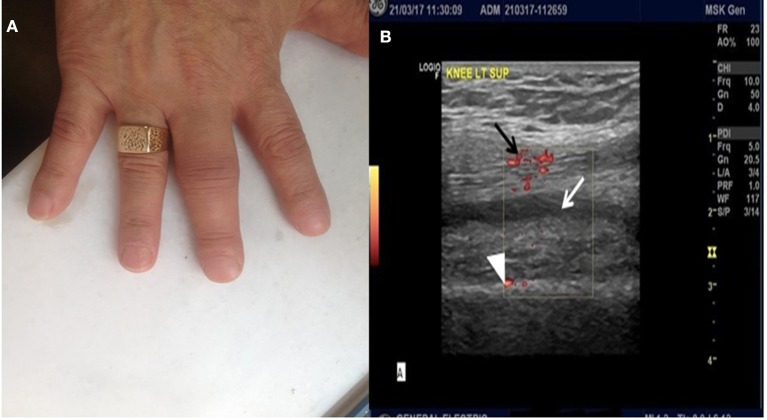
T cell checkpoint inhibitors targeting Programmed cell Death protein-1 (PD-1) have emerged as novel immunotherapy agents showing remarkable efficacy in head and neck squamous cell carcinoma (HNSCC). Despite important clinical benefits, they are associated with side effects that occur as a consequence of general immunological stimulation due to loss of T cell inhibition. Herein, we report the unusual case of inflammatory arthritis induced by anti-PD-1 agent pembrolizumab. A 55-years old male was treated with pembrolizumab at a dose of 200 mg every 3 weeks for a metastatic hypopharyngeal carcinoma. Following two cycles of immunotherapy, and while complete response of lung metastases was achieved, the patient presented with stiffness, swelling and pain of the right knee. Clinical examination and synovial fluid analysis revealed a seronegative inflammatory arthritis. Pembrolizumab therapy was interrupted and low-dose prednisone was administered with remarkable clinical improvement. Pembrolizumab was reintroduced, but after the fifth cycle, the patient developed inflammatory polyarthritis involving both knees and interphalangeal joints of both hands resulting in severe clinical deterioration. At that time, treatment with pembrolizumab was permanently discontinued. High-dose prednisone and methotrexate treatment led to remission of clinical symptoms. Pembrolizumab-induced inflammatory arthritis is an unusual rheumatic immune-related adverse event that physicians are likely to encounter as ICI use expands. Multidisciplinary management and rheumatology consultation are necessary to provide immediate treatment and avoid permanent joint damage.
靶向程序性细胞死亡蛋白-1(PD-1)的T细胞检查点抑制剂已成为新型免疫治疗药物,在头颈部鳞状细胞癌(HNSCC)中显示出显著疗效。尽管有重要的临床益处,但由于T细胞抑制作用丧失导致的全身免疫刺激,它们会引发副作用。在此,我们报告了抗PD-1药物派姆单抗诱发炎性关节炎的罕见病例。一名55岁男性因转移性下咽癌接受派姆单抗治疗,每3周一次,剂量为200毫克。经过两个周期的免疫治疗,虽然肺部转移灶实现了完全缓解,但患者出现了右膝关节僵硬、肿胀和疼痛。临床检查和滑液分析显示为血清阴性炎性关节炎。派姆单抗治疗中断,给予低剂量泼尼松,临床症状显著改善。重新使用派姆单抗,但在第五个周期后,患者出现累及双膝和双手指间关节的炎性多关节炎,导致临床症状严重恶化。此时,派姆单抗治疗永久停药。高剂量泼尼松和甲氨蝶呤治疗使临床症状缓解。派姆单抗诱发的炎性关节炎是一种不常见的风湿免疫相关不良事件,随着免疫检查点抑制剂使用的增加,医生可能会遇到这种情况。多学科管理和风湿科会诊对于提供及时治疗和避免永久性关节损伤是必要的。