Bejjanki Harini, Mramba Lazarus K, Beal Stacy G, Radhakrishnan Nila, Bishnoi Rohit, Shah Chintan, Agrawal Nikhil, Harris Neil, Leverence Robert, Rand Kenneth
Division of Hospital Medicine, Department of Medicine, University of Florida, Gainesville, FL, USA,
Statistics, Department of Internal Medicine, University of Florida, Gainesville, FL, USA.
Clinicoecon Outcomes Res. 2018 Oct 8;10:611-618. doi: 10.2147/CEOR.S167499. eCollection 2018.
The recommendations of the American Board of Internal Medicine Foundation's "Choosing Wisely" initiative recognize the importance of improving the appropriateness of testing behavior and reducing the number of duplicate laboratory tests.
To assess the effectiveness of an electronic medical record Best Practice Alert (BPA or "pop up") intervention aimed at reducing duplicate laboratory tests and hospital costs.
Comparison of the number of duplicated laboratory tests performed on inpatients before and after the intervention.
University of Florida Health Shands Hospital, Gainesville, FL, USA, during 2014-2017.
The electronic medical record intervention was a BPA pop-up alert that informed the ordering physician if a recent identical order already existed along with the "ordering time", "collecting time", "resulting time", and the result itself.
Percentage change in the number of inpatient duplicate orders of selected clinical biochemistry tests and cost savings from reduction of the duplicates. Student's -test and beta-binomial models were used to analyze the data.
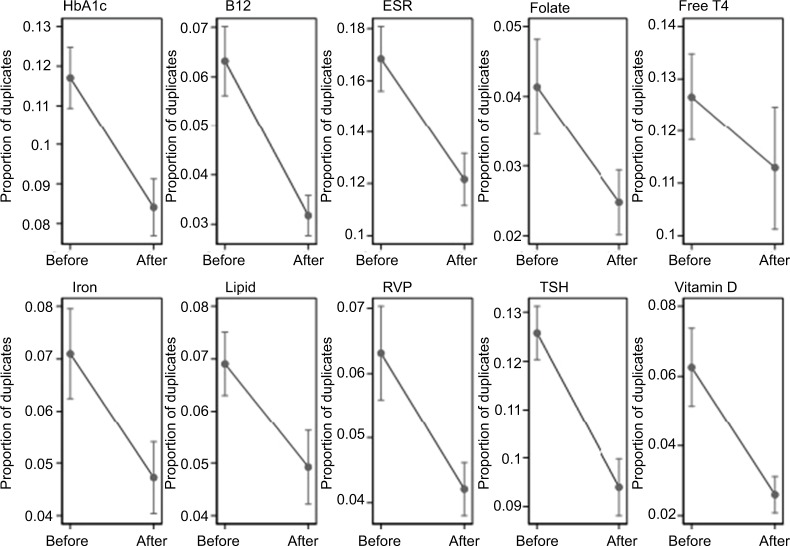
Results from the beta-binomial model indicated that the intervention reduced the overall duplicates by 18% (OR=0.82, standard error=0.016, -value<0.000). Percent reductions in 9 of the 17 tests were statistically significant: serum hemoglobin A1C level, vitamin B12, serum erythrocyte sedimentation rate, serum folate, serum iron, lipid panel, respiratory viral panel, serum thyroid stimulating hormone level, and Vitamin D. Additionally, important cost savings were realized from the reduction of duplicates for each lab test (with the exception of CRP) with an estimated overall savings of $72,543 over 17 months in the post-intervention period.
The present study included all hospital inpatients and covered 17 clinical laboratory tests. This rather simple and low-cost intervention resulted in significant reductions in percentage duplicates of several tests and resulted in cost savings. The study also highlights the role of hospitalists in quality improvement.
美国内科医学委员会基金会“明智选择”倡议的建议认识到提高检测行为的适宜性和减少重复实验室检测数量的重要性。
评估旨在减少重复实验室检测和医院成本的电子病历最佳实践警报(BPA或“弹出式”)干预措施的有效性。
比较干预前后住院患者进行的重复实验室检测数量。
美国佛罗里达州盖恩斯维尔市佛罗里达大学健康珊兹医院,2014 - 2017年期间。
电子病历干预是一个BPA弹出式警报,若近期已有相同医嘱,会告知开单医生,同时显示“开单时间”“采集时间”“出结果时间”以及结果本身。
所选临床生化检测住院患者重复医嘱数量的百分比变化以及因减少重复检测而节省的费用。使用学生t检验和贝塔二项式模型分析数据。
贝塔二项式模型结果表明,干预措施使总体重复检测减少了18%(比值比=0.82,标准误=0.016,P值<0.000)。17项检测中的9项检测重复率降低百分比具有统计学意义:糖化血红蛋白A1C水平、维生素B12、红细胞沉降率、血清叶酸、血清铁、血脂全套、呼吸道病毒检测、促甲状腺激素水平和维生素D。此外,每项实验室检测(除CRP外)减少重复检测都实现了重要的成本节约,干预后17个月估计总体节约72,543美元。
本研究纳入了所有住院患者,并涵盖17项临床实验室检测。这种相当简单且低成本的干预措施使多项检测的重复率大幅降低,并实现了成本节约。该研究还凸显了住院医师在质量改进中的作用。