
休曼氏病:影像学病理形态学及其与临床特征的关联
Scheuermann's Disease: Radiographic Pathomorphology and Association with Clinical Features.
作者信息
Bezalel Tomer, Carmeli Eli, Kalichman Leonid
机构信息
Maccabi Health Care Services, Posture Clinic, Maccabi Hashalom, Tel Aviv, Israel.
Department of Physical Therapy, Recanati School for Community Health Professions, Faculty of Health Sciences at Ben-Gurion University of the Negev, Beer-Sheva, Israel.
出版信息
Asian Spine J. 2019 Feb;13(1):86-95. doi: 10.31616/asj.2018.0025. Epub 2018 Oct 18.
STUDY DESIGN
Cross-sectional analytical study.
PURPOSE
To evaluate the spinal radiological features in patients with Scheuermann's disease and the association between the thoracic kyphosis angle and clinical presentation. Overview of the Literature: Scheuermann's disease is the most common cause of hyperkyphosis of the thoracic and thoracolumbar spine in adolescents; however, literature is limited in this area.
METHODS
Data regarding 150 successive X-ray images of 95 males and 55 females diagnosed with Scheuermann's disease were retrieved from the digital archives of the Maccabi Healthcare Services in Tel Aviv. Data included thoracic kyphosis angle (T3-T12), cervical lordosis (C2-C7), lumbar lordosis (L1-S1), sacral slope (SS), number and location of the anterior wedged vertebrae (AWV, minimum 5°), and C7 plumb line. Other data included age, sex, height, family history, Risser sign, self-perceived body image (rated by the Numeric Rating Scale [NRS]), and back pain during the previous week (rated by the Numeric Pain Rating Scale [NPRS]).
RESULTS
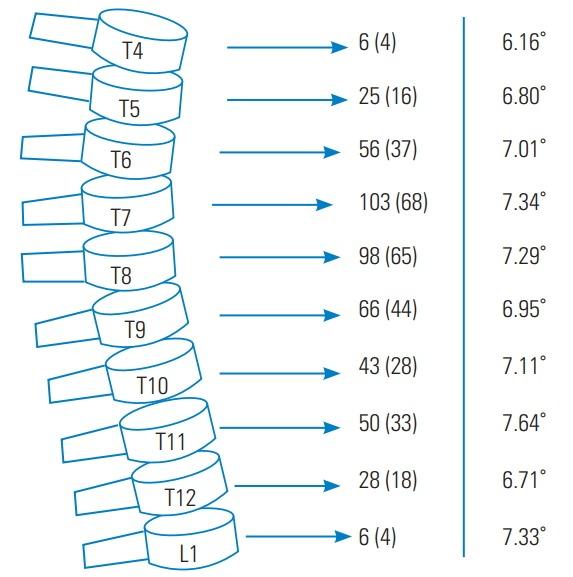
Significant positive associations were observed between the Cobb angle of thoracic kyphosis and age (r =0.186, p =0.023), cervical lordosis (r =0.263, p <0.001), lumbar lordosis (r =0.576, p <0.001), SS (r =0.236, p <0.004), T10-T12 Cobb angle (r =0.319, p <0.001), and number of AWV (r =0.519, p <0.001). The highest frequency of vertebral wedging was noted in T7 (68%), followed by T8 (65%) and T9 (44%). The NPRS showed a significant association only with SS (r =0.219, p =0.014). Significant positive associations were observed between the NRS for self-perceived body image, the thoracic kyphosis (r =0.494, p <0.001), and the number of AWV (r =0.361, p <0.001).
CONCLUSIONS
Thoracic kyphosis was significantly associated with cervical and lumbar lordosis, SS, T10-T12 Cobb angle, and AWV number. Pain was not substantial; however, self-perceived body image, the most common complaint of patients with Scheuermann's disease, was high and significantly associated with thoracic kyphosis and the number of AWV.
研究设计
横断面分析研究。
目的
评估休曼病患者的脊柱放射学特征以及胸椎后凸角与临床表现之间的关联。文献综述:休曼病是青少年胸段和胸腰段脊柱后凸过度最常见的原因;然而,该领域的文献有限。
方法
从特拉维夫马卡比医疗服务中心的数字档案中检索了95名男性和55名女性被诊断为休曼病的150张连续X线图像的数据。数据包括胸椎后凸角(T3-T12)、颈椎前凸(C2-C7)、腰椎前凸(L1-S1)、骶骨倾斜度(SS)、前方楔形变椎体(AWV,最小5°)的数量和位置,以及C7铅垂线。其他数据包括年龄、性别、身高、家族史、里塞尔征、自我感知的身体形象(由数字评分量表[NRS]评分),以及前一周的背痛(由数字疼痛评分量表[NPRS]评分)。
结果
观察到胸椎后凸的Cobb角与年龄(r = 0.186,p = 0.023)、颈椎前凸(r = 0.263,p < 0.001)、腰椎前凸(r = 0.576,p < 0.001)、SS(r = 0.236,p < 0.004)、T10-T12 Cobb角(r = 0.319,p < 0.001)和AWV数量(r = 0.519,p < 0.001)之间存在显著正相关。椎体楔形变最常见于T7(68%),其次是T8(65%)和T9(44%)。NPRS仅与SS有显著关联(r = 0.219,p = 0.014)。自我感知身体形象的NRS与胸椎后凸(r = 0.494,p < 0.001)和AWV数量(r = 0.361,p < 0.001)之间存在显著正相关。
结论
胸椎后凸与颈椎和腰椎前凸、SS、T10-T12 Cobb角以及AWV数量显著相关。疼痛并不严重;然而,自我感知的身体形象是休曼病患者最常见的主诉,其发生率较高,且与胸椎后凸和AWV数量显著相关。

 Zotero 插件