NASG Key Laboratory of Land and Environment and Disaster Monitoring, China University of Mining and Technology, Xuzhou 221116, China.
School of Environment Science and Spatial Informatics, China University of Mining and Technology, Xuzhou 221116, China.
Sensors (Basel). 2018 Oct 16;18(10):3494. doi: 10.3390/s18103494.
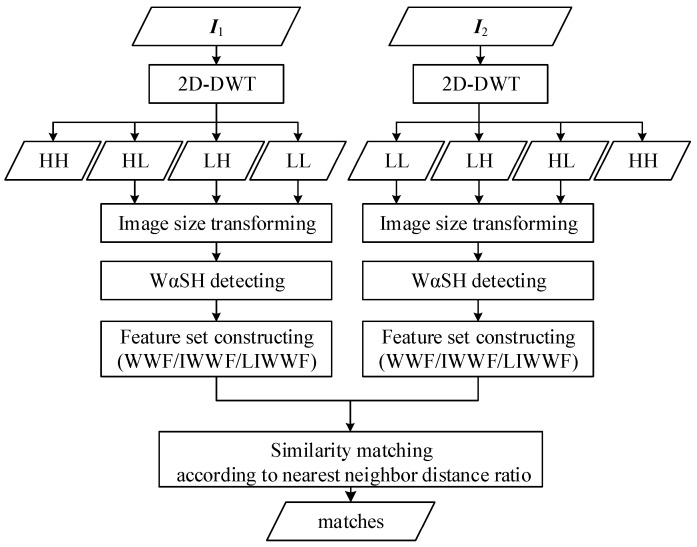
Image matching is an outstanding issue because of the existing of geometric and radiometric distortion in stereo remote sensing images. Weighted α-shape (WαSH) local invariant features are tolerant to image rotation, scale change, affine deformation, illumination change, and blurring. However, since the number of WαSH features is small, it is difficult to get enough matches to estimate the satisfactory homography matrix or fundamental matrix. In addition, the WαSH detector is extremely sensitive to image noise because it is built on sampled edges. Considering the shortcomings of the WαSH detector, this paper improves the WαSH feature matching method based on the 2D discrete wavelet transform (2D-DWT). The method firstly performs 2D-DWT on the image, and then detects WαSH features on the transformed images. According to the methods of descriptor construction for WαSH features, three matching methods on the basis of wavelet transform WαSH features (WWF), improved wavelet transform WαSH features (IWWF), and layered IWWF (LIWWF) are distinguished with respect to the character of the sub-images. The experimental results on the dataset containing affine distortion, scale distortion, illumination change, and noise images, showed that the proposed methods acquired more matches and better stableness than WαSH. Experimentation on remote sensing images with less affine distortion and slight noise showed that the proposed methods obtained the correct matching rate greater than 90%. For images containing severe distortion, KAZE obtained a 35.71% correct matching rate, which is unacceptable for calculating the homography matrix, while IWWF achieved a 71.42% correct matching rate. IWWF was the only method that achieved the correct matching rate of no less than 50% for all four test stereo remote sensing image pairs and was the most stable compared to MSER, DWT-MSER, WαSH, DWT-WαSH, KAZE, WWF, and LIWWF.
图像匹配是一个突出的问题,因为立体遥感图像中存在几何和辐射失真。加权α 形状(WαSH)局部不变特征对图像旋转、尺度变化、仿射变形、光照变化和模糊具有鲁棒性。然而,由于 WαSH 特征的数量较少,因此很难获得足够的匹配来估计令人满意的单应矩阵或基础矩阵。此外,由于它是基于采样边缘构建的,WαSH 检测器对图像噪声非常敏感。考虑到 WαSH 检测器的缺点,本文基于二维离散小波变换(2D-DWT)改进了 WαSH 特征匹配方法。该方法首先对图像进行 2D-DWT,然后在变换后的图像上检测 WαSH 特征。根据 WαSH 特征描述符构建方法,针对子图像的特点,区分了三种基于小波变换 WαSH 特征的匹配方法(WWF)、改进的小波变换 WαSH 特征(IWWF)和分层 IWWF(LIWWF)。在包含仿射失真、尺度失真、光照变化和噪声图像的数据集上的实验结果表明,与 WαSH 相比,所提出的方法获得了更多的匹配和更好的稳定性。在含有较小仿射失真和轻微噪声的遥感图像上的实验表明,所提出的方法获得的正确匹配率大于 90%。对于含有严重失真的图像,KAZE 获得了 35.71%的正确匹配率,这对于计算单应矩阵来说是不可接受的,而 IWWF 则达到了 71.42%的正确匹配率。IWWF 是唯一一种对所有四个测试立体遥感图像对的正确匹配率均不低于 50%的方法,并且与 MSER、DWT-MSER、WαSH、DWT-WαSH、KAZE、WWF 和 LIWWF 相比,它是最稳定的。