The Laboratory of Malaria and Vector Research, National Institute of Allergy and Infectious Diseases, National Institutes of Health, Rockville, MD, 20852, USA.
Present Address: Department of Epidemiology and Public Health, Central University of Tamil Nadu, Thiruvarur, India.
Parasit Vectors. 2018 Oct 17;11(1):548. doi: 10.1186/s13071-018-3129-5.
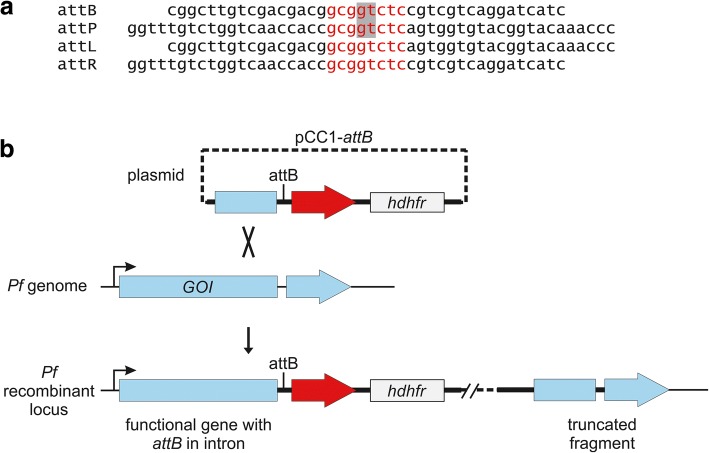
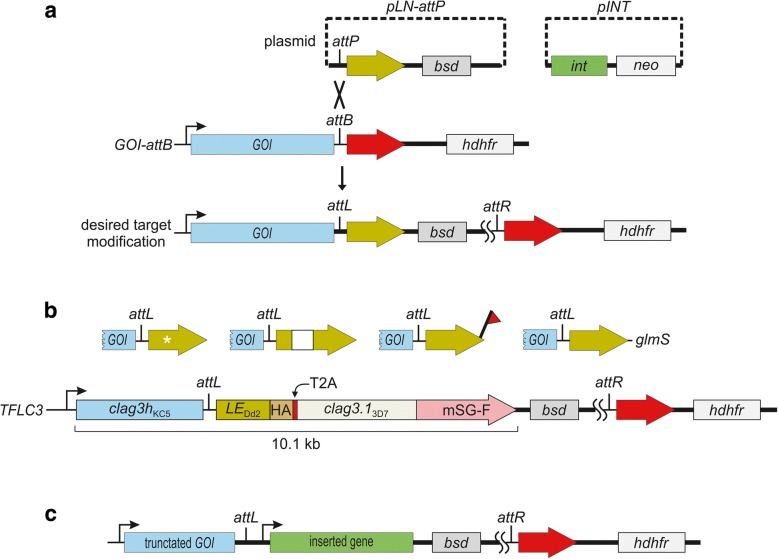
Genetic manipulation of the human malaria parasite Plasmodium falciparum is needed to explore pathogen biology and evaluate antimalarial targets. It is, however, aggravated by a low transfection efficiency, a paucity of selectable markers and a biased A/T-rich genome. While various enabling technologies have been introduced over the past two decades, facile and broad-range modification of essential genes remains challenging. We recently devised a new application of the Bxb1 integrase strategy to meet this need through an intronic attB sequence within the gene of interest. Although this attB is silent and without effect on intron splicing or protein translation and function, it allows efficient gene modification with minimal risk of unwanted changes at other genomic sites. We describe the range of applications for this new method as well as specific cases where it is preferred over CRISPR-Cas9 and other technologies. The advantages and limitations of various strategies for endogenous gene editing are also discussed.
需要对人类疟原虫寄生虫 Plasmodium falciparum 进行基因操作,以探索病原体生物学并评估抗疟靶点。然而,低转染效率、缺乏可选择的标记物和偏向 A/T 丰富的基因组使其变得复杂。虽然在过去的二十年中引入了各种使能技术,但对必需基因进行简便且广泛的修饰仍然具有挑战性。我们最近设计了 Bxb1 整合酶策略的新应用,通过感兴趣基因中的内含子 attB 序列来满足这一需求。尽管这个 attB 是沉默的,并且对内含子剪接或蛋白质翻译和功能没有影响,但它允许高效的基因修饰,而最小化其他基因组位点发生不需要的变化的风险。我们描述了这种新方法的应用范围,以及在某些情况下,它优于 CRISPR-Cas9 和其他技术。还讨论了各种内源基因编辑策略的优缺点。