Khairat Saif, Ottmar Paige, Sleath Betsy, Welch Brandon, Qanungo Suparna, Nichols Michelle, Obeid Jihad S
University of North Carolina- Chapel Hill, Chapel Hill, NC, United States.
Medical University of South Carolina, Charleston, SC, United States.
JMIR Res Protoc. 2018 Oct 17;7(10):e11239. doi: 10.2196/11239.
Informed consent is among the biggest challenges in recruiting participants for clinical research studies. Researchers face many challenges in conducting clinical trials, some of which include budgetary restrictions, lack of trained personnel, and difficulty recruiting study participants-particularly minorities and participants from rural communities.
The objective of this study is to utilize telemedicine to improve the informed consent process for clinical trials and studies. We aim to assess the feasibility and efficacy of the teleconsent intervention among residents in urban and rural settings.
This study will be conducted separately yet concurrently at two institutions, the Medical University of South Carolina and the University of North Carolina at Chapel Hill, to compare results within and across institutions.
Enrollment for Phase 1 began in March of 2018 and concluded in May 2018. Data transcription and analysis will be conducted through June and September of 2018.
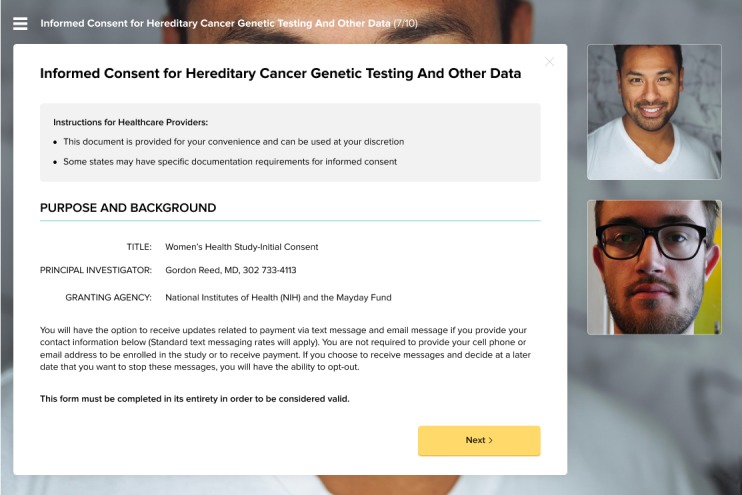
In this paper, we present a novel approach for conducting informed consent using a new telemedicine modality, namely, teleconsent. Teleconsent presents the ability to conduct a live interaction among clinical research coordinators and potential participants while synchronously presenting the consent form on the screen and obtaining participant's signature through doxy.me, the teleconsent system. Teleconsent provides potential to improve obtaining informed consent from potential clinical trial participants.
RR1-10.2196/11239.
在为临床研究招募参与者的过程中,知情同意是最大的挑战之一。研究人员在开展临床试验时面临诸多挑战,其中包括预算限制、缺乏训练有素的人员以及招募研究参与者困难,尤其是少数群体和来自农村社区的参与者。
本研究的目的是利用远程医疗改善临床试验和研究的知情同意过程。我们旨在评估远程同意干预在城市和农村居民中的可行性和有效性。
本研究将分别在南卡罗来纳医科大学和北卡罗来纳大学教堂山分校这两个机构同时进行,以比较机构内部和机构之间的结果。
第一阶段的招募工作于2018年3月开始,2018年5月结束。数据转录和分析将在2018年6月至9月进行。
在本文中,我们提出了一种使用新型远程医疗模式(即远程同意)进行知情同意的新方法。远程同意能够在临床研究协调员和潜在参与者之间进行实时互动,同时在屏幕上同步呈现同意书,并通过远程同意系统doxy.me获取参与者的签名。远程同意为改善从潜在临床试验参与者处获得知情同意提供了可能性。
RR1-10.2196/11239