Cheng Lijuan, Cortese Daniela, Monti Martin M, Wang Fuyan, Riganello Francesco, Arcuri Francesco, Di Haibo, Schnakers Caroline
International Vegetative State and Consciousness Science Institute, Hangzhou Normal University, Hangzhou, China.
Research in Advanced Neurorehabilitation, S. Anna Institute, Crotone, Italy.
Front Neurol. 2018 Oct 2;9:826. doi: 10.3389/fneur.2018.00826. eCollection 2018.
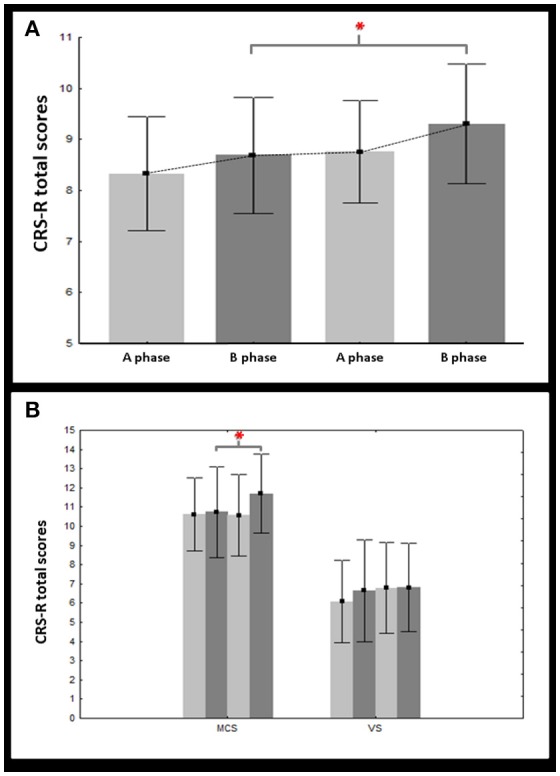
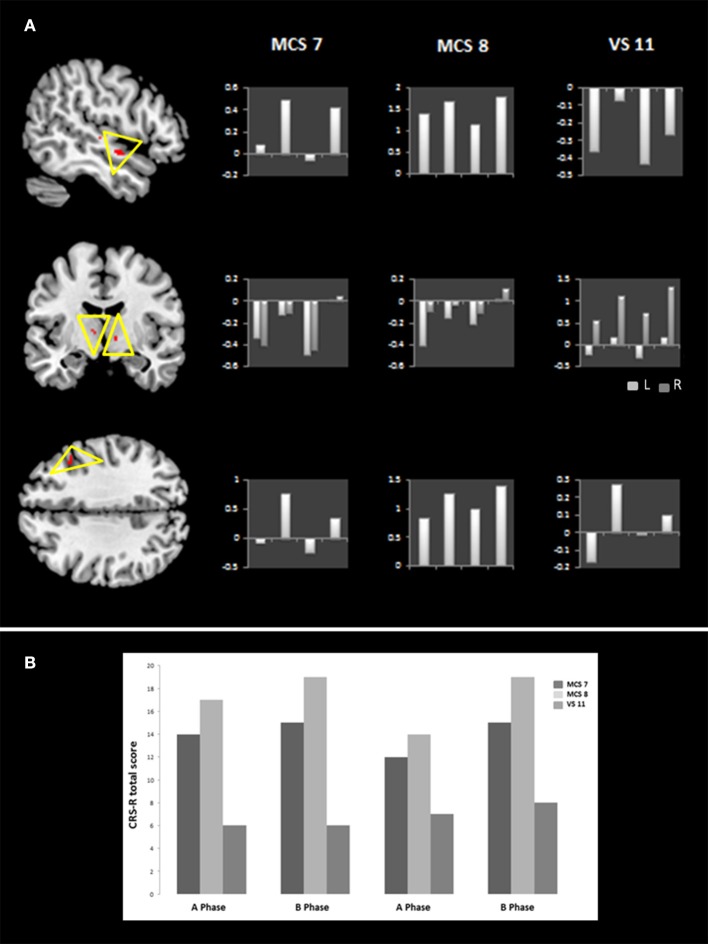
Considering sensory stimulation programs (SSP) as a treatment for disorders of consciousness is still debated today. Previous studies investigating its efficacy were affected by various biases among which small sample size and spontaneous recovery. In this study, treatment-related changes were assessed using time-series design in patients with disorders of consciousness (i.e., vegetative state-VS and minimally conscious state-MCS). A withdrawal design (ABAB) was used. During B phases, patients underwent a SSP (3 days a week, including auditory, visual, tactile, olfactory, and gustatory stimulation). The program was not applied during A phases. To assess behavioral changes, the Coma Recovery Scale-Revised (CRS-R) was administered by an independent rater on a weekly basis, across all phases. Each phase lasted 4 weeks. In a subset of patients, resting state functional magnetic resonance imaging (fMRI) data were collected at the end of each phase. Twenty nine patients (48 ± 19 years old; 15 traumatic; 21 > a year post-injury; 11 VS and 18 MCS) were included in our study. Higher CRS-R total scores (medium effect size) as well as higher arousal and oromotor subscores were observed in the B phases (treatment) as compared to A phases (no treatment), in the MCS group but not in the VS group. In the three patients who underwent fMRI analyses, a modulation of metabolic activity related to treatment was observed in middle frontal gyrus, superior temporal gyrus as well as ventro-anterior thalamic nucleus. Our results suggest that SSP may not be sufficient to restore consciousness. SSP might nevertheless lead to improved behavioral responsiveness in MCS patients. Our results show higher CRS-R total scores when treatment is applied, and more exactly, increased arousal and oromotor functions.
将感觉刺激方案(SSP)作为意识障碍的一种治疗方法,至今仍存在争议。以往研究其疗效时受到各种偏倚的影响,其中包括样本量小和自发恢复。在本研究中,采用时间序列设计对意识障碍患者(即植物状态-VS和微意识状态-MCS)的治疗相关变化进行评估。使用了撤药设计(ABAB)。在B阶段,患者接受SSP(每周3天,包括听觉、视觉、触觉、嗅觉和味觉刺激)。在A阶段不应用该方案。为了评估行为变化,由一名独立评估者在所有阶段每周使用昏迷恢复量表修订版(CRS-R)进行评估。每个阶段持续4周。在一部分患者中,在每个阶段结束时收集静息态功能磁共振成像(fMRI)数据。我们的研究纳入了29名患者(48±19岁;15名创伤性脑损伤患者;21名受伤后超过一年;11名处于VS状态,18名处于MCS状态)。与A阶段(未治疗)相比,MCS组在B阶段(治疗)观察到更高的CRS-R总分(中等效应量)以及更高的觉醒和口面部运动亚评分,但VS组未观察到。在接受fMRI分析的3名患者中,观察到与治疗相关的代谢活动在额中回、颞上回以及丘脑腹前核有调节。我们的结果表明,SSP可能不足以恢复意识。然而,SSP可能会使MCS患者的行为反应性得到改善。我们的结果显示,应用治疗时CRS-R总分更高,更确切地说,觉醒和口面部运动功能增加。