Health Promotion Research Center, Zahedan University of Medical Sciences, Zahedan, Iran.
Department of Epidemiology and Biostatistics, Iranshahr University of Medical Sciences, Iranshahr, Iran.
Epidemiol Health. 2018;40:e2018048. doi: 10.4178/epih.e2018048. Epub 2018 Oct 3.
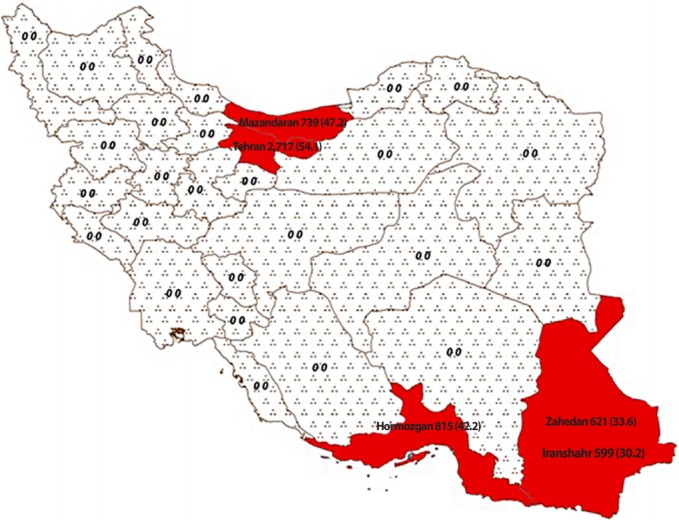
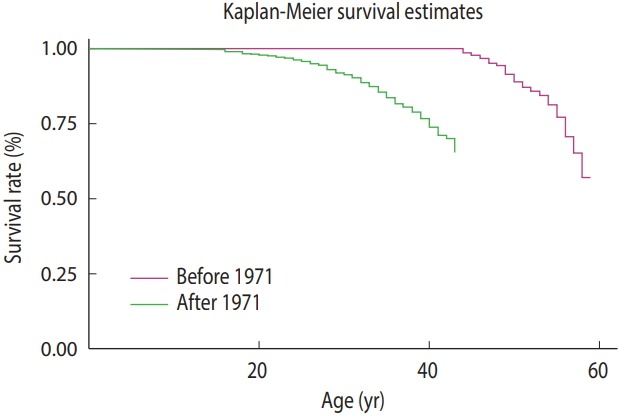
Thalassemia is a common genetic disease in Iran, especially in the north and south of Iran. The present study sought to determine the survival rate of patients with thalassemia in highly endemic regions of Iran and its variation in patients born before and after 1971.
The present historical cohort study extracted data from the health records of patients with beta-thalassemia major, beta-thalassemia intermedia, and sickle beta-thalassemia who had presented to thalassemia treatment centers in the past years. The collected data were analyzed using the Kaplan-Meier test, the log-rank test, and the chi-square test.
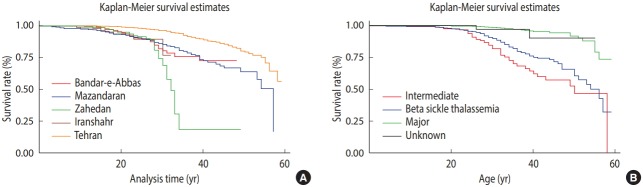
Of the total of 5,491 medical records (2,647 men and 2,634 women; mean age, 23.81±11.32 years), 3,936 belonged to patients with beta-thalassemia major, and 999 and 89 to patients with beta-thalassemia intermedia and sickle beta-thalassemia, respectively. In 467 cases, the type of thalassemia was not clear. The cumulative survival rate was calculated as 0.92, 0.83, 0.74, and 0.51 by ages 25, 35, 45, and 55, respectively. The hazard ratio of death was 4.22 (p<0.05) for beta-thalassemia major and 0.77 for beta-thalassemia intermedia (p=0.70). It was calculated as 1.45 for men patients and as 3.82 for single patients.
The present study showed relatively high survival rates in patients with thalassemia. The survival of patients was unfavorable in poorer regions (Zahedan and Iranshahr). Factors including women gender, a higher level of education, being married, and living in metropolises decreased the risk of death at younger ages and improved survival.
地中海贫血是伊朗常见的遗传性疾病,尤其是在伊朗北部和南部。本研究旨在确定伊朗高度流行地区地中海贫血患者的生存率及其在 1971 年前和后出生的患者中的变化。
本历史队列研究从过去几年中在地中海贫血治疗中心就诊的重型β地中海贫血、中间型β地中海贫血和镰状β地中海贫血患者的健康记录中提取数据。使用 Kaplan-Meier 检验、对数秩检验和卡方检验对收集的数据进行分析。
在总共 5491 份病历中(2647 名男性和 2634 名女性;平均年龄 23.81±11.32 岁),3936 份属于重型β地中海贫血患者,999 份和 89 份分别属于中间型β地中海贫血和镰状β地中海贫血患者。在 467 例中,地中海贫血的类型不明确。按年龄 25、35、45 和 55 岁计算,累积生存率分别为 0.92、0.83、0.74 和 0.51。重型β地中海贫血患者的死亡风险比为 4.22(p<0.05),中间型β地中海贫血患者的死亡风险比为 0.77(p=0.70)。男性患者的风险比为 1.45,单身患者的风险比为 3.82。
本研究显示地中海贫血患者的生存率相对较高。在较贫困地区(扎黑丹和伊兰沙赫尔),患者的生存状况不佳。女性性别、较高的教育水平、已婚和居住在大都市等因素降低了年轻患者死亡的风险,提高了生存率。