Ramachandran P, Morcus R, Tahir M, Onukogu I, Spinowitz B, Wang Jen C
Division of Hematology/Oncology, Brookdale University Hospital Medical Center, Brooklyn, NY, 11212, USA.
Division of Nephrology, New York Presbyterian Queens, Flushing, NY, USA.
J Med Case Rep. 2018 Oct 19;12(1):303. doi: 10.1186/s13256-018-1849-y.
Lung cancer is among the top causes of cancer-related mortality in men and is the second most common cancer after breast cancer in women. There are approximately 234,030 new cases of lung cancer and 154,050 deaths from lung cancer in 2018 as per the latest American Cancer Society's report. Alectinib, a more potent orally active tyrosine kinase inhibitor which was approved by the US Food & Drug Administration for anaplastic lymphoma kinase-positive lung adenocarcinoma, has been shown to have a reasonable safety profile when compared with other anaplastic lymphoma kinase-targeted therapy. As per research studies, grade 1 or 2 renal impairment has been reported but grade 4 renal toxicity due to alectinib has not been reported so far. We report a case of acute renal failure caused by alectinib which necessitated emergency dialysis. This is the first case report describing the severe renal toxicity of alectinib.
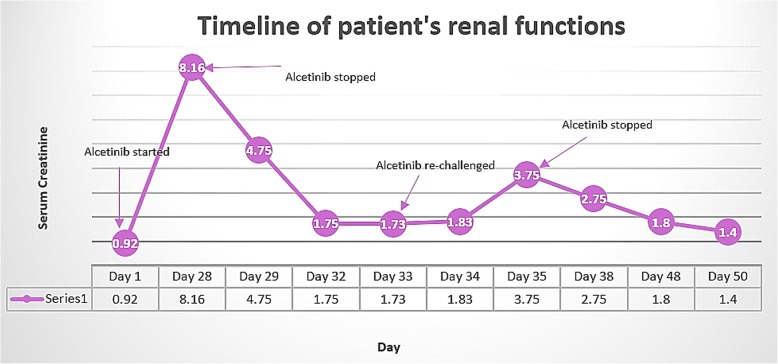
We describe a case of 72-year-old Taiwanese man diagnosed with stage IV anaplastic lymphoma kinase-positive adenocarcinoma of the lung initially treated with crizotinib for over a year, which was switched to alectinib due to disease progression with brain metastasis. Within 6 weeks of starting alectinib, he developed acute renal failure needing emergency dialysis support. His renal failure was secondary to acute tubular necrosis and had a complete reversal within 7-10 days on withdrawing the medication. When he was re-challenged with alectinib, his creatinine started to worsen again which confirmed the renal toxicity of alectinib.
This case emphasizes the uncommon adverse effect of the anaplastic lymphoma kinase-targeted therapy alectinib causing acute renal failure manifesting as acute tubular necrosis. Recognition of alectinib nephropathy requires a thorough drug history and knowledge of risk factors that lessen its margin of safety at therapeutic ingestions. Frequent monitoring of renal functions and early nephrology referral significantly reduce the mortality and morbidity of these patients.
肺癌是男性癌症相关死亡的主要原因之一,在女性中是仅次于乳腺癌的第二大常见癌症。根据美国癌症协会的最新报告,2018年约有234,030例新发肺癌病例,154,050人死于肺癌。阿来替尼是一种更有效的口服活性酪氨酸激酶抑制剂,已被美国食品药品监督管理局批准用于间变性淋巴瘤激酶阳性的肺腺癌,与其他间变性淋巴瘤激酶靶向治疗相比,已显示出合理的安全性。根据研究报告,曾有1级或2级肾功能损害的报道,但迄今为止尚未有因阿来替尼导致4级肾毒性的报道。我们报告一例由阿来替尼引起的急性肾衰竭病例,该病例需要紧急透析。这是第一例描述阿来替尼严重肾毒性的病例报告。
我们描述了一例72岁的台湾男性,被诊断为IV期间变性淋巴瘤激酶阳性肺腺癌,最初接受克唑替尼治疗一年多,由于疾病进展并出现脑转移而改用阿来替尼。在开始使用阿来替尼的6周内,他出现了急性肾衰竭,需要紧急透析支持。他的肾衰竭继发于急性肾小管坏死,停药后7 - 10天内完全逆转。当他再次使用阿来替尼时,肌酐水平再次恶化,这证实了阿来替尼的肾毒性。
本病例强调了间变性淋巴瘤激酶靶向治疗药物阿来替尼导致急性肾衰竭(表现为急性肾小管坏死)这一罕见的不良反应。认识到阿来替尼肾病需要详细的用药史以及了解在治疗用药时降低其安全边际的危险因素。频繁监测肾功能并尽早转诊至肾病科可显著降低这些患者的死亡率和发病率。