Saile Nadja, Schuh Elisabeth, Semmler Torsten, Eichhorn Inga, Wieler Lothar H, Bauwens Andreas, Schmidt Herbert
1Institute of Food Science and Biotechnology, University of Hohenheim, Garbenstr. 28, 70599 Stuttgart, Germany.
2Department Biological Safety, National Reference Laboratory for Escherichia coli, Federal Institute for Risk Assessment (BfR), Diedersdorfer Weg 1, 12277 Berlin, Germany.
Gut Pathog. 2018 Oct 8;10:43. doi: 10.1186/s13099-018-0271-8. eCollection 2018.
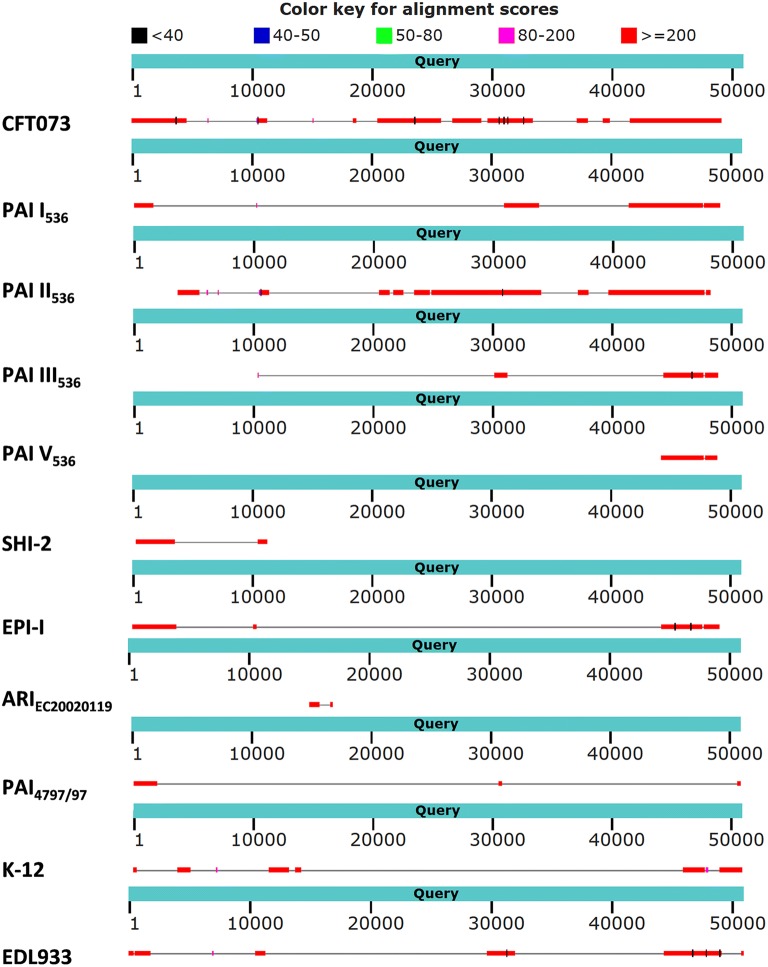
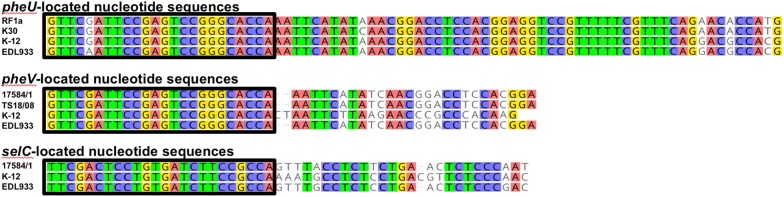
In the current study, nine foodborne "Locus of Enterocyte Effacement" (LEE)-negative Shiga toxin-producing (STEC) strains were selected for whole genome sequencing and analysis for yet unknown genetic elements within the already known LEE integration sites , and . Foreign DNA ranging in size from 3.4 to 57 kbp was detected and further analyzed. Five STEC strains contained an insertion of foreign DNA adjacent to the tRNA gene and five and seven strains contained foreign DNA adjacent to the and tRNA genes, respectively. We characterized the foreign DNA insertion associated with (STEC O91:H21 strain 17584/1), (STEC O8:H4 strain RF1a and O55:Hnt strain K30) and (STEC O91:H21 strain 17584/1 and O113:H21 strain TS18/08) as examples.
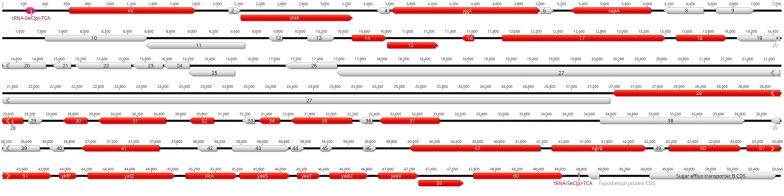
In total, 293 open reading frames partially encoding putative virulence factors such as TonB-dependent receptors, DNA helicases, a hemolysin activator protein precursor, antigen 43, anti-restriction protein KlcA, ShiA, and phosphoethanolamine transferases were detected. A virulence type IV toxin-antitoxin system was detected in three strains. Additionally, the system was found in one strain. In strain 17584/1 we were able to define a new genomic island which we designated GI . The island contained integrases and mobile elements in addition to genes for increased fitness and those playing a putative role in pathogenicity.
The data presented highlight the important role of the three tRNAs , and for the genomic flexibility of .
在本研究中,选择了9株食源性“肠细胞脱落位点”(LEE)阴性产志贺毒素大肠杆菌(STEC)菌株进行全基因组测序,并分析已知LEE整合位点内未知的遗传元件。检测到大小在3.4至57 kbp之间的外源DNA并进行了进一步分析。5株STEC菌株在tRNA基因附近含有外源DNA插入片段,另外5株和7株菌株分别在tRNA基因和tRNA基因附近含有外源DNA。我们以与(STEC O91:H21菌株17584/1)、(STEC O8:H4菌株RF1a和O55:Hnt菌株K30)和(STEC O91:H21菌株17584/1和O113:H21菌株TS18/08)相关的外源DNA插入片段为例进行了特征分析。
总共检测到293个开放阅读框,部分编码推定的毒力因子,如TonB依赖性受体、DNA解旋酶、溶血素激活蛋白前体、抗原43、抗限制蛋白KlcA、ShiA和磷酸乙醇胺转移酶。在3株菌株中检测到一种IV型毒力毒素-抗毒素系统。此外,在1株菌株中发现了系统。在菌株17584/1中,我们能够定义一个新的基因组岛,我们将其命名为GI。该岛除了包含与适应性增加和假定在致病性中起作用的基因外,还包含整合酶和移动元件。
所呈现的数据突出了三种tRNA对于基因组灵活性的重要作用。