Department of Internal Medicine, Herlev and Gentofte University Hospital, Hellerup, Denmark.
Department of Infectious Diseases, University of Copenhagen, CHIP/PERSIMUNE, Rigshospitalet, Finsencentret, Copenhagen, Denmark.
Shock. 2019 Sep;52(3):370-377. doi: 10.1097/SHK.0000000000001279.
Gelsolin is an actin-scavenger controlling the tissue damage from actin in the blood. Gelsolin levels in circulation drops when tissue damage and corresponding actin release is pronounced due to catabolic conditions. The purpose of this study was to determine if low plasma gelsolin independently predicts a reduced chance of weaning from ventilator-demanding respiratory failure in critically ill patients within 28 days from admission.
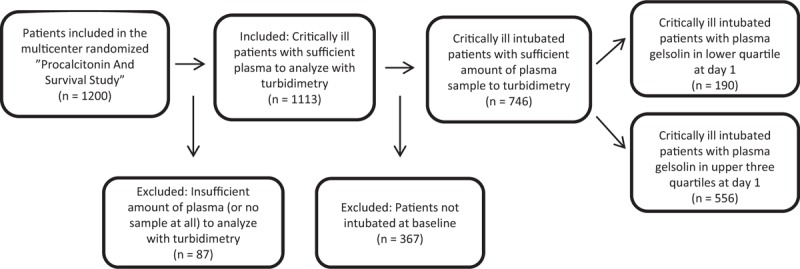
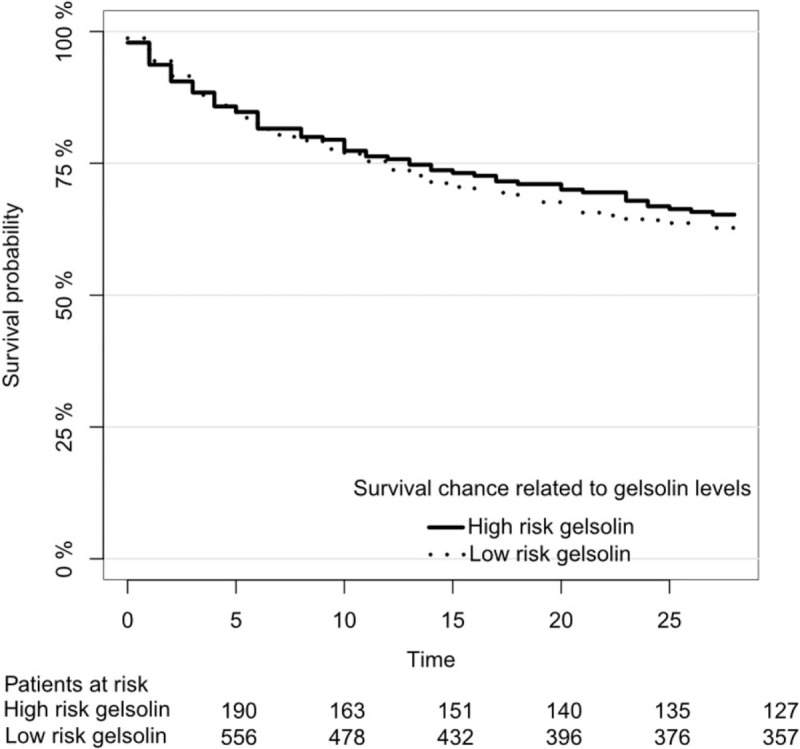
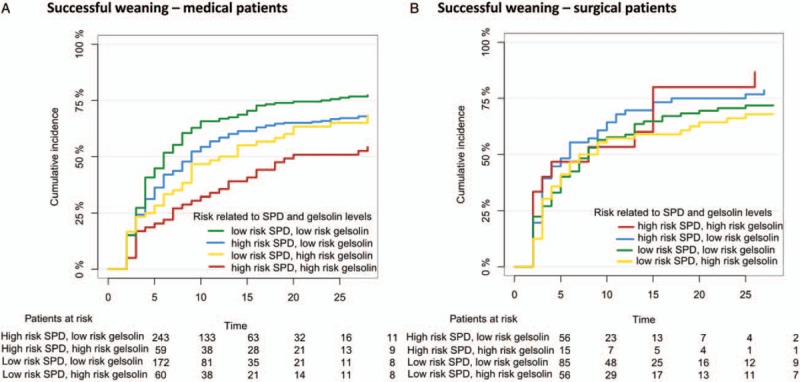
This cohort study included 746 critically ill patients with ventilator-demanding respiratory failure from the randomized clinical trial, "Procalcitonin And Survival Study (PASS)." Primary end point was successful weaning from mechanical ventilation within 28 days. We used multivariable Cox regression adjusted for age, sepsis, PaO2/FiO2 ratio and other known and suspected predictors of persistent respiratory failure. Follow-up was complete.For medical patients, baseline-gelsolin below the 25th percentile independently predicted a 40% lower chance of successful weaning within 28 days (HR 0.60, 95% CI 0.46-0.79, P = 0.0002); among surgical patients this end point was not predicted. Low gelsolin levels predicted chance of being "alive and out of intensive care at day 14" for both medical and surgical patients (HR 0.69, 95% CI 0.54-0.89, P = 0.004). Gelsolin levels did not predict 28 day mortality for surgical or medical patients.
Low levels of serum gelsolin independently predict a decreased chance of successful weaning from ventilator within 28 days among medical intensive care patients. This finding has implications for identifying patients who need individualized intervention early in intensive care course to prevent unfavorable lung prognosis in acute respiratory failure.
This is a substudy to the PASS, Clinicaltrials.gov ID: NCT00271752, first registered January 1, 2006.
凝溶胶蛋白是一种肌动蛋白清除剂,可控制血液中肌动蛋白引起的组织损伤。由于分解代谢状态,当组织损伤和相应的肌动蛋白释放明显时,循环中的凝溶胶蛋白水平会下降。本研究的目的是确定低血浆凝溶胶蛋白是否独立预测入住后 28 天内从需要呼吸机的呼吸衰竭中成功撤机的机会降低。
这项队列研究包括来自随机临床试验“降钙素原和生存研究(PASS)”的 746 例需要呼吸机的呼吸衰竭的危重病患者。主要终点是在 28 天内成功撤机。我们使用多变量 Cox 回归调整了年龄、脓毒症、PaO2/FiO2 比和其他已知和可疑的持续呼吸衰竭预测因素。对于内科患者,基线凝溶胶蛋白低于第 25 百分位独立预测 28 天内成功撤机的机会降低 40%(HR 0.60,95%CI 0.46-0.79,P=0.0002);在外科患者中,这一终点没有预测。低凝溶胶蛋白水平预测内科和外科患者在第 14 天“存活并离开重症监护病房”的机会(HR 0.69,95%CI 0.54-0.89,P=0.004)。凝溶胶蛋白水平不能预测外科或内科患者 28 天死亡率。
低水平的血清凝溶胶蛋白独立预测内科重症监护患者在 28 天内成功撤机的机会降低。这一发现对于在重症监护过程中尽早识别需要个体化干预的患者以预防急性呼吸衰竭的不良肺预后具有重要意义。
这是 PASS 的子研究,Clinicaltrials.gov ID:NCT00271752,首次注册于 2006 年 1 月 1 日。