Kantorovich Vitaly, Pacak Karel
Section of Endocrine, MedStar Washington Hospital Center, Washington, DC, USA.
Section on Medical Neuroendocrinology, Eunice Kennedy Shriver National Institute of Child Health and Human Development, National Institutes of Health, Bethesda, MD, USA.
F1000Res. 2018 Sep 20;7. doi: 10.12688/f1000research.14568.1. eCollection 2018.
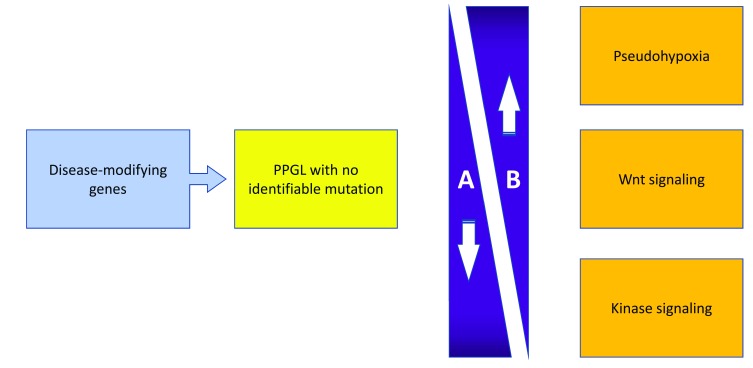
Pheochromocytomas (PCCs) and paragangliomas (PGLs) are rare chromaffin cell tumors (PPGLs) that at times raise significant challenges in clinical recognition, diagnosis, and therapy and when undiagnosed could associate with severe morbidity. Recent discoveries in PPGL genetics propelled our understanding in the pathophysiology of tumorigenesis and allowed the application of functional classification of pathogenetically distinct groups of PPGLs. This also resulted in a qualitative change in our approach to clinical assessment, diagnosis, and therapy of different subgroups of PPGLs. Establishment of the fact that mutations in multiple components of the PHD-VHL-HIF-2α pathway associate with pseudohypoxia-driven tumorigenesis allowed us not only to better understand the effect of this phenomenon but also to more deeply appreciate the value of functional abnormalities in the physiologic tissue oxygen-sensing mechanism. Mutations in the tricarboxylic acid cycle-related genes opened an additional window into understanding the physiology of one of the basic cellular metabolic pathways and consequences of its disruption. Mutations in the kinase signaling-related genes allow the PPGL field to join a massive innovative process in therapeutic advances in current oncology. New pathophysiologically distinct groups of mutations will widen and deepen our understanding of additional pathways in PPGL tumorigenesis and hopefully introduce additional diagnostic and therapeutic approaches. All of these developments are tremendously important in our understanding of both the normal physiology and pathophysiology of PPGLs and are strong tools and stimuli in the development of modern approaches to all components of medical management.
嗜铬细胞瘤(PCCs)和副神经节瘤(PGLs)是罕见的嗜铬细胞瘤(PPGLs),有时在临床识别、诊断和治疗方面会带来重大挑战,若未被诊断出来可能会导致严重的发病率。PPGL遗传学的最新发现推动了我们对肿瘤发生病理生理学的理解,并使得对具有不同发病机制的PPGLs组进行功能分类得以应用。这也导致我们对PPGLs不同亚组的临床评估、诊断和治疗方法发生了质的变化。PHD-VHL-HIF-2α通路多个成分的突变与假低氧驱动的肿瘤发生相关这一事实的确立,不仅使我们能够更好地理解这一现象的影响,还能更深刻地认识生理组织氧传感机制功能异常的价值。三羧酸循环相关基因的突变打开了一扇额外的窗口,有助于理解基本细胞代谢途径之一的生理学及其破坏的后果。激酶信号相关基因的突变使PPGL领域能够参与当前肿瘤学治疗进展中的大规模创新进程。新的具有不同病理生理学特征的突变组将拓宽和加深我们对PPGL肿瘤发生中其他途径的理解,并有望引入更多的诊断和治疗方法。所有这些进展对于我们理解PPGLs的正常生理学和病理生理学都极为重要,并且是现代医疗管理所有组成部分发展的有力工具和刺激因素。