CHU Bordeaux, Pôle de santé publique, Service d'information médicale, USMR & CIC 1401 EC (Clinical Epidemiology), F-33000, Bordeaux, France.
Inserm, Bordeaux Population Health Research Center, team EMOS, UMR 1219, University Bordeaux, F-33000, Bordeaux, France.
BMC Med Res Methodol. 2018 Oct 22;18(1):113. doi: 10.1186/s12874-018-0571-1.
Value of information is now recognized as a reference method in the decision process underpinning cost-effectiveness evaluation. The expected value of perfect information (EVPI) is the expected value from completely reducing the uncertainty surrounding the cost-effectiveness of an innovative intervention. Among sample size calculation methods used in cost-effectiveness studies, only one is coherent with this decision framework. It uses a Bayesian approach and requires data of a pre-existing cost-effectiveness study to derive a valid prior EVPI. When evaluating the cost-effectiveness of innovations, no observed prior EVPI is usually available to calculate the sample size. We here propose a sample size calculation method for cost-effectiveness studies, that follows the value of information theory, and, being frequentist, can be based on assumptions if no observed prior EVPI is available.
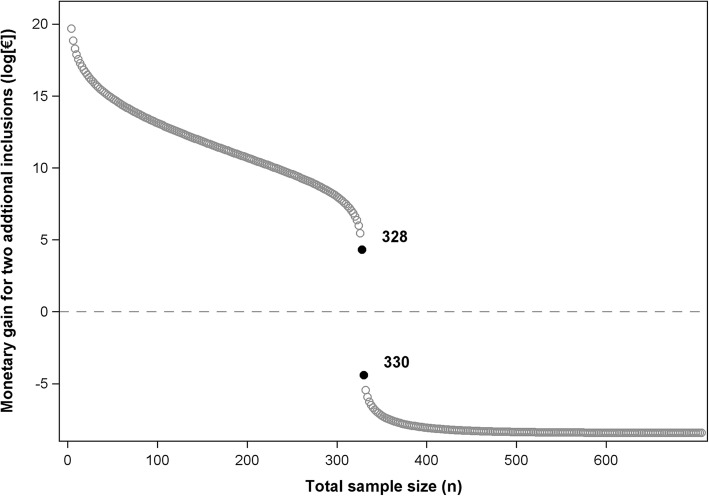
The general principle of our method is to define the sampling distribution of the incremental net monetary benefit (ΔB), or the distribution of ΔB that would be observed in a planned cost-effectiveness study of size n. Based on this sampling distribution, the EVPI that would remain at the end of the trial (EVPI) is estimated. The optimal sample size of the planned cost-effectiveness study is the n for which the cost of including an additional participant becomes equal or higher than the value of the information gathered through this inclusion.
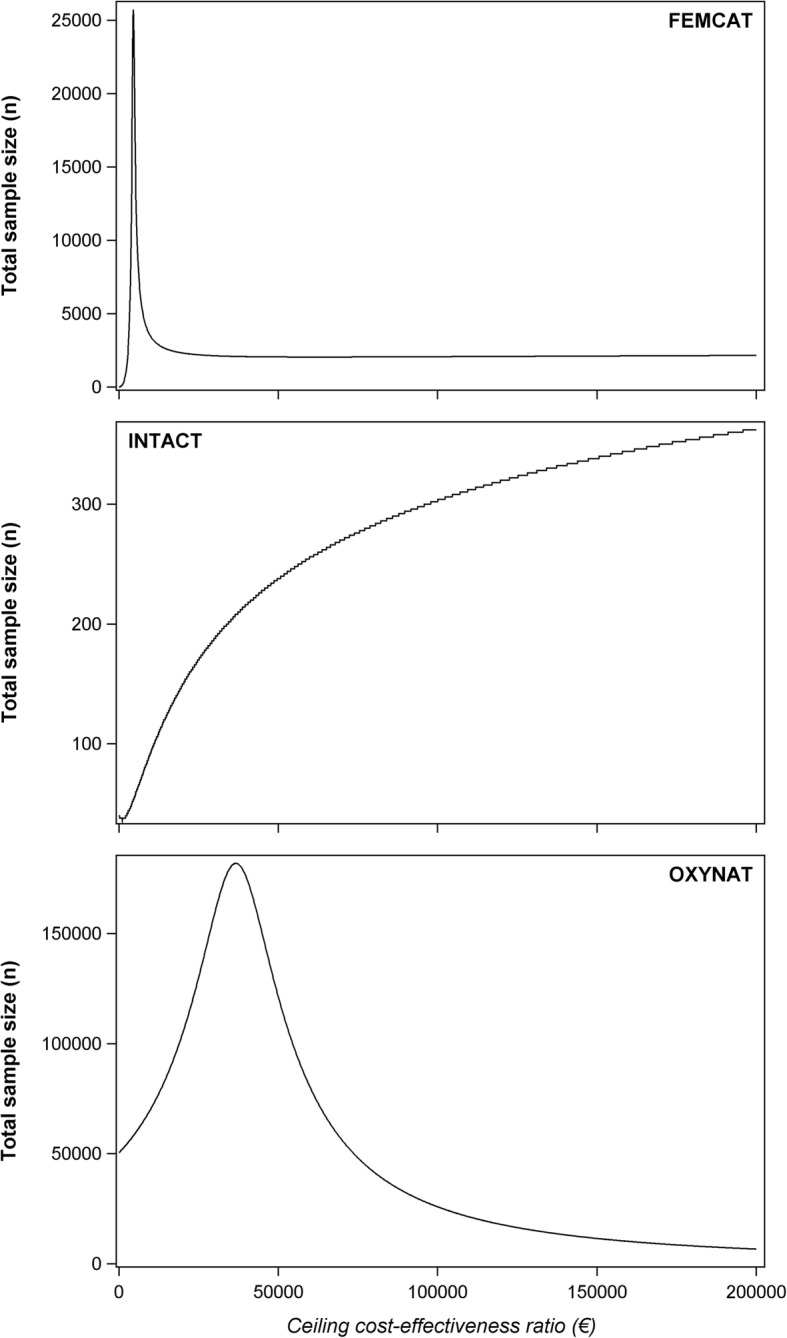
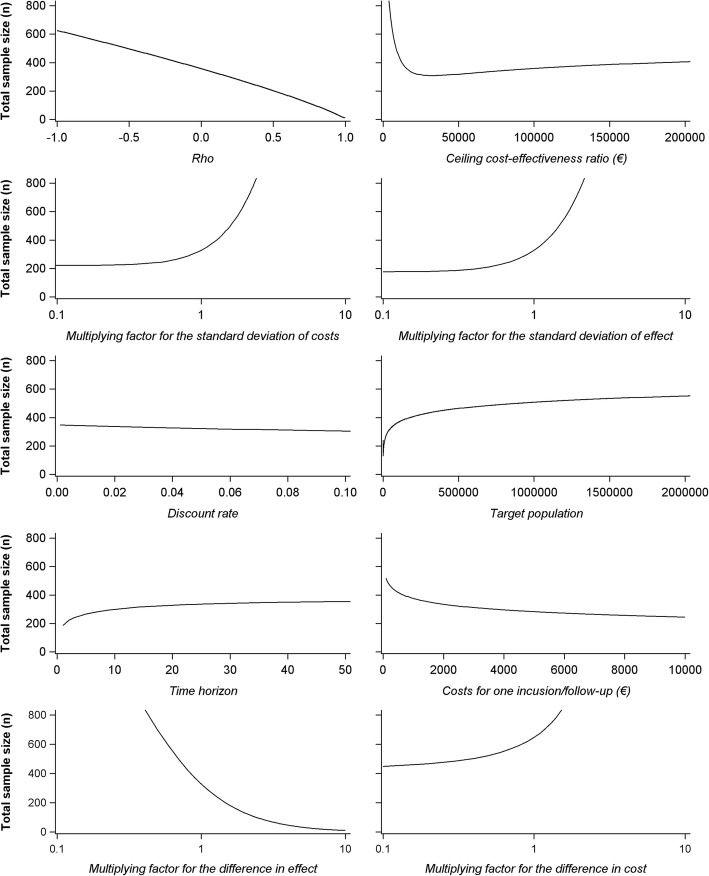
Our method is illustrated through four examples. The first one is used to present the method in depth and describe how the sample size may vary according to the parameters' value. The three other examples are used to illustrate in different situations how the sample size may vary according to the ceiling cost-effectiveness ratio, and how it compares with a test statistic-based method. We developed an R package (EBASS) to run these calculations.
Our sample size calculation method follows the value of information theory that is now recommended for analyzing and interpreting cost-effectiveness data, and sets the size of a study that balances its cost and the value of its information.
现在,价值信息已被视为成本效益评估决策过程中的参考方法。完全减少创新干预成本效益不确定性的完全信息预期价值(EVPI)是预期价值。在成本效益研究中使用的样本量计算方法中,只有一种方法与该决策框架一致。它使用贝叶斯方法,并且需要现有成本效益研究的数据来得出有效的先验 EVPI。在评估创新的成本效益时,通常没有可用的观察到的先验 EVPI 来计算样本量。在这里,我们提出了一种成本效益研究的样本量计算方法,该方法遵循价值信息理论,并且是频率主义的,如果没有可用的观察到的先验 EVPI,则可以基于假设。
我们的方法的一般原则是定义增量净货币收益(ΔB)的抽样分布,或在计划的大小为 n 的成本效益研究中观察到的ΔB 的分布。基于此抽样分布,估计试验结束时的 EVPI(EVPI)。计划成本效益研究的最佳样本量是 n,对于 n,包括额外参与者的成本等于或高于通过这种纳入获得的信息的价值。
我们的方法通过四个示例进行说明。第一个示例用于深入介绍该方法,并描述样本量如何根据参数值而变化。其他三个示例用于说明在不同情况下,根据上限成本效益比,样本量如何变化,以及与基于检验统计量的方法相比如何变化。我们开发了一个 R 包(EBASS)来运行这些计算。
我们的样本量计算方法遵循价值信息理论,该理论现在推荐用于分析和解释成本效益数据,并确定研究的规模,以平衡其成本和信息的价值。