Chaudhary V, Gwalani B, Soni V, Ramanujan R V, Banerjee R
School of Materials Science and Engineering, Nanyang Technological University, Singapore, 639798, Singapore.
Department of Materials Science and Engineering, University of North Texas, Denton, TX, 76201, USA.
Sci Rep. 2018 Oct 22;8(1):15578. doi: 10.1038/s41598-018-33922-w.
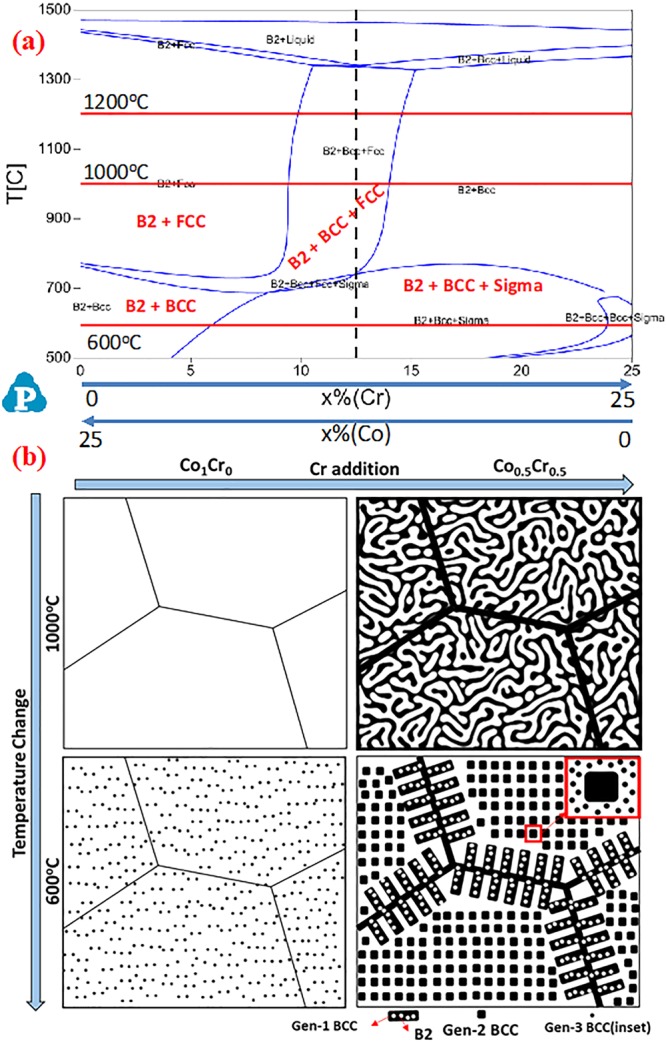
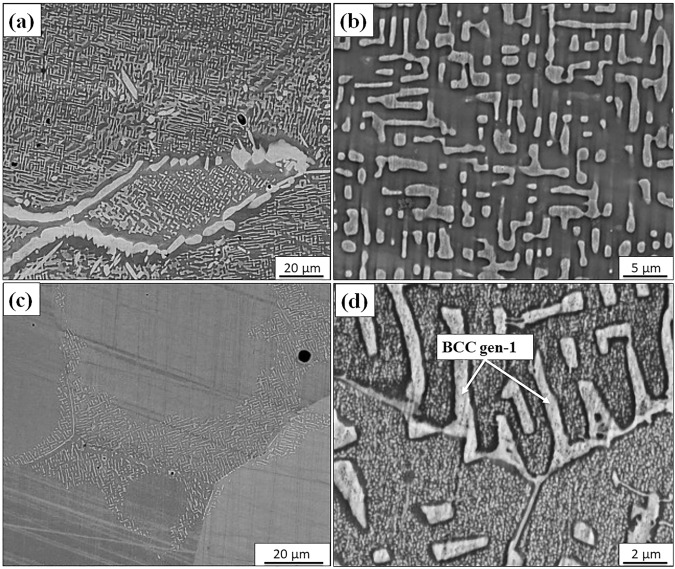
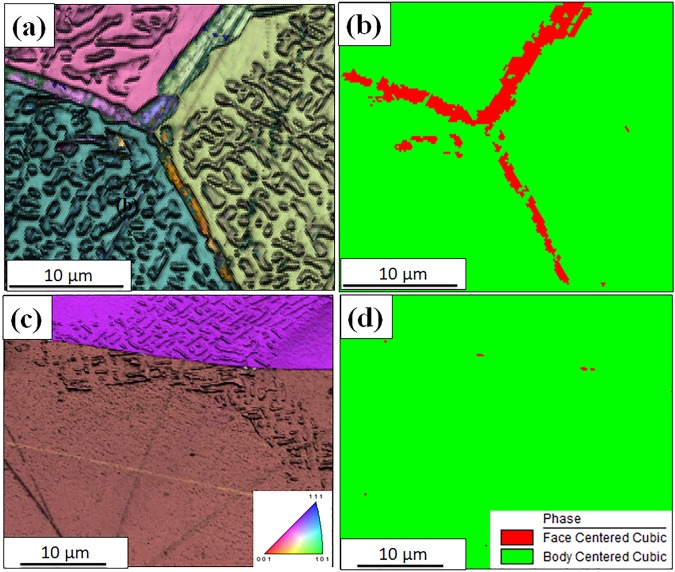
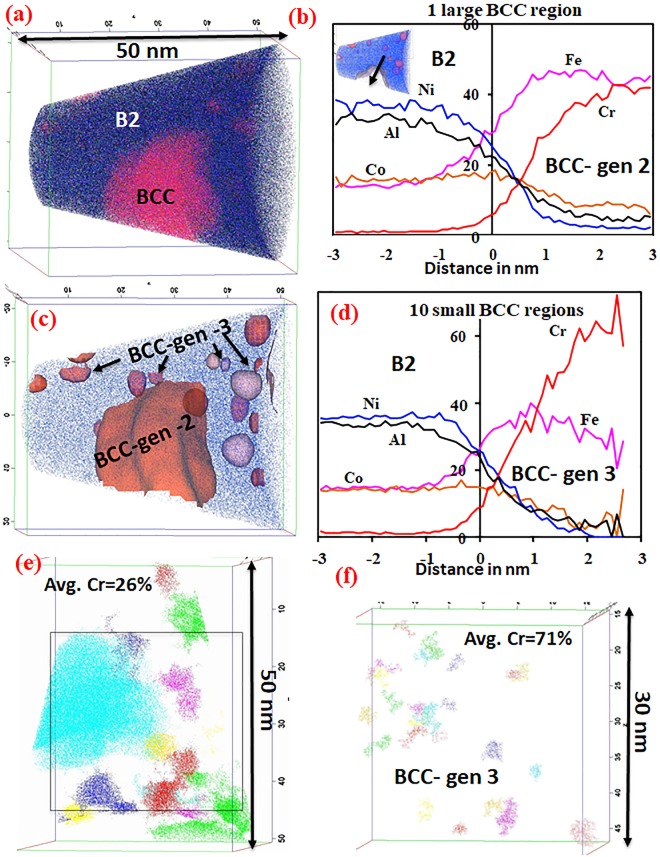
While the AlCoFeNi high entropy alloy exhibits a single ordered B2 phase at high temperature, both the substitution of ferromagnetic Co with antiferromagnetic Cr, and lower annealing temperatures lead to a tendency for this system to decompose into a two-phase mixture of ordered B2 and disordered BCC solid solution. The length scale of this decomposition is determined by the combination of composition and annealing temperature, as demonstrated in this investigation by comparing and contrasting AlCoFeNi with the AlCoCrFeNi alloy. The resulting phase stability has been rationalized based on solution thermodynamic predictions. Additionally, it is shown that replacement of Co by Cr in the AlCoFeNi alloy resulted in a substantial reduction in saturation magnetization and increase in coercivity. The microhardness is also strongly influenced by the composition and the length scale of B2 + BCC decomposition in these high entropy alloys.
虽然AlCoFeNi高熵合金在高温下呈现单一的有序B2相,但用反铁磁性的Cr替代铁磁性的Co以及较低的退火温度都会导致该体系倾向于分解为有序B2相和无序BCC固溶体的两相混合物。这种分解的长度尺度由成分和退火温度共同决定,本研究通过对比AlCoFeNi和AlCoCrFeNi合金对此进行了证明。基于溶液热力学预测,对所得的相稳定性进行了合理的解释。此外,研究表明,在AlCoFeNi合金中用Cr替代Co会导致饱和磁化强度大幅降低,矫顽力增加。这些高熵合金中的B2 + BCC分解的成分和长度尺度也对显微硬度有很大影响。