Myeloid Cell Immunology Lab, VIB Center for Inflammation Research, Brussels, Belgium.
Lab of Cellular and Molecular Immunology, Vrije Universiteit Brussel, Brussels, Belgium.
Front Immunol. 2018 Oct 8;9:2250. doi: 10.3389/fimmu.2018.02250. eCollection 2018.
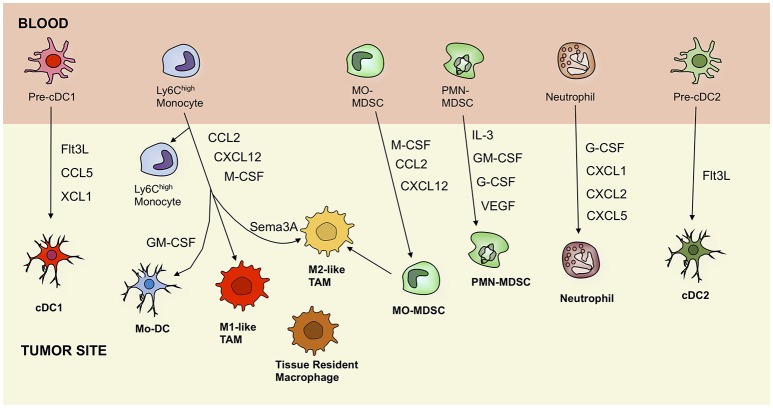
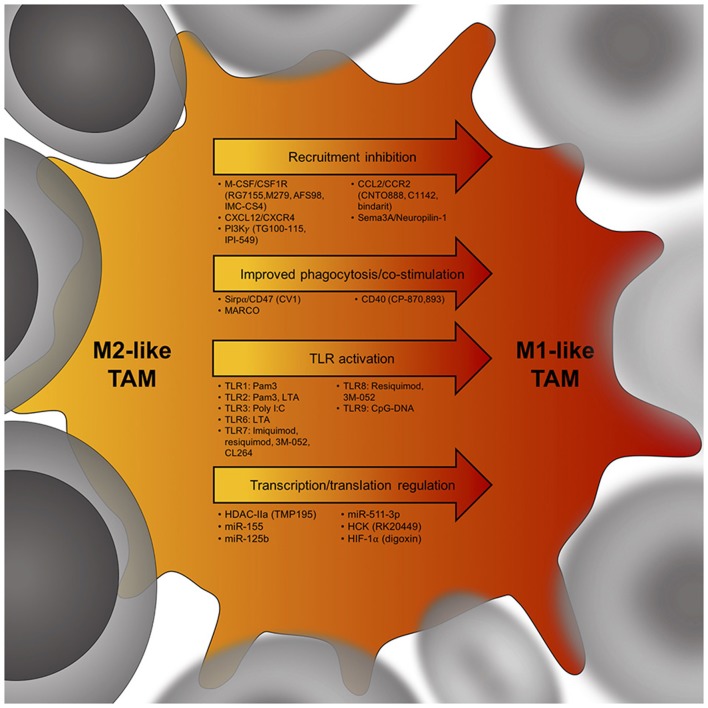
Therapeutic approaches that engage immune cells to treat cancer are becoming increasingly utilized in the clinics and demonstrated durable clinical benefit in several solid tumor types. Most of the current immunotherapies focus on manipulating T cells, however, the tumor microenvironment (TME) is abundantly infiltrated by a heterogeneous population of tumor-associated myeloid cells, including tumor-associated macrophages (TAMs), tumor-associated dendritic cells (TADCs), tumor-associated neutrophils (TANs), and myeloid-derived suppressor cells (MDSCs). Educated by signals perceived in the TME, these cells often acquire tumor-promoting properties ultimately favoring disease progression. Upon appropriate stimuli, myeloid cells can exhibit cytoxic, phagocytic, and antigen-presenting activities thereby bolstering antitumor immune responses. Thus, depletion, reprogramming or reactivation of myeloid cells to either directly eradicate malignant cells or promote antitumor T-cell responses is an emerging field of interest. In this review, we briefly discuss the tumor-promoting and tumor-suppressive roles of myeloid cells in the TME, and describe potential therapeutic strategies in preclinical and clinical development that aim to target them to further expand the range of current treatment options.
针对癌症的治疗方法正在越来越多地应用于临床,这些方法能够使几种实体肿瘤类型获得持久的临床获益,其中大部分免疫疗法都集中在操纵 T 细胞上,但肿瘤微环境 (TME) 中充满了大量异质性的肿瘤相关髓系细胞,包括肿瘤相关巨噬细胞 (TAMs)、肿瘤相关树突状细胞 (TADCs)、肿瘤相关中性粒细胞 (TANs) 和髓系来源的抑制细胞 (MDSCs)。这些细胞受到 TME 中感知到的信号的影响,往往获得促进肿瘤的特性,最终有利于疾病进展。在适当的刺激下,髓系细胞可以表现出细胞毒性、吞噬和抗原呈递活性,从而增强抗肿瘤免疫反应。因此,髓系细胞的耗竭、重编程或再激活,无论是直接消灭恶性细胞还是促进抗肿瘤 T 细胞反应,都是一个新兴的研究领域。在这篇综述中,我们简要讨论了髓系细胞在 TME 中的促肿瘤和抑肿瘤作用,并描述了临床前和临床开发中潜在的治疗策略,旨在针对它们进一步扩大当前治疗选择的范围。