Ito Kei, Ogawa Hiroaki, Shimizuguchi Takuya, Nihei Keiji, Furuya Tomohisa, Tanaka Hiroshi, Karasawa Katsuyuki
1 Division of Radiation Oncology, Department of Radiology, Tokyo Metropolitan Cancer and Infectious Diseases Center Komagome Hospital, Bunkyo-ku, Tokyo, Japan.
2 Department of Radiation Oncology, Aichi Cancer Center Hospital, Chikusa-ku Nagoya, Aichi, Japan.
Technol Cancer Res Treat. 2018 Jan 1;17:1533033818806472. doi: 10.1177/1533033818806472.
This study aimed to clarify the outcomes of stereotactic body radiotherapy for spinal metastases with a uniform dose fractionation schedule in our institution.
Patients treated with spine stereotactic body radiotherapy were retrospectively reviewed. The prescribed dose was 24 Gy in 2 fractions. End points were local control, pain control, and adverse events. Local control was defined as elimination, shrinkage, or stable disease in the tumor on imaging evaluations. Pain status was measured on a scale of 0 to 10 by patients' self-reports, and pain response was defined as the time at which pain scale score decreased by 2 or more from the baseline score without increase in analgesics. In addition, various treatment- and tumor-specific factors were evaluated to determine predictive values for local and pain control.
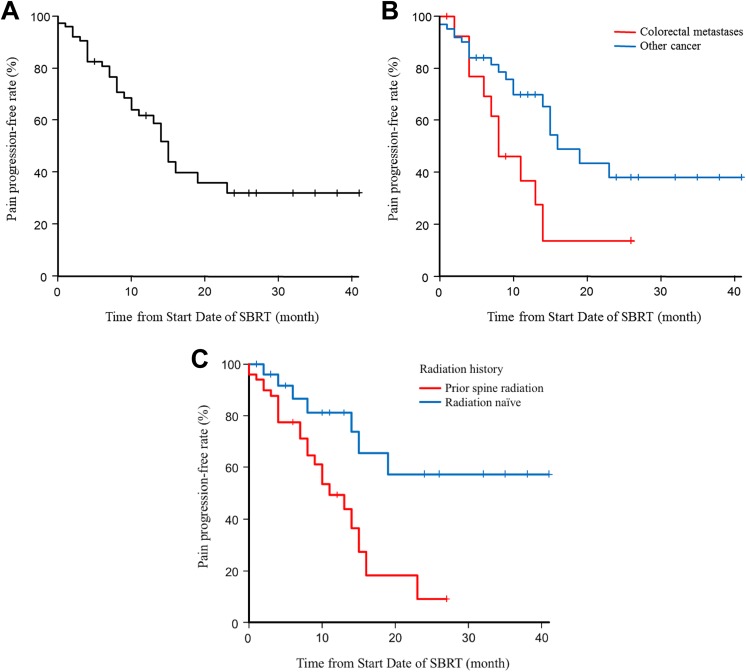
This study included 134 lesions in 131 patients, with: lesion histopathology, lung/colorectal/thyroid/renal/breast/prostate/sarcoma/other cancer, 24/22/18/14/12/10/6/25; reirradiation stereotactic body radiotherapy, 82 (61.2%) cases; and postoperative stereotactic body radiotherapy for epidural spinal cord compression, 45 (33.6%) cases. Median follow-up after stereotactic body radiotherapy was 9 months. The 1-year local control rate was 72.3%. Seventy (79.5%) of the 88 cases with pain from spinal metastases achieved pain response. The 1-year pain progression-free rate was 61.7%. Regarding metastases from colorectal cancer, local and pain control rates at 1 year were significantly lower compared with other cancer types (local control rate, 34.1% vs 81.8%; P < .01; pain progression-free rate, 36.9% vs 69.9%; P = .02). On multivariate analysis, colorectal cancer metastases and radiation history were identified as independent predictors of lower local and pain control rates. Radiation-induced myelopathy, radiculopathy, and vertebral compression fractures were observed in 0, 2 (1.5%), and 16 (11.9%) cases, respectively.
This study showed that spine stereotactic body radiotherapy achieved good local and pain control, with a clinically acceptable safety profile. However, stereotactic body radiotherapy may be less effective against spinal metastases from colorectal cancer.
本研究旨在阐明在我们机构采用统一剂量分割方案对脊柱转移瘤进行立体定向体部放疗的结果。
对接受脊柱立体定向体部放疗的患者进行回顾性分析。处方剂量为24 Gy,分2次给予。观察终点为局部控制、疼痛控制和不良事件。局部控制定义为影像学评估显示肿瘤消失、缩小或病情稳定。疼痛状况通过患者自我报告在0至10分的量表上进行测量,疼痛缓解定义为疼痛量表评分较基线评分降低2分或更多且未增加镇痛药用量的时间点。此外,评估了各种治疗和肿瘤特异性因素以确定局部和疼痛控制的预测价值。
本研究纳入131例患者的134个病灶,其中:病灶组织病理学类型为肺癌/结直肠癌/甲状腺癌/肾癌/乳腺癌/前列腺癌/肉瘤/其他癌症,分别为24/22/18/14/12/10/6/25例;再次立体定向体部放疗82例(61.2%);术后立体定向体部放疗治疗硬膜外脊髓压迫45例(33.6%)。立体定向体部放疗后的中位随访时间为9个月。1年局部控制率为72.3%。88例有脊柱转移瘤疼痛的患者中,70例(79.5%)实现了疼痛缓解。1年无疼痛进展率为61.7%。对于结直肠癌转移,1年时的局部和疼痛控制率与其他癌症类型相比显著较低(局部控制率,34.1%对81.8%;P <.01;无疼痛进展率,36.9%对69.9%;P =.02)。多因素分析显示,结直肠癌转移和放疗史是局部和疼痛控制率较低的独立预测因素。分别有0例、2例(1.5%)和16例(11.9%)观察到放射性脊髓病、神经根病和椎体压缩骨折。
本研究表明,脊柱立体定向体部放疗实现了良好的局部和疼痛控制,且安全性在临床可接受范围内。然而,立体定向体部放疗对结直肠癌脊柱转移瘤的疗效可能较差。