
用于使用脑磁图/脑电图数据进行群体研究的贝叶斯模型选择图。
Bayesian Model Selection Maps for Group Studies Using M/EEG Data.
作者信息
Harris Clare D, Rowe Elise G, Randeniya Roshini, Garrido Marta I
机构信息
Computational Cognitive Neuroscience Laboratory, Queensland Brain Institute, The University of Queensland, Brisbane, QLD, Australia.
Monash Neuroscience of Consciousness Laboratory, School of Psychological Sciences, Faculty of Medicine Nursing and Health Science, Monash University, Melbourne, VIC, Australia.
出版信息
Front Neurosci. 2018 Sep 28;12:598. doi: 10.3389/fnins.2018.00598. eCollection 2018.
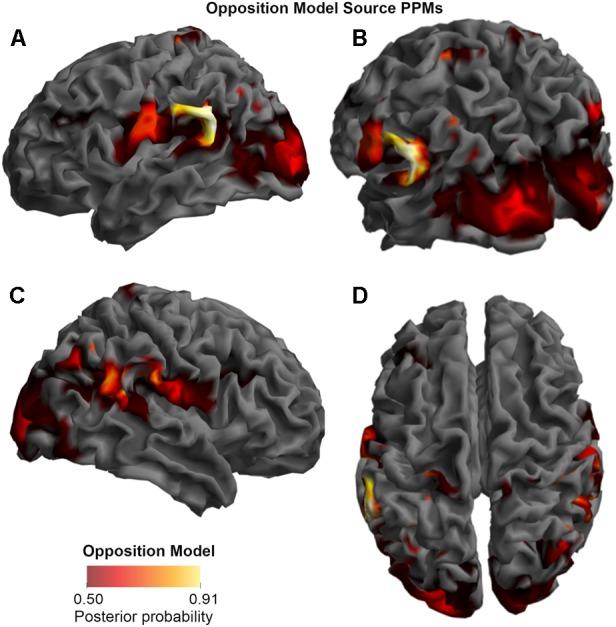
Predictive coding postulates that we make (top-down) predictions about the world and that we continuously compare incoming (bottom-up) sensory information with these predictions, in order to update our models and perception so as to better reflect reality. That is, our so-called "Bayesian brains" continuously create and update generative models of the world, inferring (hidden) causes from (sensory) consequences. Neuroimaging datasets enable the detailed investigation of such modeling and updating processes, and these datasets can themselves be analyzed with Bayesian approaches. These offer methodological advantages over classical statistics. Specifically, any number of models can be compared, the models need not be nested, and the "null model" can be accepted (rather than only failing to be rejected as in frequentist inference). This methodological paper explains how to construct posterior probability maps (PPMs) for Bayesian Model Selection (BMS) at the group level using electroencephalography (EEG) or magnetoencephalography (MEG) data. The method has only recently been used for EEG data, after originally being developed and applied in the context of functional magnetic resonance imaging (fMRI) analysis. Here, we describe how this method can be adapted for EEG using the Statistical Parametric Mapping (SPM) software package for MATLAB. The method enables the comparison of an arbitrary number of hypotheses (or explanations for observed responses), at each and every voxel in the brain (source level) and/or in the scalp-time volume (scalp level), both within participants and at the group level. The method is illustrated here using mismatch negativity (MMN) data from a group of participants performing an audio-spatial oddball attention task. All data and code are provided in keeping with the Open Science movement. In doing so, we hope to enable others in the field of M/EEG to implement our methods so as to address their own questions of interest.
预测编码假定我们对世界进行(自上而下的)预测,并持续将传入的(自下而上的)感官信息与这些预测进行比较,以便更新我们的模型和感知,从而更好地反映现实。也就是说,我们所谓的“贝叶斯大脑”不断创建和更新世界的生成模型,从(感官)结果中推断(隐藏的)原因。神经成像数据集能够对这种建模和更新过程进行详细研究,并且这些数据集本身可以用贝叶斯方法进行分析。与经典统计学相比,这些方法具有方法学上的优势。具体而言,可以比较任意数量的模型,模型不必嵌套,并且可以接受“零模型”(而不是像频率主义推理那样仅不能被拒绝)。这篇方法学论文解释了如何使用脑电图(EEG)或脑磁图(MEG)数据在群体水平上构建用于贝叶斯模型选择(BMS)的后验概率图(PPM)。该方法最初是在功能磁共振成像(fMRI)分析的背景下开发和应用的,直到最近才用于EEG数据。在这里,我们描述了如何使用MATLAB的统计参数映射(SPM)软件包将此方法应用于EEG。该方法能够在大脑的每个体素(源水平)和/或头皮时间体积(头皮水平)上,在个体内部和群体水平上比较任意数量的假设(或对观察到的反应的解释)。本文使用一组执行音频空间异常球注意力任务的参与者的失配负波(MMN)数据来说明该方法。所有数据和代码都按照开放科学运动的要求提供。通过这样做,我们希望使M/EEG领域的其他人能够实施我们的方法,以解决他们自己感兴趣的问题。



 Zotero 插件