Lea Delbos, Annie-Kim Gareau-Labelle, Eve-Lyne Langlais, Madeleine Lemyre, Marianne Boutet, Sarah Maheux-Lacroix, Lucie Dallaire, Philippe Y Laberge
Département de gynécologie du CHU de Québec - Université Laval, Québec, QC, Canada.
Département de pharmacie du CHU de Québec - Université Laval, Québec, QC, Canada.
JSLS. 2018 Jul-Sep;22(3). doi: 10.4293/JSLS.2018.00019.
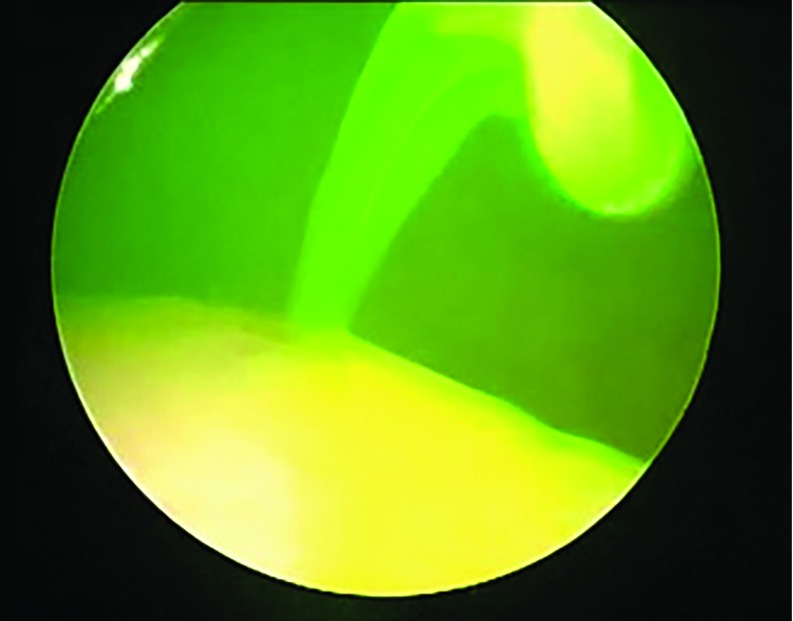
Laparoscopic hysterectomy poses the risk of lower urinary tract injury, and intraoperative recognition of urinary tract injury is often difficult. We sought to evaluate sodium fluorescein coloration of ureteral jets during cystoscopy after laparoscopic hysterectomy and to evaluate surgeons' satisfaction with this method of injury detection.
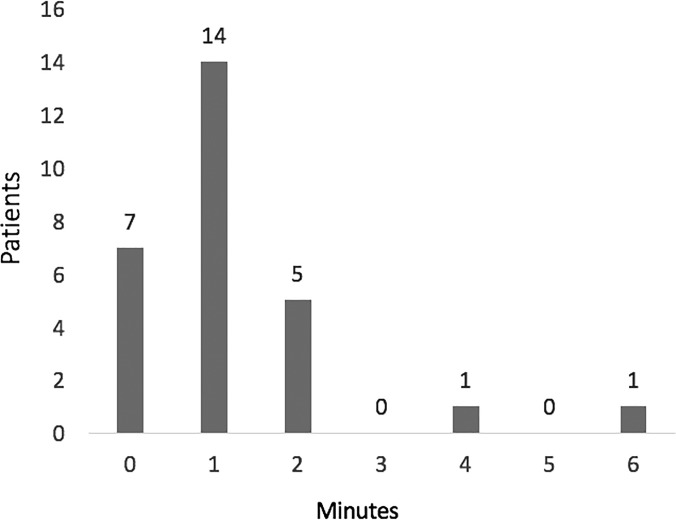
This was an observational study, in which data were collected prospectively. A total of 30 women who underwent laparoscopic hysterectomy from August 2016 to February 2017 at the Centre Hospitalier de l'Université Laval (CHUL) de Québec. Twenty-five milligrams of 10% intravenous sodium fluorescein was administered after vaginal cuff closure. Cystoscopy was then systematically performed, and the time to visualization (time from injection to coloration of ureteral jet), the quality of coloration, and the duration of cystoscopy were recorded. Side effects were systematically recorded and rigorously analyzed.
Most frequent indications for hysterectomy were fibroids and endometriosis with uterine weight from 76 to 885 g. Ninety-three percent of patients (n = 28) had bilateral ureteral jet coloration, whereas 1 patient had no coloration bilaterally, and another patient had a complete unilateral obstruction immediately diagnosed and resolved intraoperatively after removal of the vaginal sutures. In 90% of cases (n = 27), surgeons were highly satisfied with the use of sodium fluorescein. The average time between visualization of both left and right ureteral jets was 1 minute. Side effects included hypotension (n = 3) and yellow coloration of urine (n = 15).
Our study suggests that sodium fluorescein is an effective dye for documenting ureteral patency and improving visualization of ureteral jets during cystoscopy upon completion of laparoscopic hysterectomy.
腹腔镜子宫切除术存在下尿路损伤的风险,而术中识别尿路损伤往往困难。我们旨在评估腹腔镜子宫切除术后膀胱镜检查时输尿管喷尿的荧光素钠染色情况,并评估外科医生对这种损伤检测方法的满意度。
这是一项观察性研究,前瞻性收集数据。2016年8月至2017年2月期间,共有30名女性在魁北克拉瓦尔大学中心医院(CHUL)接受了腹腔镜子宫切除术。阴道残端缝合后,静脉注射25毫克10%的荧光素钠。然后系统地进行膀胱镜检查,记录可视化时间(从注射到输尿管喷尿染色的时间)、染色质量和膀胱镜检查持续时间。系统记录并严格分析副作用。
子宫切除术最常见的指征是肌瘤和子宫内膜异位症,子宫重量为76至885克。93%的患者(n = 28)双侧输尿管喷尿染色,而1例患者双侧均未染色,另1例患者存在完全性单侧梗阻,在拆除阴道缝线后术中立即诊断并解决。90%的病例(n = 27)中,外科医生对荧光素钠的使用非常满意。左右输尿管喷尿可视化的平均时间为1分钟。副作用包括低血压(n = 3)和尿液变黄(n = 15)。
我们的研究表明,荧光素钠是一种有效的染料,可用于记录输尿管通畅情况,并在腹腔镜子宫切除术后膀胱镜检查时改善输尿管喷尿的可视化。