Bhaskar Yamini, Lim Lee Wei, Mitra Rupshi
School of Biological Sciences, Nanyang Technological University, Singapore, Singapore.
Front Behav Neurosci. 2018 Oct 9;12:204. doi: 10.3389/fnbeh.2018.00204. eCollection 2018.
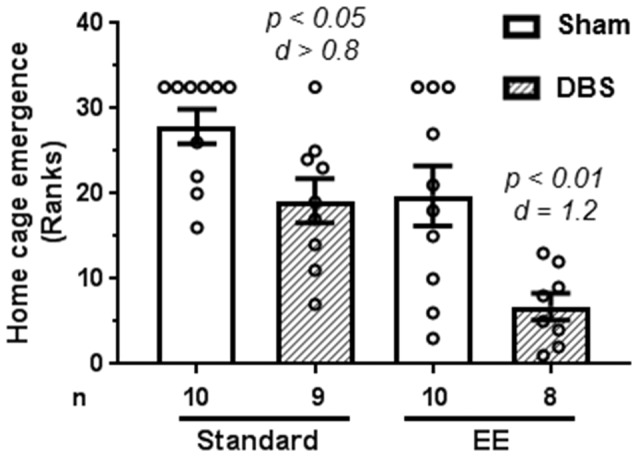
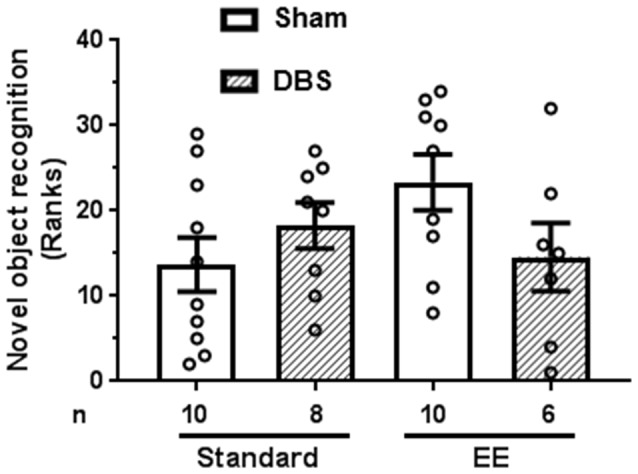
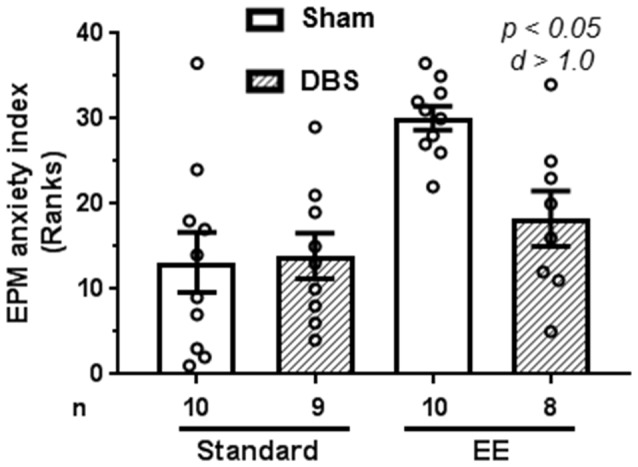
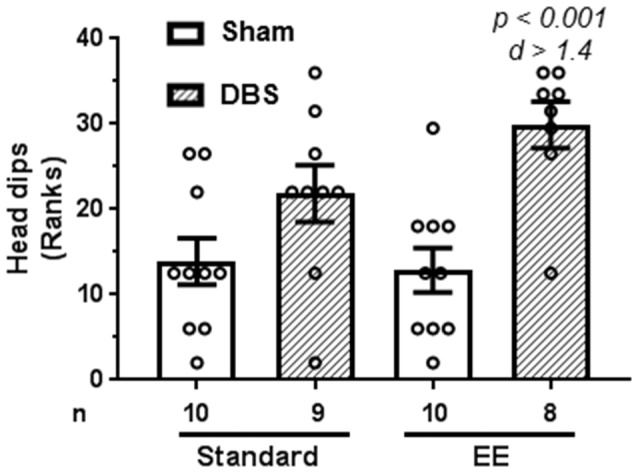
Deep brain stimulation (DBS) is a widely used treatment for neurodegenerative disorders like Parkinson's disease. Recently, several studies have used preclinical animal models to suggest that DBS has a potential to improve emotional symptoms in mental disorders such as treatment-resistant depression and post-traumatic stress disorder. An important difference between neurodegenerative and emotional disorders is the crucial role of environment in the ontogeny of the latter. Thus, it is important to understand the effects of DBS in the context of environmental variation. In this study, we show that DBS of ventromedial prefrontal cortex reduces anxiety in rats when it is coupled with simultaneous exposure to an enriched environment (EE). In contrast, effects of DBS on anxiety-like behaviors remained equivocal when animals were housed in standard laboratory conditions. These results suggest that the ability of DBS to treat anxiety and related phenotypes can be significantly enhanced by EE opportunities.
深部脑刺激(DBS)是一种广泛用于治疗帕金森病等神经退行性疾病的方法。最近,几项研究利用临床前动物模型表明,DBS有改善难治性抑郁症和创伤后应激障碍等精神障碍中情绪症状的潜力。神经退行性疾病和情绪障碍之间的一个重要区别是环境在后者发生过程中的关键作用。因此,了解DBS在环境变化背景下的影响很重要。在本研究中,我们表明,当腹内侧前额叶皮层的DBS与同时暴露于丰富环境(EE)相结合时,可降低大鼠的焦虑。相比之下,当动物饲养在标准实验室条件下时,DBS对焦虑样行为的影响仍不明确。这些结果表明,EE机会可显著增强DBS治疗焦虑和相关表型的能力。