Department of Paediatrics, "Sapienza" University of Rome, Viale Regina Elena 324, 00161, Rome, Italy.
Department of Experimental Medicine, "Sapienza" University of Rome, Rome, Italy.
J Cancer Res Clin Oncol. 2019 Jan;145(1):137-152. doi: 10.1007/s00432-018-2774-6. Epub 2018 Oct 24.
PARP inhibitors (PARPi) are used in a wide range of human solid tumours but a limited evidence is reported in rhabdomyosarcoma (RMS), the most frequent childhood soft-tissue sarcoma. The cellular and molecular effects of Olaparib, a specific PARP1/2 inhibitor, and AZD2461, a newly synthesized PARP1/2/3 inhibitor, were assessed in alveolar and embryonal RMS cells both as single-agent and in combination with ionizing radiation (IR).
Cell viability was monitored by trypan blue exclusion dye assays. Cell cycle progression and apoptosis were measured by flow cytometry, and alterations of specific molecular markers were investigated by, Real Time PCR, Western blotting and immunofluorescence experiments. Irradiations were carried out at a dose rate of 2 Gy (190 UM/min) or 4 Gy (380 UM/min). Radiosensitivity was assessed by using clonogenic assays.
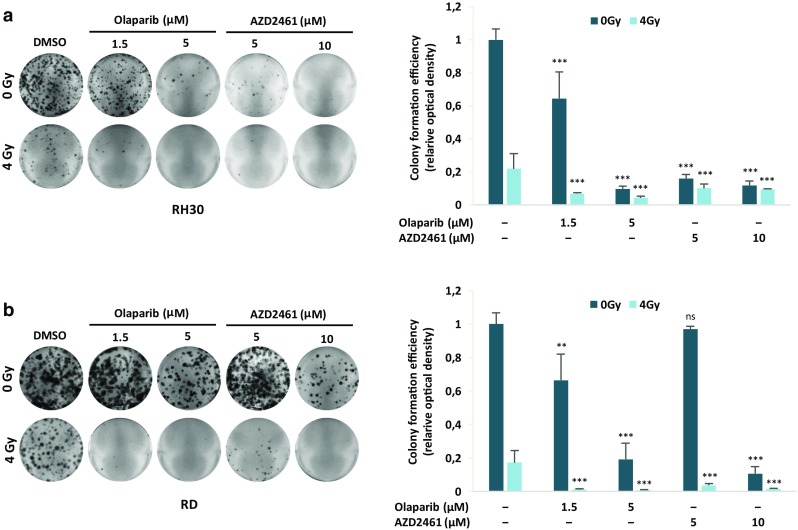
Olaparib and AZD2461 dose-dependently reduced growth of both RH30 and RD cells by arresting growth at G2/M phase and by modulating the expression, activation and subcellular localization of specific cell cycle regulators. Downregulation of phospho-AKT levels and accumulation of γH2AX, a specific marker of DNA damage, were significantly and persistently induced by Olaparib and AZD2461 exposure, this leading to apoptosis-related cell death. Both PARPi significantly enhanced the effects of IR by accumulating DNA damage, increasing G2 arrest and drastically reducing the clonogenic capacity of RMS-cotreated cells.
This study suggests that the combined exposure to PARPi and IR might display a role in the treatment of RMS tumours compared with single-agent exposure, since stronger cytotoxic effects are induced, and compensatory survival mechanisms are prevented.
聚腺苷二磷酸核糖聚合酶(PARP)抑制剂(PARPi)在广泛的人类实体肿瘤中得到应用,但在横纹肌肉瘤(RMS)中报道的证据有限,RMS 是最常见的儿童软组织肉瘤。评估奥拉帕利(一种特异性 PARP1/2 抑制剂)和 AZD2461(一种新合成的 PARP1/2/3 抑制剂)在肺泡和胚胎 RMS 细胞中的细胞和分子作用,无论是单独使用还是与电离辐射(IR)联合使用。
通过台盼蓝排斥染料测定法监测细胞活力。通过流式细胞术测量细胞周期进程和细胞凋亡,并通过实时 PCR、Western blot 和免疫荧光实验研究特定分子标记的变化。照射在剂量率为 2 Gy(190 UM/min)或 4 Gy(380 UM/min)下进行。通过集落形成实验评估放射敏感性。
奥拉帕利和 AZD2461 剂量依赖性地降低了 RH30 和 RD 细胞的生长,通过将生长阻滞在 G2/M 期并调节特定细胞周期调节剂的表达、激活和亚细胞定位来实现。磷酸化 AKT 水平的下调和γH2AX 的积累,这是 DNA 损伤的特异性标志物,奥拉帕利和 AZD2461 暴露后显著且持续地诱导,导致与凋亡相关的细胞死亡。两种 PARPi 都通过积累 DNA 损伤、增加 G2 期阻滞和极大地降低 RMS 共处理细胞的集落形成能力,显著增强了 IR 的作用。
这项研究表明,与单独使用 PARPi 相比,PARPi 和 IR 的联合暴露可能在 RMS 肿瘤的治疗中发挥作用,因为诱导更强的细胞毒性作用,并防止代偿性生存机制。