Center for Targeted Drug Delivery, Department of Biomedical and Pharmaceutical Sciences, Chapman University School of Pharmacy, Harry and Diane Rinker Health Science Campus, Irvine, CA 92618, USA.
Department of Pharmacy Practice, Chapman University School of Pharmacy, Harry and Diane Rinker Health Science Campus, Irvine, CA 92618, USA.
Molecules. 2018 Oct 22;23(10):2722. doi: 10.3390/molecules23102722.
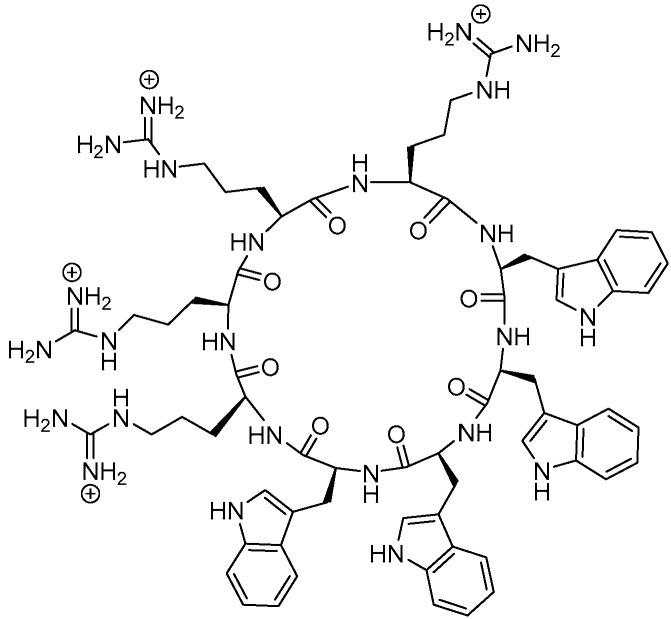
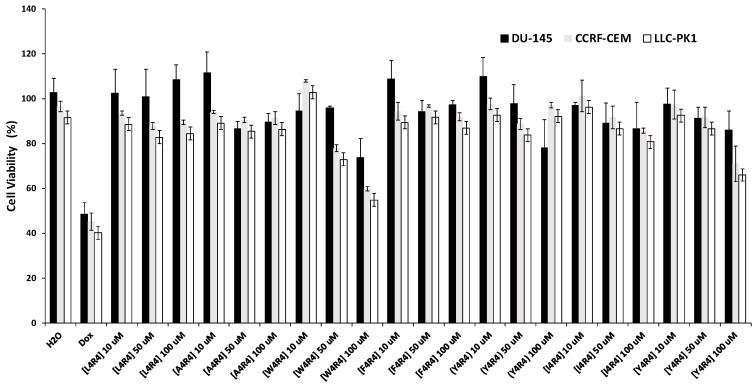
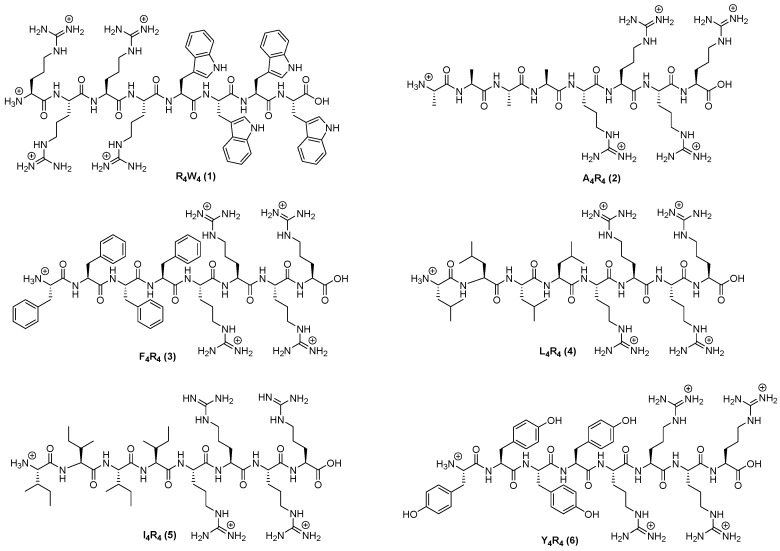
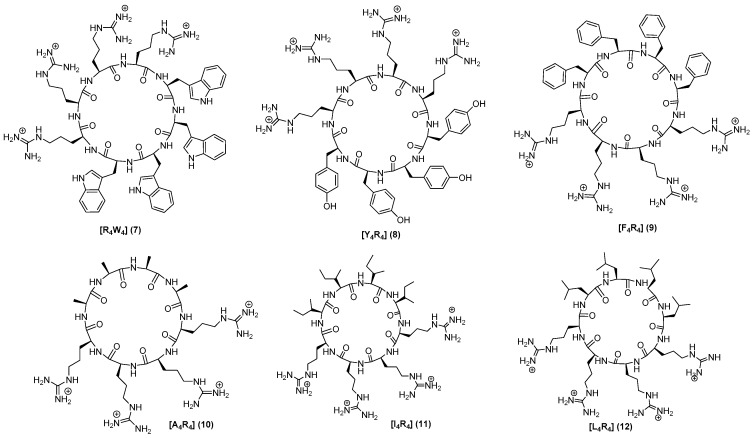
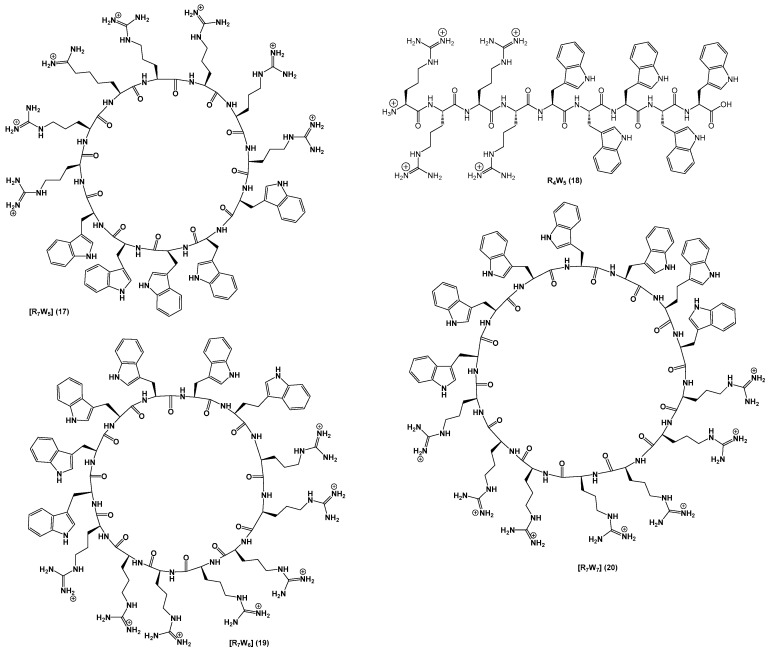
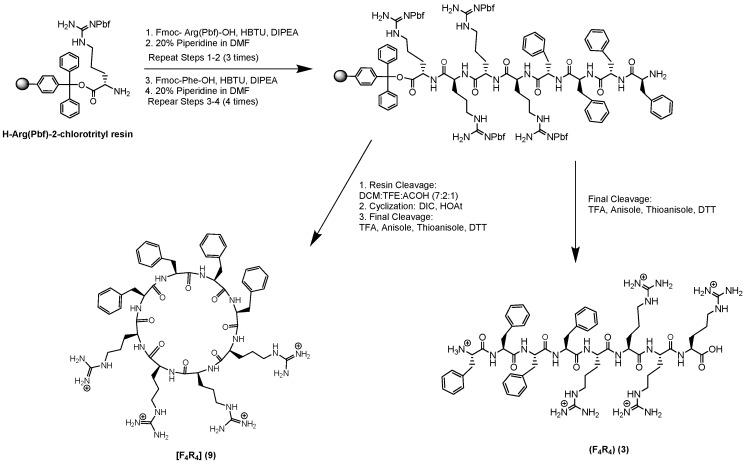
Antimicrobial peptides (AMPs) contain amphipathic structures and are derived from natural resources. AMPs have been found to be effective in treating the infections caused by antibiotic-resistant bacteria (ARB), and thus, are potential lead compounds against ARB. AMPs' physicochemical properties, such as cationic nature, amphiphilicity, and their size, will provide the opportunity to interact with membrane bilayers leading to damage and death of microorganisms. Herein, AMP analogs of [R₄W₄] were designed and synthesized by changing the hydrophobicity and cationic nature of the lead compound with other amino acids to provide insights into a structure-activity relationship against selected model Gram-negative and Gram-positive pathogens. Clinical resistant strains of methicillin-resistant (MRSA) and () were used in the studies. Our results provided information about the structural requirements for optimal activity of the [R₄W₄] template. When tryptophan was replaced with other hydrophobic amino acids, such as phenylalanine, tyrosine, alanine, leucine, and isoleucine, the antibacterial activities were significantly reduced with MIC values of >128 µg/mL. Furthermore, a change in stereochemistry caused by d-arginine, and use of -methyltryptophan, resulted in a two-fold reduction of antibacterial activity. It was found that the presence of tryptophan is critical for antibacterial activity, and could not be substituted with other hydrophobic residues. The study also confirmed that cyclic peptides generally showed higher antibacterial activities when compared with the corresponding linear counterparts. Furthermore, by changing tryptophan numbers in the compound while maintaining a constant number of arginine, we determined the optimal number of tryptophan residues to be four, as shown when the number of tryptophan residues increased, a decrease in activity was observed.
抗菌肽(AMPs)含有两亲性结构,源自天然资源。已发现 AMP 可有效治疗由抗生素耐药菌(ARB)引起的感染,因此是对抗 ARB 的潜在先导化合物。AMPs 的物理化学性质,如阳离子性质、两亲性和大小,将为其与膜双层相互作用提供机会,导致微生物损伤和死亡。在此,通过用其他氨基酸改变先导化合物的疏水性和阳离子性质,设计并合成了 [R₄W₄] 的 AMP 类似物,以深入了解针对选定的革兰氏阴性和革兰氏阳性模式病原体的结构-活性关系。研究中使用了耐甲氧西林金黄色葡萄球菌(MRSA)和 ()的临床耐药菌株。我们的结果提供了有关 [R₄W₄] 模板最佳活性的结构要求的信息。当色氨酸被其他疏水性氨基酸如苯丙氨酸、酪氨酸、丙氨酸、亮氨酸和异亮氨酸取代时,抗菌活性显著降低,MIC 值>128 µg/mL。此外,由于 d-精氨酸引起的立体化学变化和使用 -甲基色氨酸,抗菌活性降低了两倍。研究发现,色氨酸的存在对于抗菌活性至关重要,不能被其他疏水性残基取代。该研究还证实,与相应的线性对应物相比,环状肽通常显示出更高的抗菌活性。此外,通过在保持精氨酸数量不变的情况下改变化合物中的色氨酸数量,我们确定了四个色氨酸残基是最佳数量,因为当色氨酸残基数量增加时,活性会降低。