Sczepanski Matthew, Bozyk Paul
Beaumont Health-Royal Oak, 3601 W. 13 Mile Rd., Royal Oak, MI 48073, USA.
Crit Care Res Pract. 2018 Sep 27;2018:9360918. doi: 10.1155/2018/9360918. eCollection 2018.
Tissue plasminogen activator (tPA) is commonly used in ischemic cerebral vascular accidents (CVAs). tPA is generally well tolerated; however, orolingual angioedema is a well-documented adverse effect. Angioedema is generally mild, transient, and unilateral but can manifest as severe, life-threatening upper airway obstruction requiring intubation. Reported incidence for all severities ranges from one to five percent, whereas reported incidence of severe cases ranges from 0.18 to 1 percent of patients receiving tPA for ischemic CVA. Angiotensin-converting enzyme (ACE) inhibitors and middle cerebral artery distribution have been associated with a higher risk of developing angioedema. The aim of this study is to evaluate the incidence of severe tPA-induced angioedema and its effects on length of stay (LOS) and death.
A retrospective chart review of patients receiving tPA for ischemic CVA from January 2014 through December 2016 was conducted at a large tertiary center with Comprehensive Stroke Center designation. Subjects were eighteen or older. Baseline demographics and clinical data were collected.
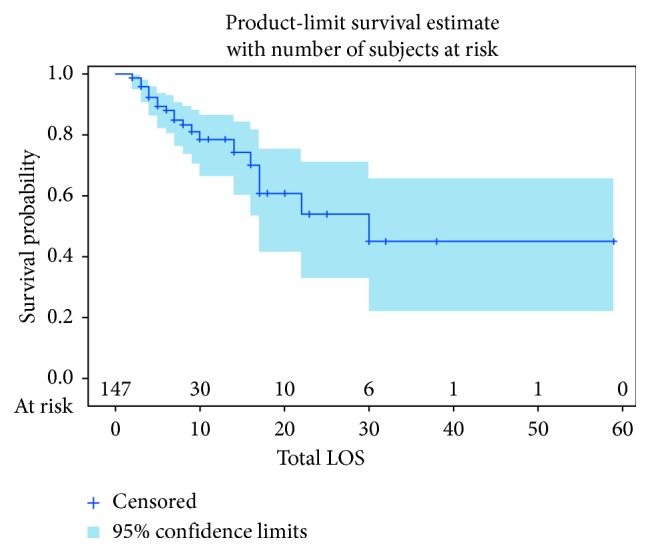
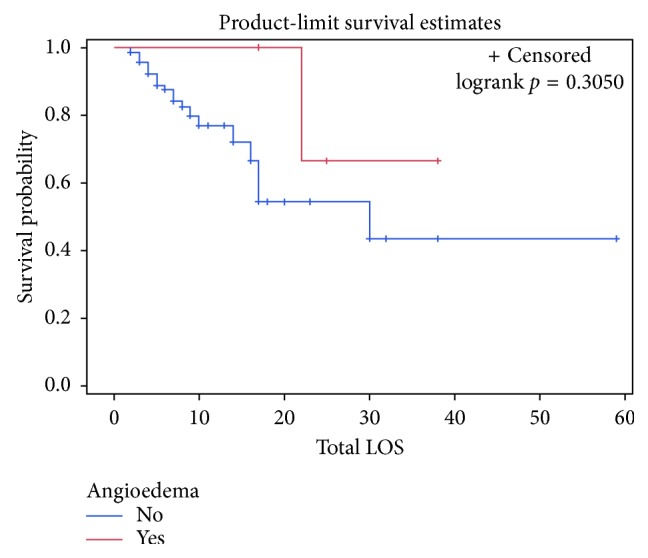
147 patients were included with four developing severe angioedema due to tPA resulting in an incidence of 2.72%. All four were female. The median LOS was thirty days for patients with angioedema and twelve days for those without. The survival probability was higher in the angioedema group and mean time to death was twenty-two days in the angioedema group and twenty-one days in the nonangioedema group. Twenty-five patients died, one from the angioedema group. ACE inhibitor use was found to have an OR of 7.72.
This study found a higher incidence of severe angioedema than that reported. Development of severe angioedema increased length of stay but was not shown to worsen outcomes in regards to death. Consistent with previous studies, ACE inhibitor use was associated with a higher risk of developing angioedema.
组织型纤溶酶原激活剂(tPA)常用于缺血性脑血管意外(CVA)。tPA一般耐受性良好;然而,口咽血管性水肿是一种有充分文献记载的不良反应。血管性水肿通常为轻度、短暂且单侧性,但可表现为严重的、危及生命的上呼吸道梗阻,需要进行插管。所有严重程度的报告发生率为1%至5%,而严重病例的报告发生率为接受tPA治疗缺血性CVA患者的0.18%至1%。血管紧张素转换酶(ACE)抑制剂和大脑中动脉分布与发生血管性水肿的较高风险相关。本研究的目的是评估严重tPA诱导的血管性水肿的发生率及其对住院时间(LOS)和死亡的影响。
在一家指定为综合卒中中心的大型三级中心,对2014年1月至2016年12月期间接受tPA治疗缺血性CVA的患者进行回顾性病历审查。受试者年龄在18岁及以上。收集基线人口统计学和临床数据。
纳入147例患者,4例因tPA发生严重血管性水肿,发生率为2.72%。所有4例均为女性。血管性水肿患者的中位住院时间为30天,无血管性水肿患者为12天。血管性水肿组的生存概率较高,血管性水肿组的平均死亡时间为22天,非血管性水肿组为21天。25例患者死亡,血管性水肿组1例。发现使用ACE抑制剂的比值比为7.72。
本研究发现严重血管性水肿的发生率高于报告值。严重血管性水肿的发生增加了住院时间,但未显示在死亡方面使预后恶化。与先前研究一致,使用ACE抑制剂与发生血管性水肿的较高风险相关。