Institut Agronomique néo-Calédonien (IAC), Equipes ARBOREAL and SOLVEG, BP 711, Mont-Dore 98810, New Caledonia.
Endemia, Plant Red List Authority, 7 rue Pierre Artigue, Nouméa 98800, New Caledonia.
Syst Biol. 2019 May 1;68(3):460-481. doi: 10.1093/sysbio/syy070.
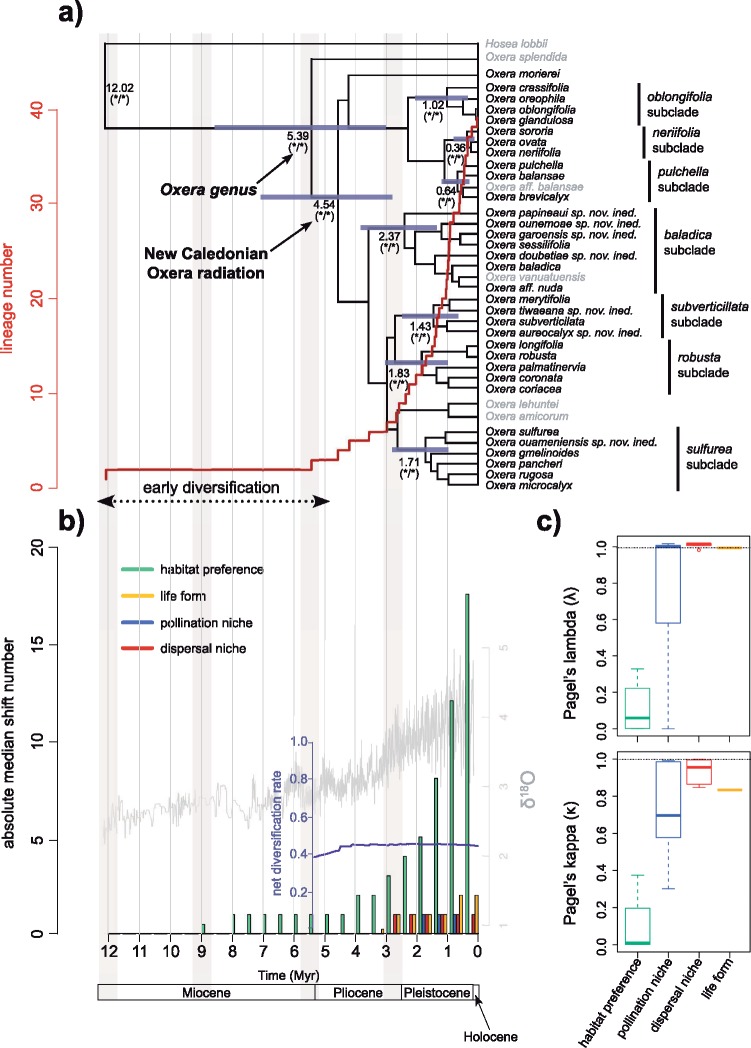
Phylogenies recurrently demonstrate that oceanic island systems have been home to rapid clade diversification and adaptive radiations. The existence of adaptive radiations posits a central role of natural selection causing ecological divergence and speciation, and some plant radiations have been highlighted as paradigmatic examples of such radiations. However, neutral processes may also drive speciation during clade radiations, with ecological divergence occurring following speciation. Here, we document an exceptionally rapid and unique radiation of Lamiaceae within the New Caledonian biodiversity hotspot. Specifically, we investigated various biological, ecological, and geographical drivers of species diversification within the genus Oxera. We found that Oxera underwent an initial process of rapid cladogenesis likely triggered by a dramatic period of aridity during the early Pliocene. This early diversification of Oxera was associated with an important phase of ecological diversification triggered by significant shifts of pollination syndromes, dispersal modes, and life forms. Finally, recent diversification of Oxera appears to have been further driven by the interplay of allopatry and habitat shifts likely related to climatic oscillations. This suggests that Oxera could be regarded as an adaptive radiation at an early evolutionary stage that has been obscured by more recent joint habitat diversification and neutral geographical processes. Diversification within Oxera has perhaps been triggered by varied ecological and biological drivers acting in a leapfrog pattern, but geographic processes may have been an equally important driver. We suspect that strictly adaptive radiations may be rare in plants and that most events of rapid clade diversification may have involved a mixture of geographical and ecological divergence.
系统发育分析反复表明,海洋岛屿系统一直是快速分支多样化和适应性辐射的家园。适应性辐射的存在假定自然选择在导致生态分歧和物种形成方面起着核心作用,一些植物辐射已被强调为这种辐射的典范例子。然而,中性过程也可能在分支辐射中驱动物种形成,生态分歧发生在物种形成之后。在这里,我们记录了新喀里多尼亚生物多样性热点地区唇形科植物一个极其迅速和独特的辐射。具体来说,我们研究了 Oxera 属内物种多样化的各种生物、生态和地理驱动因素。我们发现,Oxera 经历了一个快速的分支发生过程,可能是由上新世早期剧烈干旱期引发的。Oxera 的这种早期多样化与授粉综合征、传播模式和生活形式的重大转变引发的重要生态多样化阶段有关。最后,Oxera 的近期多样化似乎进一步受到异地和栖息地变化的相互作用的驱动,这可能与气候波动有关。这表明 Oxera 可以被视为一个早期进化阶段的适应性辐射,它已经被最近的共同栖息地多样化和中性地理过程所掩盖。Oxera 内部的多样化可能是由各种生态和生物学驱动因素以跳跃模式触发的,但地理过程可能也是一个同样重要的驱动因素。我们怀疑严格的适应性辐射在植物中可能很少见,大多数快速分支多样化事件可能涉及地理和生态分歧的混合。