Kim Sun-Jin, Kim Jong-Sung, Kim Sung-Soo, Jung Jin-Kyu, Yoon Seok-Joon, Lee Jung-Yoon, Kim Ji-Han
Department of Family Medicine, Research Institute for Medical Sciences, Chungnam National University School of Medicine, Daejeon, Korea.
Korean J Fam Med. 2018 Nov;39(6):333-339. doi: 10.4082/kjfm.17.0042. Epub 2018 Oct 29.
There is a distinction in alcohol consumption behavior between adults and college students. This study aims to verify the usability and the optimal cutoff point of Alcohol Use Disorders Identification Test-Korean revised version (AUDIT-KR) for screening alcohol use disorder in college students when the diagnostic and statistical manual of mental disorders (DSM), 5th edition diagnostic criteria is applied.
A total of 922 college students living in Daejeon were enrolled and divided into two groups based on how many items they corresponded to among DSM-5 alcohol use disorder diagnostic criteria: those who corresponded to ≥2 of the 11 items were classified into the patient group (107 males, 89 females) while the others into the control group (311 males, 415 females). The participants were evaluated using AUDIT-KR to find the optimal cutoff point for screening alcohol use disorder, sensitivity, and specificity.
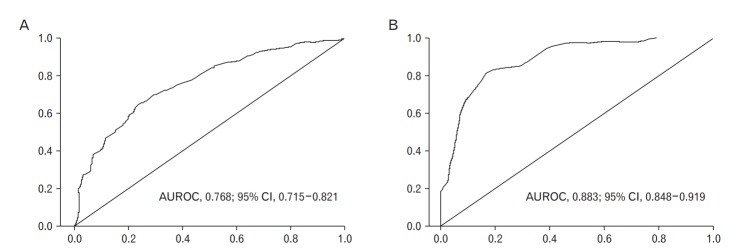
The mean±standard deviation scores in the AUDIT-KR were 12.76±7.27, 10.72±4.62 for males and females, respectively, in the patient group. In contrast, in the control group the scores were 6.26±5.23 and 3.95±3.59 in males and females, respectively. The area under the receiver operating characteristic curve (95% confidence interval) regarding alcohol use disorder screening by AUDIT-KR was 0.768 (0.715-0.821) and 0.883 (0.848-0.919) for males and females, respectively. The optimal cutoff point of alcohol use disorder for males was >9, sensitivity 64.49%, and specificity 76.85%. The optimal cutoff point for females was >6, sensitivity 82.02%, and specificity 80.48%.
This study suggested that AUDIT-KR can be used as a screening tool for alcohol use disorder in groups of college students when DSM-5 diagnosis criteria are applied.
成年人与大学生在饮酒行为方面存在差异。本研究旨在验证当应用《精神疾病诊断与统计手册》(DSM)第5版诊断标准时,韩国修订版酒精使用障碍识别测试(AUDIT-KR)在筛查大学生酒精使用障碍方面的可用性及最佳临界值。
共招募了922名居住在大田的大学生,并根据他们符合DSM-5酒精使用障碍诊断标准的项目数量分为两组:符合11项中≥2项的被归类为患者组(107名男性,89名女性),其余的为对照组(311名男性,415名女性)。使用AUDIT-KR对参与者进行评估,以确定筛查酒精使用障碍的最佳临界值、敏感性和特异性。
患者组中,男性和女性在AUDIT-KR中的平均±标准差得分分别为12.76±7.27、10.72±4.62。相比之下,对照组中男性和女性的得分分别为6.26±5.23和3.95±3.59。AUDIT-KR用于酒精使用障碍筛查的受试者工作特征曲线下面积(95%置信区间)男性为0.768(0.715 - 0.821),女性为0.883(0.848 - 0.919)。男性酒精使用障碍的最佳临界值>9,敏感性为64.49%,特异性为76.85%。女性的最佳临界值>6,敏感性为82.02%·,特异性为80.48%。
本研究表明,当应用DSM-5诊断标准时,AUDIT-KR可作为大学生群体酒精使用障碍的筛查工具。