Sommer Olaf, Aug Rosana L, Schmidt Andreas J, Heiser Philip, Schulz Eberhard, Vedder Helmut, Clement Hans-Willi
Department of Child and Adolescent Psychiatry, Psychotherapy, and Psychosomatics, Albert-Ludwigs-University Freiburg, Freiburg, Germany.
Department of Psychiatry and Psychotherapy, Philipps-University, Marburg, Germany.
Front Psychiatry. 2018 Oct 16;9:501. doi: 10.3389/fpsyt.2018.00501. eCollection 2018.
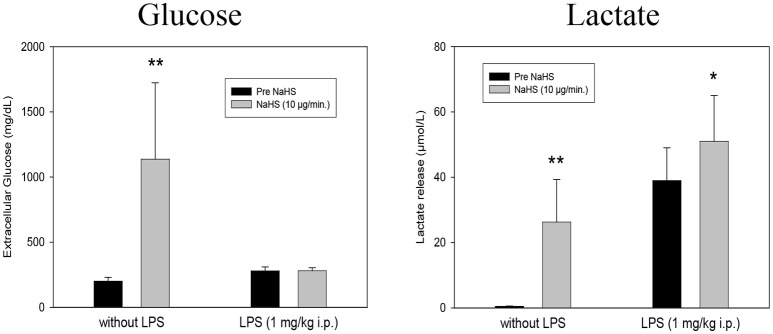
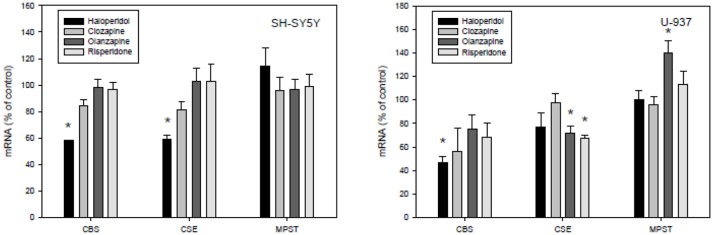
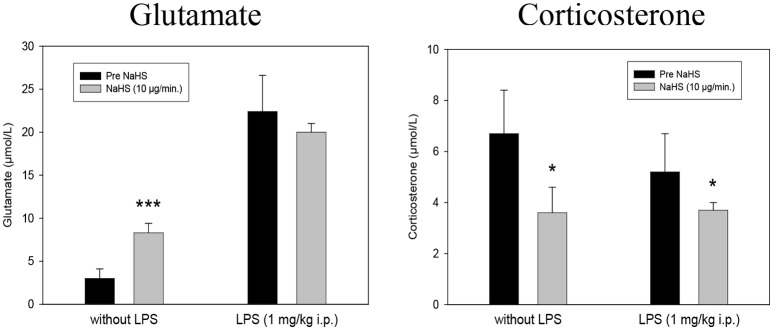
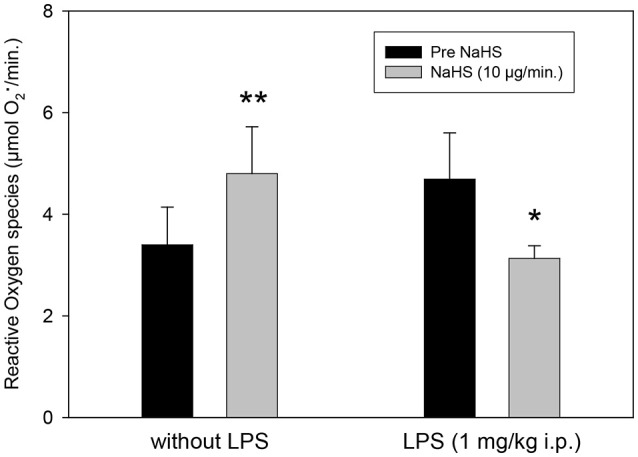
Psychiatric disorders, such as schizophrenia and other neuroinflammatory diseases are accompanied by an increase in the oxidative stress and changes in the immune system and in the metabolic, hormonal and neurological components of the central nervous system (CNS). Hydrogen sulfide (HS) is a gaseous molecule that is endogenously produced in the peripheral and central nervous system through cysteine by the following major HS producing enzymes in the brain: cystathionine-γlyase (CSE), cystathionine ß-synthase (CBS) and 3-mercaptopyruvate sulfurtransferase (MPST). The physiological effects of HS are broad, with antioxidative properties being a major role in the body. The aims of our investigation were to analyze the central nervous antioxidant, metabolic and neuronal effects in the hippocampus of the rat after inflammatory peripheral lipopolysaccharide (LPS) treatment; and to examine the effects of antipsychotics on the expression of these enzymes in human cell lines. Male Lewis rats (250 g) received an i.p. LPS injection (1 mg/kg) 24 h before microdialysis experiments. Conscious rats were infused via these probes (1.5 μl/min) with a radical scavenger 1-hydroxy-3-methoxycarbonyl-2,2,5,5-tetramethylpyrrolidine (CMH) in Krebs-Ringer solution. Sodiumhydrogensulfide (NaHS, 10 μg/min) was infused after a 2- h baseline for 1 h. Corticosterone, glutamate, glucose and lactate were measured by Elisa. Reactive oxygen species (ROS) were detected by electron spin resonance spectroscopy (ESR). The impact of the antipsychotics haloperidol, clozapine, olanzapine and risperidone on the expression of genes encoding the key enzymes of HS synthesis was studied at the human neuroblastoma SH-SY5Y and monocytic U-937 cell lines. The cells were incubated for 24 h with 30 μM antipsychotic following which mRNA levels were measured by polymerase chain reaction. Microdialysate glucose and lactate levels dramatically increased in the hippocampus of LPS untreated rats by local application of NaHS. By contrast, in the LPS pretreated rats, there was no effect of NaHS infusion on glucose but a further significant increase in microdialysate lactate was found. It was LPS pretreatment alone that particularly enhanced lactate levels. There was a marked increase in hippocampal microdialysate glutamate levels after local NaHS infusion in LPS untreated animals. In LPS treated rats, no change was observed by NaHS, but LPS itself had the strongest effect on microdialysate glutamate levels. Microdialysate corticosterone levels were reduced by NaHS in both LPS pretreated and untreated rats. The formation of free radicals in the hippocampus significantly reduced in LPS pretreated rats, while in LPS untreated rats a significant increase was observed after NaHS infusion. In human SH-SY5Y and U-937 cells, all three major enzymes of HS-Synthesis, namely cystathionine-γ-lyase, cystathione ß-synthase and 3-mercaptopyruvate sulfurtransferase, could be detected by PCR. The antipsychotics haloperidol, clozapine, olanzapine and risperidone affected all three enzymes in different ways; with haloperidol and risperidone showing major effects that led to reductions in CBS or CSE expression. The local application of NaHS in the hippocampus of the rat strongly affected glucose, lactate and glutamate release. Contrastingly, in LPS pretreated rats, a decreased radical formation was the only effect found. HS synthetizing enzymes may be involved in antipsychotic mechanisms, although no clear common mechanism could be found.
精神疾病,如精神分裂症和其他神经炎症性疾病,伴随着氧化应激的增加以及免疫系统、中枢神经系统(CNS)的代谢、激素和神经成分的变化。硫化氢(HS)是一种气态分子,通过大脑中以下主要的HS生成酶,由半胱氨酸在周围和中枢神经系统内源性产生:胱硫醚-γ-裂解酶(CSE)、胱硫醚β-合成酶(CBS)和3-巯基丙酮酸硫转移酶(MPST)。HS的生理作用广泛,抗氧化特性在体内起着主要作用。我们研究的目的是分析炎症性外周脂多糖(LPS)处理后大鼠海马体中的中枢神经抗氧化、代谢和神经元效应;并研究抗精神病药物对这些酶在人类细胞系中表达的影响。雄性Lewis大鼠(250 g)在微透析实验前24小时接受腹腔注射LPS(1 mg/kg)。清醒的大鼠通过这些探针(1.5 μl/分钟)在Krebs-Ringer溶液中注入自由基清除剂1-羟基-3-甲氧基羰基-2,2,5,5-四甲基吡咯烷(CMH)。在2小时基线期后,注入硫氢化钠(NaHS,10 μg/分钟),持续1小时。通过酶联免疫吸附测定法(ELISA)测量皮质酮、谷氨酸、葡萄糖和乳酸。通过电子自旋共振光谱(ESR)检测活性氧(ROS)。在人类神经母细胞瘤SH-SY5Y和单核细胞U-937细胞系中研究了抗精神病药物氟哌啶醇、氯氮平、奥氮平和利培酮对编码HS合成关键酶的基因表达的影响。细胞与30 μM抗精神病药物孵育24小时,然后通过聚合酶链反应测量mRNA水平。通过局部应用NaHS,未用LPS处理的大鼠海马体中的微透析葡萄糖和乳酸水平显著增加。相比之下,在预先用LPS处理的大鼠中,注入NaHS对葡萄糖没有影响,但微透析乳酸进一步显著增加。单独的LPS预处理尤其提高了乳酸水平。在未用LPS处理的动物中,局部注入NaHS后海马体微透析谷氨酸水平显著增加。在LPS处理的大鼠中,NaHS未观察到变化,但LPS本身对微透析谷氨酸水平有最强的影响。在预先用LPS处理和未处理的大鼠中,NaHS均降低了微透析皮质酮水平。预先用LPS处理的大鼠海马体中自由基的形成显著减少,而在未用LPS处理的大鼠中,注入NaHS后观察到显著增加。在人类SH-SY5Y和U-937细胞中,通过聚合酶链反应可以检测到HS合成的所有三种主要酶,即胱硫醚-γ-裂解酶、胱硫醚β-合成酶和3-巯基丙酮酸硫转移酶。抗精神病药物氟哌啶醇、氯氮平、奥氮平和利培酮以不同方式影响这三种酶;氟哌啶醇和利培酮显示出主要作用,导致CBS或CSE表达降低。在大鼠海马体中局部应用NaHS强烈影响葡萄糖、乳酸和谷氨酸的释放。相反,在预先用LPS处理的大鼠中,发现唯一的影响是自由基形成减少。HS合成酶可能参与抗精神病机制,尽管未发现明确共同机制。