Dr. Ishrat-ul-Ibad Khan Institute of Oral Health Sciences, Dow University of Health Sciences, Gulzar e Hijri, Karachi, Pakistan.
School of Public Health, Dow University of Health Sciences, Gulzar e Hijri, Karachi, Pakistan.
PLoS One. 2018 Nov 2;13(11):e0206919. doi: 10.1371/journal.pone.0206919. eCollection 2018.
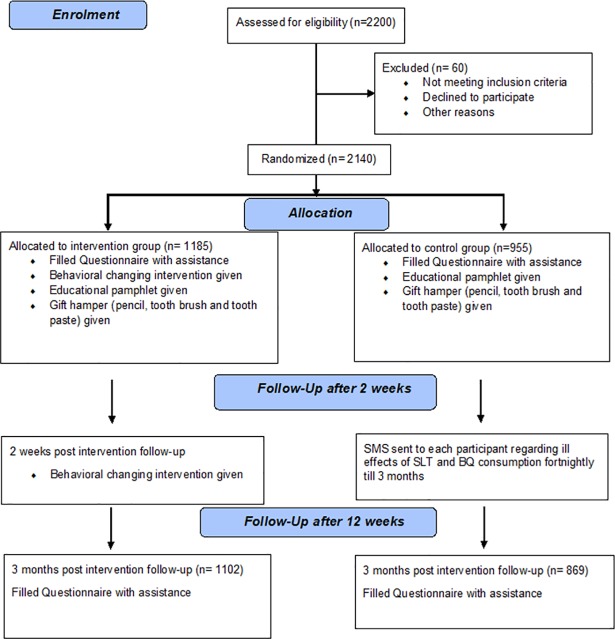
There have been recent surges in the use of smokeless tobacco (SLT) and betel quid (BQ) chew among adolescents in South East Asian countries, with an increase, on average, of 7% to 15% between 2004 and 2013, necessitating interventional investigations to modify this behavior. The current intervention was aimed towards changing adolescents' perceptions regarding the harmful effects of SLT and BQ use and encouraging them to quit. This randomized control trial involved 2140 adolescents from 26 private and public-sector schools in Karachi, Pakistan. After randomization, 1185 individuals were placed in the intervention group and administered a behavior changing intervention (BCI), while 955 individuals constituted the control group. A generalized estimating equation was employed to measure differences in repeated measures for both groups. The beta coefficients were reported after adjusting the covariates with the 95% confidence interval, and the p-value was considered significant at <0.050. Cohen's d was employed to report the effect size of the intervention. The BCI resulted in a 0.176-unit (95% CI 0.078-0.274, p-value <0.001) increase in knowledge scores regarding the health hazards of SLT and BQ, a 0.141-unit (95% CI 0.090-0.192, p-value <0.001) increase in use perception scores, and a 0.067-unit (95% CI 0.006-0.129, p-value 0.031) increase in quit perception scores in the intervention group compared with those in the control group. A knowledge related module (p-value 0.024) and quit preparation module (p-value 0.005) were found to be helpful by adolescents in either changing their perceptions regarding SLT and/or BQ chew use or in quitting. The role of BCI is promising in improving adolescents' knowledge and changing their perceptions in a positive manner regarding their harmful SLT and BQ use. Convincing results may be achieved if interventions are tailored, with an emphasis on the identification of the products that are used by adolescents in addition to highlighting their ill effects and how students may manage to quit them. If included in the schools' curricula, this BCI method may help in developing schools that are free of SLT and BQ use. Trial registration: ClinicalTrials.gov NCT03488095.
最近,东南亚国家青少年使用无烟烟草(SLT)和槟榔咀嚼物(BQ)的情况有所增加,2004 年至 2013 年间,平均增长了 7%至 15%,因此需要进行干预性调查以改变这种行为。目前的干预措施旨在改变青少年对 SLT 和 BQ 使用危害的认识,并鼓励他们戒烟。这项随机对照试验涉及巴基斯坦卡拉奇的 26 所私立和公立学校的 2140 名青少年。随机分组后,1185 人被纳入干预组,接受行为改变干预(BCI),955 人构成对照组。采用广义估计方程测量两组重复测量的差异。调整协变量后,报告β系数及其 95%置信区间,p 值<0.050 时认为差异有统计学意义。采用 Cohen's d 报告干预的效果大小。BCI 使 SLT 和 BQ 健康危害知识得分增加了 0.176 个单位(95%CI:0.078-0.274,p<0.001),使用感知得分增加了 0.141 个单位(95%CI:0.090-0.192,p<0.001),戒烟感知得分增加了 0.067 个单位(95%CI:0.006-0.129,p=0.031)。与对照组相比,干预组青少年对 SLT 和 BQ 咀嚼物使用的认识得分更高(p=0.024),戒烟准备得分更高(p=0.005)。青少年认为知识相关模块(p=0.024)和戒烟准备模块(p=0.005)有助于改变他们对 SLT 和/或 BQ 咀嚼物使用的认识或帮助他们戒烟。BCI 在提高青少年的知识水平和以积极的方式改变他们对 SLT 和 BQ 有害使用的认识方面具有广阔的前景。如果干预措施能够针对青少年使用的产品进行调整,并强调这些产品的危害以及学生如何能够戒烟,那么可能会取得令人信服的结果。如果将这种 BCI 方法纳入学校课程,可能有助于建立一个没有 SLT 和 BQ 使用的学校环境。试验注册:ClinicalTrials.gov NCT03488095。