Department of Biomedical Engineering, Rutgers University, Piscataway, NJ, United States.
Department of Chemical and Biochemical Engineering, Rutgers University, Piscataway, NJ, United States.
Sci Rep. 2018 Nov 2;8(1):16289. doi: 10.1038/s41598-018-34511-7.
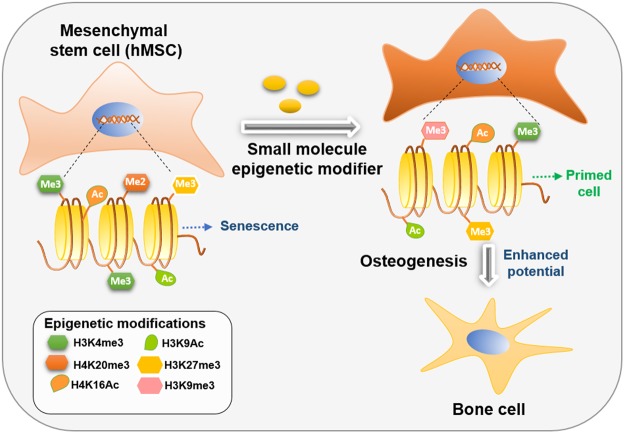
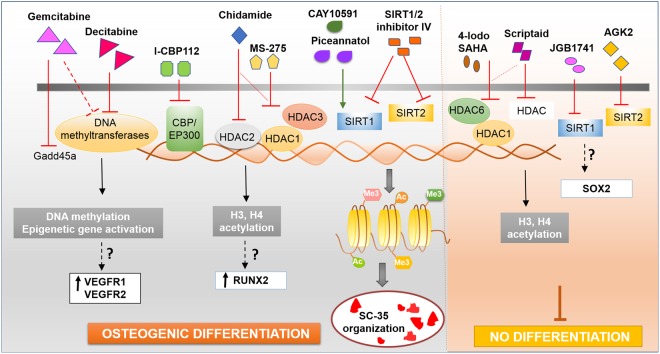
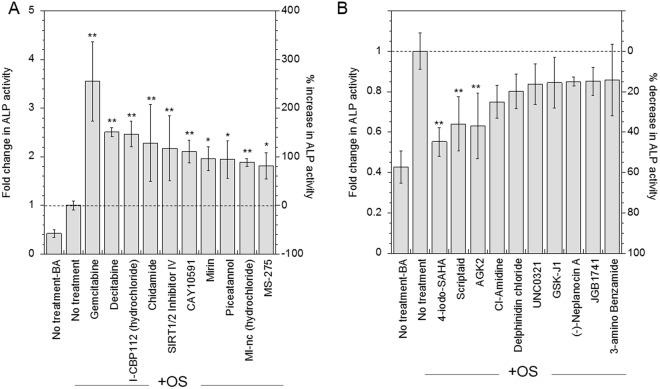
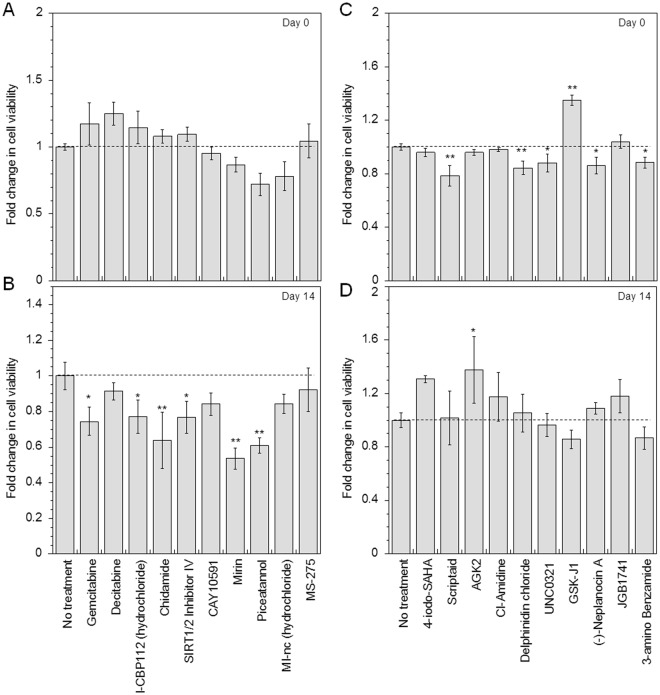
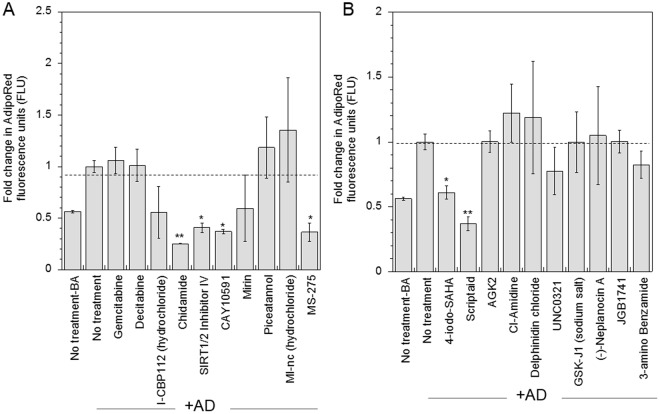
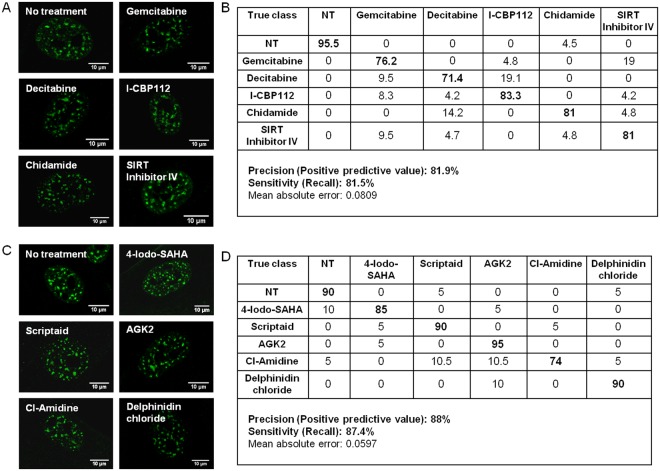
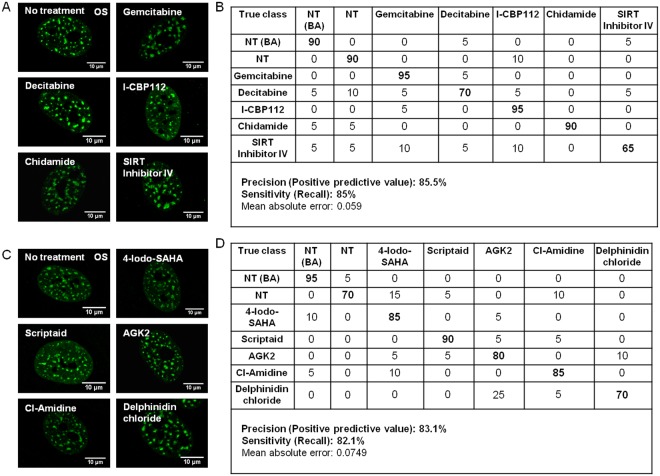
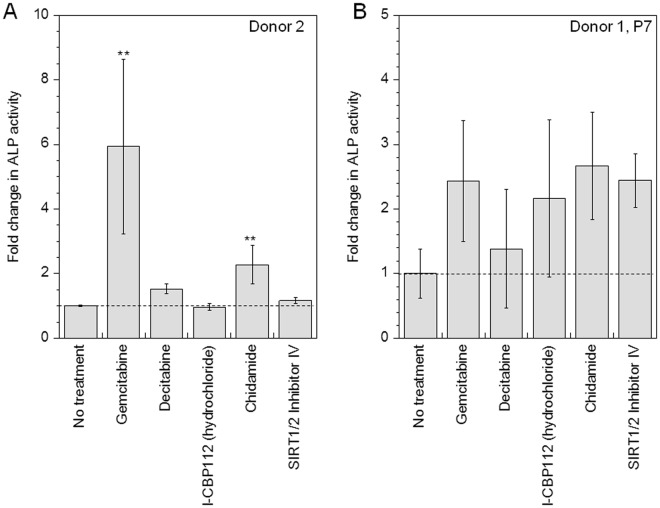
Stem cells are considered as a multipotent regenerative source for diseased and dysfunctional tissues. Despite the promise of stem cells, the inherent capacity of stem cells to convert to tissue-specific lineages can present a major challenge to the use of stem cells for regenerative medicine. We hypothesized that epigenetic regulating molecules can modulate the stem cell's developmental program, and thus potentially overcome the limited lineage differentiation that human stem cells exhibit based on the source and processing of stem cells. In this study, we screened a library of 84 small molecule pharmacological agents indicated in nucleosomal modification and identified a sub-set of specific molecules that influenced osteogenesis in human mesenchymal stem cells (hMSCs) while maintaining cell viability in-vitro. Pre-treatment with five candidate hits, Gemcitabine, Decitabine, I-CBP112, Chidamide, and SIRT1/2 inhibitor IV, maximally enhanced osteogenesis in-vitro. In contrast, five distinct molecules, 4-Iodo-SAHA, Scriptaid, AGK2, CI-amidine and Delphidine Chloride maximally inhibited osteogenesis. We then tested the role of these molecules on hMSCs derived from aged human donors and report that small epigenetic molecules, namely Gemcitabine and Chidamide, can significantly promote osteogenic differentiation by 5.9- and 2.3-fold, respectively. Taken together, this study demonstrates new applications of identified small molecule drugs for sensitively regulating the lineage plasticity fates of bone-marrow derived mesenchymal stem cells through modulating the epigenetic profile of the cells.
干细胞被认为是病变和功能失调组织的多能再生来源。尽管干细胞有很大的应用前景,但干细胞转化为组织特异性谱系的固有能力,给基于干细胞来源和处理的再生医学应用带来了重大挑战。我们假设,表观遗传调节分子可以调节干细胞的发育程序,从而有可能克服人干细胞表现出的有限谱系分化。在这项研究中,我们筛选了 84 种指示核小体修饰的小分子药理学药物文库,并确定了一小部分特定分子,它们在体外保持细胞活力的同时,影响人间充质干细胞(hMSC)的成骨作用。用 5 种候选物预处理,吉西他滨、地西他滨、I-CBP112、西达本胺和 SIRT1/2 抑制剂 IV,最大限度地增强了体外成骨作用。相比之下,5 种不同的分子,4-碘-SAHA、Scriptaid、AGK2、CI-脒和 Delphidine Chloride 最大限度地抑制了成骨作用。然后,我们测试了这些分子在来源于老年供体的 hMSC 上的作用,并报告说,小的表观遗传分子,即吉西他滨和西达本胺,可分别显著增强成骨分化 5.9 倍和 2.3 倍。综上所述,这项研究证明了已识别的小分子药物的新应用,通过调节细胞的表观遗传特征,可灵敏调节骨髓间充质干细胞的谱系可塑性命运。