Centre for Epidemiology and Biostatistics, The University of Melbourne, Parkville, VIC, Australia.
Cancer Epidemiology and Intelligence Division, Cancer Council Victoria, Melbourne, VIC, Australia.
Breast Cancer Res. 2018 Nov 3;20(1):132. doi: 10.1186/s13058-018-1056-1.
The association between body mass index (BMI) and risk of breast cancer depends on time of life, but it is unknown whether this association depends on a woman's familial risk.
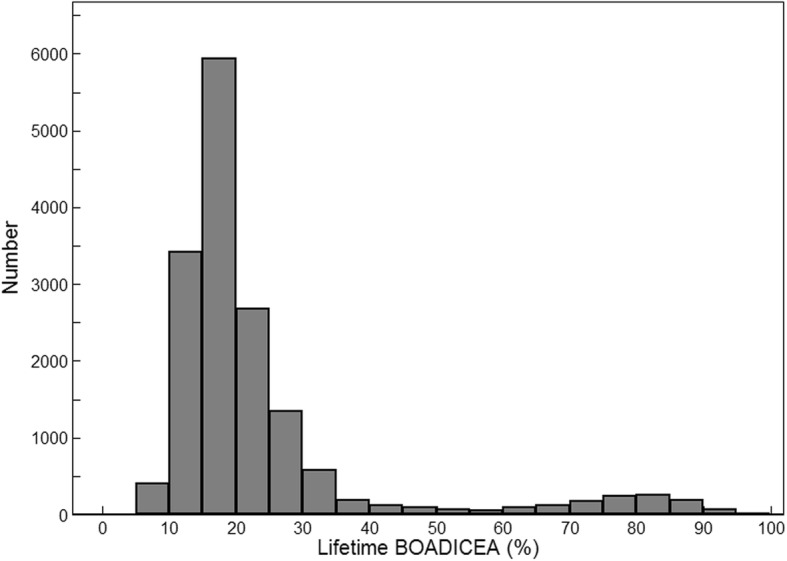
We conducted a prospective study of a cohort enriched for familial risk consisting of 16,035 women from 6701 families in the Breast Cancer Family Registry and the Kathleen Cunningham Foundation Consortium for Research into Familial Breast Cancer followed for up to 20 years (mean 10.5 years). There were 896 incident breast cancers (mean age at diagnosis 55.7 years). We used Cox regression to model BMI risk associations as a function of menopausal status, age, and underlying familial risk based on pedigree data using the Breast and Ovarian Analysis of Disease Incidence and Carrier Estimation Algorithm (BOADICEA), all measured at baseline.
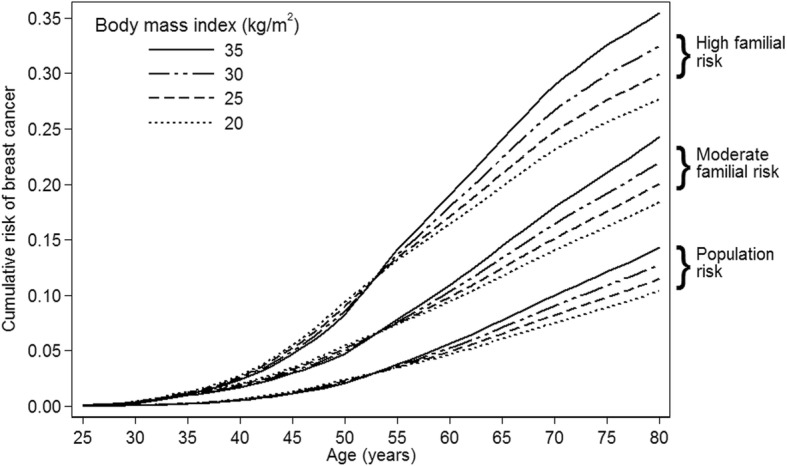
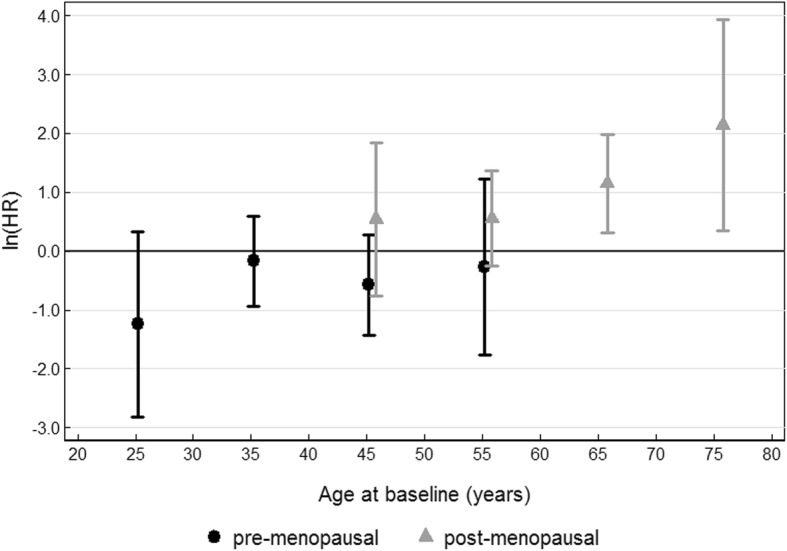
The strength and direction of the BMI risk association depended on baseline menopausal status (P < 0.001); after adjusting for menopausal status, the association did not depend on age at baseline (P = 0.6). In terms of absolute risk, the negative association with BMI for premenopausal women has a much smaller influence than the positive association with BMI for postmenopausal women. Women at higher familial risk have a much larger difference in absolute risk depending on their BMI than women at lower familial risk.
The greater a woman's familial risk, the greater the influence of BMI on her absolute postmenopausal breast cancer risk. Given that age-adjusted BMI is correlated across adulthood, maintaining a healthy weight throughout adult life is particularly important for women with a family history of breast cancer.
体重指数(BMI)与乳腺癌风险之间的关联取决于生命的时间,但尚不清楚这种关联是否取决于女性的家族风险。
我们对一个家族风险丰富的队列进行了前瞻性研究,该队列由来自乳腺癌家族登记处和凯瑟琳·坎宁安基金会家族性乳腺癌研究联盟的 6701 个家庭的 16035 名女性组成,随访时间长达 20 年(平均随访 10.5 年)。共有 896 例乳腺癌(诊断时的平均年龄为 55.7 岁)。我们使用 Cox 回归模型,根据家族谱数据,使用乳腺癌和卵巢疾病发病和携带者估计算法(BOADICEA),将 BMI 风险关联作为绝经状态、年龄和潜在家族风险的函数进行建模,所有这些都是在基线时测量的。
BMI 风险关联的强度和方向取决于基线时的绝经状态(P<0.001);在调整了绝经状态后,该关联与基线时的年龄无关(P=0.6)。就绝对风险而言,BMI 与绝经前女性的负相关比 BMI 与绝经后女性的正相关的影响要小得多。家族风险较高的女性,其 BMI 对绝对绝经后乳腺癌风险的影响要比家族风险较低的女性大得多。
女性的家族风险越高,BMI 对其绝经后乳腺癌绝对风险的影响就越大。鉴于年龄调整后的 BMI 在成年期是相关的,因此对于有乳腺癌家族史的女性来说,在整个成年期保持健康的体重尤为重要。