• 文献检索
  • 文档翻译
  • 深度研究
  • 学术资讯
  • Suppr Zotero 插件Zotero 插件
  • 邀请有礼
  • 套餐&价格
  • 历史记录
应用&插件
Suppr Zotero 插件Zotero 插件浏览器插件Mac 客户端Windows 客户端微信小程序
定价
高级版会员购买积分包购买API积分包
服务
文献检索文档翻译深度研究API 文档MCP 服务
关于我们
关于 Suppr公司介绍联系我们用户协议隐私条款
关注我们

Suppr 超能文献

核心技术专利:CN118964589B侵权必究
粤ICP备2023148730 号-1Suppr @ 2026

文献检索

告别复杂PubMed语法,用中文像聊天一样搜索,搜遍4000万医学文献。AI智能推荐,让科研检索更轻松。

立即免费搜索

文件翻译

保留排版,准确专业,支持PDF/Word/PPT等文件格式,支持 12+语言互译。

免费翻译文档

深度研究

AI帮你快速写综述,25分钟生成高质量综述,智能提取关键信息,辅助科研写作。

立即免费体验

基于倒立摆模型的稳定性指标比较,用于评估斜坡行走。

A comparison of stability metrics based on inverted pendulum models for assessment of ramp walking.

机构信息

Department of Bioengineering, The University of Texas at Dallas, Richardson, Texas, United States of America.

Department of Mechanical Engineering, Colorado School of Mines, Golden, Colorado, United States of America.

出版信息

PLoS One. 2018 Nov 5;13(11):e0206875. doi: 10.1371/journal.pone.0206875. eCollection 2018.

DOI:10.1371/journal.pone.0206875
PMID:30395597
原文链接:https://pmc.ncbi.nlm.nih.gov/articles/PMC6218075/
Abstract

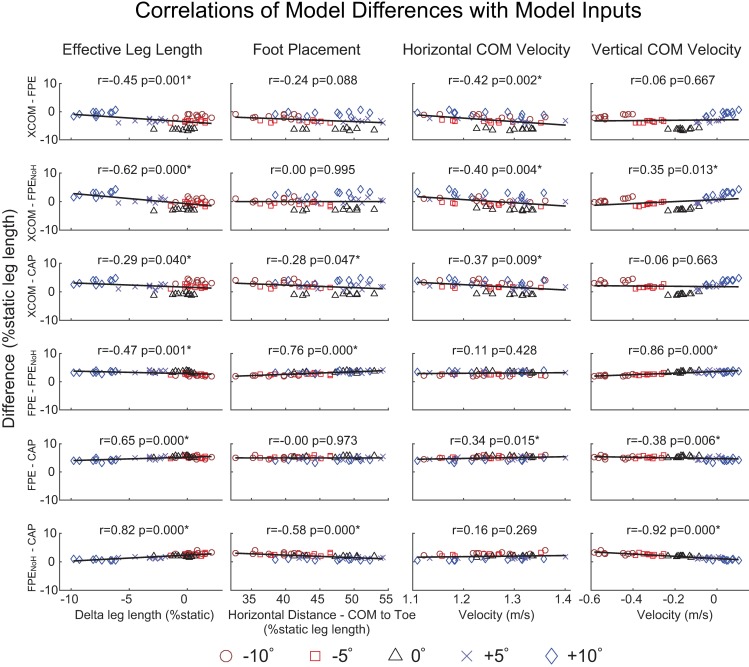
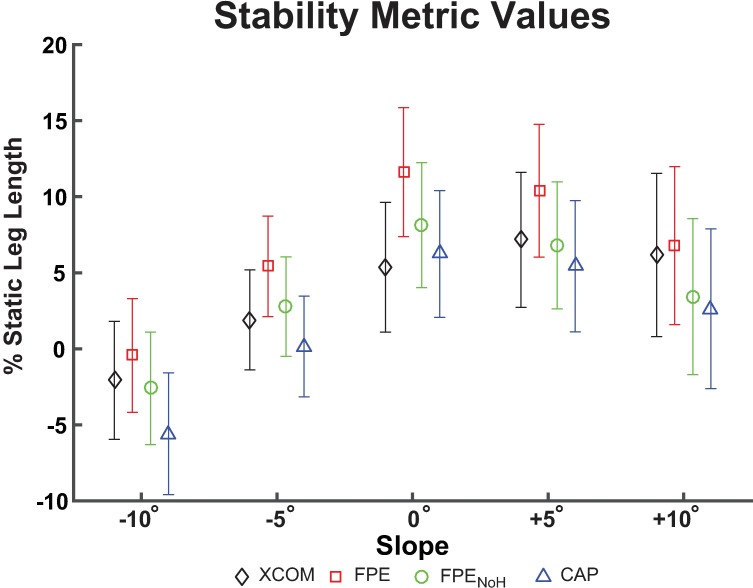
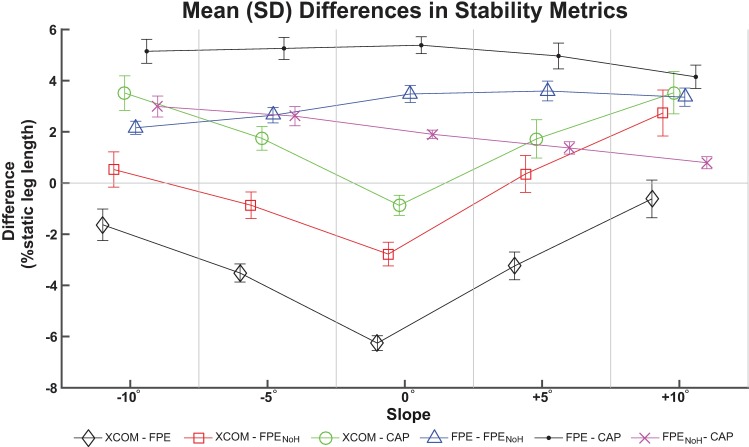
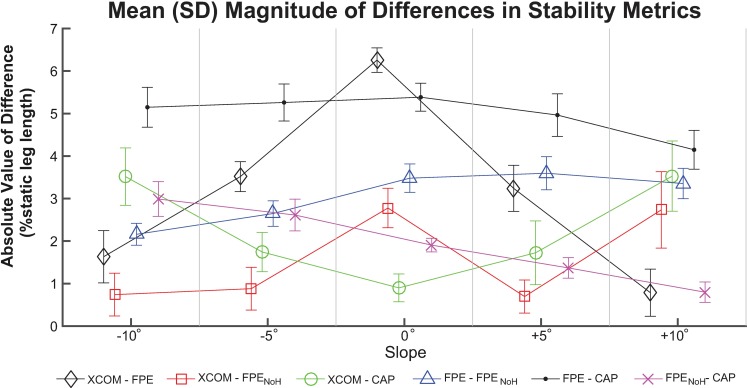
Maintaining balance on ramps is important for mobility. However, balance is commonly assessed using inverted pendulum-based metrics (e.g., margin of stability), which may not be appropriate for assessment of human walking on non-level surfaces. To investigate this, we analyzed stability on ramps using four different inverted pendulum models: extrapolated center of mass (XCOM), foot placement estimate (FPE), foot placement estimate neglecting angular momentum (FPENoH), and capture point (CAP). We analyzed experimental data from 10 able-bodied individuals walking on a ramp at 0°, ±5°, and ±10°. Contrary to our hypothesis that the magnitude of differences between metrics would be greatest at ±10°, we observed the greatest magnitude of differences between metrics at 0°. In general, the stability metrics were bounded by FPE and CAP at each slope, consistent with prior studies of level walking. Our results also suggest that clinical providers and researchers should be aware that assessments that neglect angular momentum (e.g., margin of stability, XCOM) may underestimate stability in the sagittal-plane in comparison to analyses which incorporate angular momentum (e.g., FPE). Except for FPENoH-CAP (r = 0.82), differences between metrics were only moderately correlated (|r|≤0.65) with violations of leg length assumptions in the underlying inverted pendulum models. The differences in FPENoH relative to FPE and CAP were strongly correlated with body center of mass vertical velocity (max |r| = 0.92), suggesting that model representations of center of mass motion influence stability metrics. However, there was not a clear overall relationship between model inputs and differences in stability metrics. Future sensitivity analyses may provide additional insight into model characteristics that influence stability metrics.

摘要

在斜坡上保持平衡对于行动能力很重要。然而,平衡通常是通过基于倒立摆的指标(例如,稳定裕度)来评估的,而这些指标可能不适合评估人类在非水平表面上的行走。为了研究这个问题,我们使用了四个不同的倒立摆模型(外推质心(XCOM)、脚放置估计(FPE)、忽略角动量的脚放置估计(FPENoH)和捕获点(CAP))来分析斜坡上的稳定性。我们分析了 10 名健康个体在 0°、±5°和±10°的斜坡上行走的实验数据。与我们的假设相反,即指标之间的差异幅度在±10°时最大,我们在 0°时观察到了最大的差异幅度。一般来说,在每个坡度下,稳定性指标都被 FPE 和 CAP 所限制,这与之前对水平行走的研究一致。我们的结果还表明,临床医生和研究人员应该意识到,忽略角动量的评估(例如,稳定裕度、XCOM)可能会低估矢状面的稳定性,与纳入角动量的分析(例如,FPE)相比。除了 FPENoH-CAP(r = 0.82)之外,指标之间的差异仅与基础倒立摆模型中腿长假设的违反程度中度相关(|r|≤0.65)。与 FPE 和 CAP 相比,FPENoH 的差异与身体质心垂直速度高度相关(max |r| = 0.92),这表明质心运动的模型表示影响稳定性指标。然而,在模型输入和稳定性指标之间没有明显的整体关系。未来的敏感性分析可能会提供更多关于影响稳定性指标的模型特征的见解。
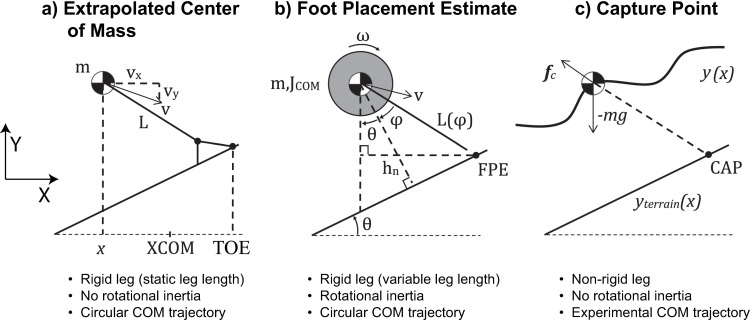
https://cdn.ncbi.nlm.nih.gov/pmc/blobs/6add/6218075/d2ef1f6d65ed/pone.0206875.g005.jpg
https://cdn.ncbi.nlm.nih.gov/pmc/blobs/6add/6218075/3ddebe99bfe3/pone.0206875.g001.jpg
https://cdn.ncbi.nlm.nih.gov/pmc/blobs/6add/6218075/ddba2792cef7/pone.0206875.g002.jpg
https://cdn.ncbi.nlm.nih.gov/pmc/blobs/6add/6218075/9353e730463b/pone.0206875.g003.jpg
https://cdn.ncbi.nlm.nih.gov/pmc/blobs/6add/6218075/d5fc5d924822/pone.0206875.g004.jpg
https://cdn.ncbi.nlm.nih.gov/pmc/blobs/6add/6218075/d2ef1f6d65ed/pone.0206875.g005.jpg
https://cdn.ncbi.nlm.nih.gov/pmc/blobs/6add/6218075/3ddebe99bfe3/pone.0206875.g001.jpg
https://cdn.ncbi.nlm.nih.gov/pmc/blobs/6add/6218075/ddba2792cef7/pone.0206875.g002.jpg
https://cdn.ncbi.nlm.nih.gov/pmc/blobs/6add/6218075/9353e730463b/pone.0206875.g003.jpg
https://cdn.ncbi.nlm.nih.gov/pmc/blobs/6add/6218075/d5fc5d924822/pone.0206875.g004.jpg
https://cdn.ncbi.nlm.nih.gov/pmc/blobs/6add/6218075/d2ef1f6d65ed/pone.0206875.g005.jpg

相似文献

1
A comparison of stability metrics based on inverted pendulum models for assessment of ramp walking.基于倒立摆模型的稳定性指标比较,用于评估斜坡行走。
PLoS One. 2018 Nov 5;13(11):e0206875. doi: 10.1371/journal.pone.0206875. eCollection 2018.
2
Ankle torque control that shifts the center of pressure from heel to toe contributes non-zero sagittal plane angular momentum during human walking.踝关节扭矩控制可使压力中心从脚跟转移到脚趾,从而在人类行走过程中产生非零矢状面角动量。
J Biomech. 2014 Apr 11;47(6):1389-94. doi: 10.1016/j.jbiomech.2014.01.034. Epub 2014 Jan 29.
3
Mediolateral angular momentum changes in persons with amputation during perturbed walking.截肢者在步态受扰时的内外侧角动量变化。
Gait Posture. 2015 Mar;41(3):795-800. doi: 10.1016/j.gaitpost.2015.02.008. Epub 2015 Feb 27.
4
Coordination of push-off and collision determine the mechanical work of step-to-step transitions when isolated from human walking.从人类行走中分离出来时,蹬离和碰撞的协调决定了步步过渡的机械功。
Gait Posture. 2012 Feb;35(2):292-7. doi: 10.1016/j.gaitpost.2011.09.102. Epub 2011 Oct 24.
5
Dynamic balance during walking adaptability tasks in individuals post-stroke.中风后个体在步行适应性任务中的动态平衡。
J Biomech. 2018 Jun 6;74:106-115. doi: 10.1016/j.jbiomech.2018.04.029. Epub 2018 Apr 24.
6
Human foot placement and balance in the sagittal plane.人体足部在矢状面的放置与平衡。
J Biomech Eng. 2009 Dec;131(12):121001. doi: 10.1115/1.4000193.
7
Segmental contributions to sagittal-plane whole-body angular momentum when using powered compared to passive ankle-foot prostheses on ramps.在斜坡上使用动力型与被动型踝足假肢时,矢状面全身角动量的节段性贡献。
IEEE Int Conf Rehabil Robot. 2017 Jul;2017:1609-1614. doi: 10.1109/ICORR.2017.8009478.
8
The choice of reference point for computing sagittal plane angular momentum affects inferences about dynamic balance.计算矢状面角动量的参考点选择会影响对动态平衡的推断。
PeerJ. 2022 May 12;10:e13371. doi: 10.7717/peerj.13371. eCollection 2022.
9
Control of human gait stability through foot placement.通过脚部位置控制人体步态稳定性。
J R Soc Interface. 2018 Jun;15(143). doi: 10.1098/rsif.2017.0816.
10
Parameters that remain consistent independent of pausing before gait-initiation during normal rise-to-walk behaviour delineated by sit-to-walk and sit-to-stand-and-walk.在正常的从坐到站再到行走过程中,与起始行走前的停顿无关的参数,通过坐-站-行走和坐-站-行走来划定。
PLoS One. 2018 Oct 9;13(10):e0205346. doi: 10.1371/journal.pone.0205346. eCollection 2018.

引用本文的文献

1
The effects of age and physical activity status on muscle synergies when walking down slopes.下坡行走时年龄和身体活动状态对肌肉协同作用的影响。
Eur J Appl Physiol. 2025 Apr;125(4):1139-1156. doi: 10.1007/s00421-024-05679-w. Epub 2024 Nov 28.
2
State-Space Characterization of Balance Capabilities in Biped Systems with Segmented Feet.具有分段足部的双足系统平衡能力的状态空间表征
Front Robot AI. 2021 Feb 26;8:613038. doi: 10.3389/frobt.2021.613038. eCollection 2021.
3
Dynamic stability and stepping strategies of young healthy adults walking on an oscillating treadmill.

本文引用的文献

1
Evaluation of a Powered Ankle-Foot Prosthesis during Slope Ascent Gait.动力踝关节假肢在斜坡上升步态中的评估。
PLoS One. 2016 Dec 15;11(12):e0166815. doi: 10.1371/journal.pone.0166815. eCollection 2016.
2
Whole-body angular momentum during sloped walking using passive and powered lower-limb prostheses.使用被动和动力下肢假肢在斜坡行走时的全身角动量。
J Biomech. 2016 Oct 3;49(14):3397-3406. doi: 10.1016/j.jbiomech.2016.09.010. Epub 2016 Sep 14.
3
The functional roles of muscles during sloped walking.斜坡行走时肌肉的功能作用。
年轻人在振荡跑步机上行走的动态稳定性和步策略。
PLoS One. 2019 Feb 13;14(2):e0212207. doi: 10.1371/journal.pone.0212207. eCollection 2019.
J Biomech. 2016 Oct 3;49(14):3244-3251. doi: 10.1016/j.jbiomech.2016.08.004. Epub 2016 Aug 6.
4
Correlations between measures of dynamic balance in individuals with post-stroke hemiparesis.中风后偏瘫患者动态平衡测量指标之间的相关性。
J Biomech. 2016 Feb 8;49(3):396-400. doi: 10.1016/j.jbiomech.2015.12.047. Epub 2016 Jan 8.
5
The correlation between metabolic and individual leg mechanical power during walking at different slopes and velocities.不同坡度和速度行走时代谢与单腿机械能之间的相关性。
J Biomech. 2015 Aug 20;48(11):2919-24. doi: 10.1016/j.jbiomech.2015.04.023. Epub 2015 Apr 22.
6
Walking in an unstable environment: strategies used by transtibial amputees to prevent falling during gait.在不稳定环境中行走:胫骨截肢患者在步态中防止跌倒所使用的策略。
Arch Phys Med Rehabil. 2013 Nov;94(11):2186-93. doi: 10.1016/j.apmr.2013.07.020. Epub 2013 Aug 2.
7
Dynamic stability control in younger and older adults during stair descent.老年人和青年人在下楼梯时的动态稳定性控制。
Hum Mov Sci. 2012 Dec;31(6):1560-70. doi: 10.1016/j.humov.2012.05.003. Epub 2012 Jul 31.
8
Dynamic margins of stability during human walking in destabilizing environments.人体在不稳定环境中行走时的动态稳定裕度。
J Biomech. 2012 Apr 5;45(6):1053-9. doi: 10.1016/j.jbiomech.2011.12.027. Epub 2012 Feb 9.
9
Whole-body angular momentum in incline and decline walking.倾斜和下降行走中的全身角动量。
J Biomech. 2012 Apr 5;45(6):965-71. doi: 10.1016/j.jbiomech.2012.01.012. Epub 2012 Feb 11.
10
Reliability and Minimal Detectible Change values for gait kinematics and kinetics in healthy adults.健康成年人步态运动学和动力学的可靠性和最小可检测变化值。
Gait Posture. 2012 Feb;35(2):301-7. doi: 10.1016/j.gaitpost.2011.09.105. Epub 2011 Oct 29.