Huang Chi-Hsien, Lin Chi-Wei, Lee Yi-Che, Huang Chih-Yuan, Huang Ru-Yi, Tai Yi-Cheng, Wang Kuo-Wei, Yang San-Nan, Sun Yuan-Ting, Wang Hao-Kuang
Department of Family Medicine, E-Da Hospital, I-Shou University, Kaohsiung, Taiwan.
School of Medicine for International Students, I-Shou University, Kaohsiung, Taiwan.
BMC Neurol. 2018 Nov 5;18(1):184. doi: 10.1186/s12883-018-1187-0.
To determine the association of prior traumatic brain injury (TBI) with subsequent diagnosis of neurodegeneration disease.
All studies from 1980 to 2016 reporting TBI as a risk factor for diagnoses of interest were identified by searching PubMed, Embase, study references, and review articles. The data and study design were assessed by 2 investigators independently. A meta-analysis was performed by RevMan 5.3.
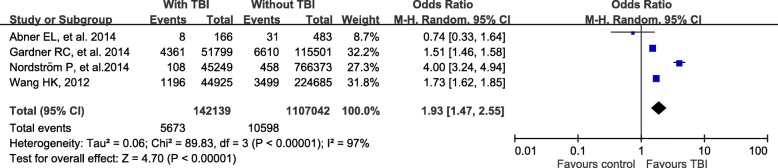
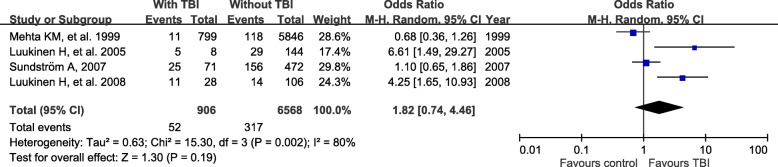
There were 18 studies comprising 3,263,207 patients. Meta-analysis revealed a significant association of prior TBI with subsequent dementia. The pooled odds ratio (OR) for TBI on development of dementia, FTD and TDP-43 associated disease were 1.93 (95% CI 1.47-2.55, p < 0.001), 4.44 (95% CI 3.86-5.10, p < 0.001), and 2.97 (95% CI 1.35-6.53, p < 0.001). However, analyses of individual diagnoses found no evidence that the risk of Alzheimer's disease, and Parkinson's disease in individuals with previous TBI compared to those without TBI.
History of TBI is not associated with the development of subsequent neurodegeneration disease. Care must be taken in extrapolating from these results because no suitable criteria define post TBI neurodegenerative processes. Therefore, further research in this area is needed to confirm these questions and uncover the link between TBI and neurodegeneration disease.
确定既往创伤性脑损伤(TBI)与随后神经退行性疾病诊断之间的关联。
通过检索PubMed、Embase、研究参考文献和综述文章,识别1980年至2016年期间所有将TBI报告为感兴趣诊断的危险因素的研究。由2名研究人员独立评估数据和研究设计。使用RevMan 5.3进行荟萃分析。
有18项研究,共纳入3,263,207例患者。荟萃分析显示,既往TBI与随后的痴呆症之间存在显著关联。TBI对痴呆症、额颞叶痴呆(FTD)和TDP-43相关疾病发生的合并比值比(OR)分别为1.93(95%CI 1.47-2.55,p<0.001)、4.44(95%CI 3.86-5.10,p<0.001)和2.97(95%CI 1.35-6.53,p<0.001)。然而,对个体诊断的分析未发现有证据表明既往有TBI的个体患阿尔茨海默病和帕金森病的风险与无TBI的个体相比有差异。
TBI病史与随后神经退行性疾病的发生无关。从这些结果进行推断时必须谨慎,因为没有合适的标准来定义TBI后的神经退行性过程。因此,需要在该领域进行进一步研究以证实这些问题并揭示TBI与神经退行性疾病之间的联系。