Zhao Chong-Yi, Ye Feng
Department of Gynecology, First People's Hospital of Yunnan Province, Kunming 650000, Yunnan Province, China.
Department of Neurosurgery, People's Hospital of Deyang City, Deyang 618000, Sichuan Province, China.
World J Clin Cases. 2018 Oct 26;6(12):559-563. doi: 10.12998/wjcc.v6.i12.559.
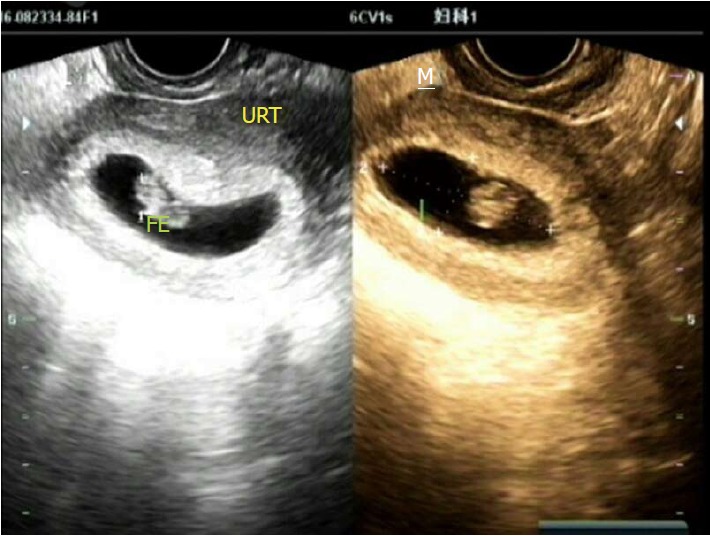
Generally, hysteroscopy is not appropriate for pregnant women without an indication. What if a patient undergoes hysteroscopy accidentally during the early gestational period? We here report a rare case of a woman who continued pregnancy after a diagnostic hysteroscopy was performed in early pregnancy and delivered a healthy baby. The patient had a history of infertility and oligomenorrhea, probably due to a previous induced abortion. A hysteroscopy was performed after the end of her "menstruation" for assessment of her uterine cavity. Early pregnancy, instead of the expected intrauterine adhesions, was suspected, and the procedure was immediately ceased. Subsequent tests confirmed the diagnosis of pregnancy. She had a full-term delivery by elective caesarean section. The success of this case was attributed to the use of vaginoscopic techniques in hysteroscopy and correct judgment and decision-making during the procedure. This case report provides some useful methods and experience that might be helpful when a similar situation occurs in clinical practice.
一般来说,对于无适应症的孕妇,宫腔镜检查并不适用。如果患者在孕早期意外接受了宫腔镜检查会怎样呢?我们在此报告一例罕见病例,一名女性在孕早期接受诊断性宫腔镜检查后继续妊娠,并产下一名健康婴儿。该患者有不孕和月经过少病史,可能归因于既往人工流产。在其“月经”结束后进行了宫腔镜检查以评估宫腔情况。怀疑为早孕而非预期的宫腔粘连,于是立即停止了该操作。随后的检查确诊为妊娠。她通过择期剖宫产足月分娩。该病例的成功归因于宫腔镜检查中使用了阴道镜技术以及术中的正确判断和决策。本病例报告提供了一些有用的方法和经验,可能对临床实践中遇到类似情况时有所帮助。