Division of Molecular Radiation Biology, Department of Radiation Oncology, University of Texas Southwestern Medical Center, Dallas, TX 75390, USA.
Int J Mol Sci. 2018 Nov 2;19(11):3442. doi: 10.3390/ijms19113442.
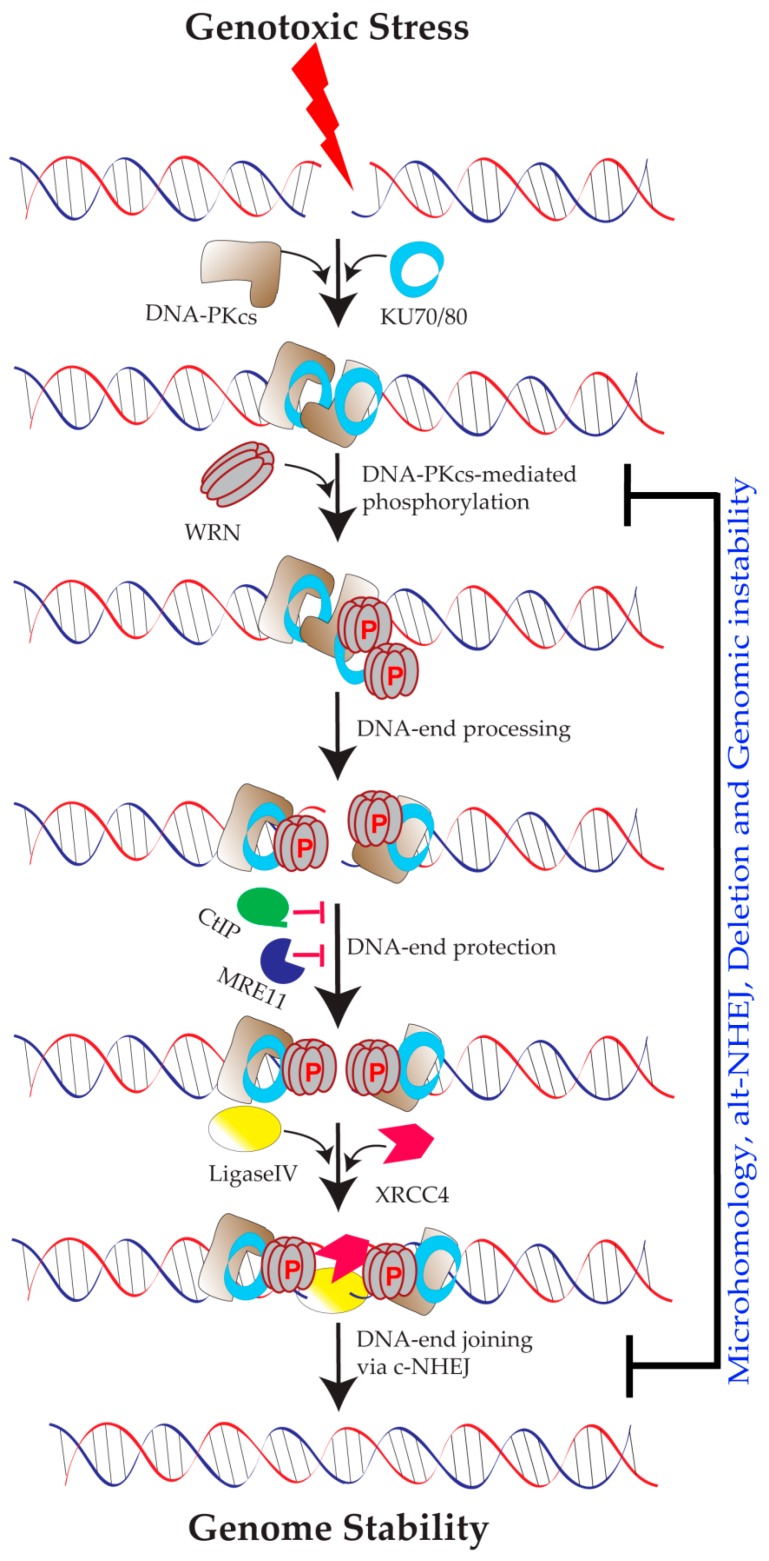
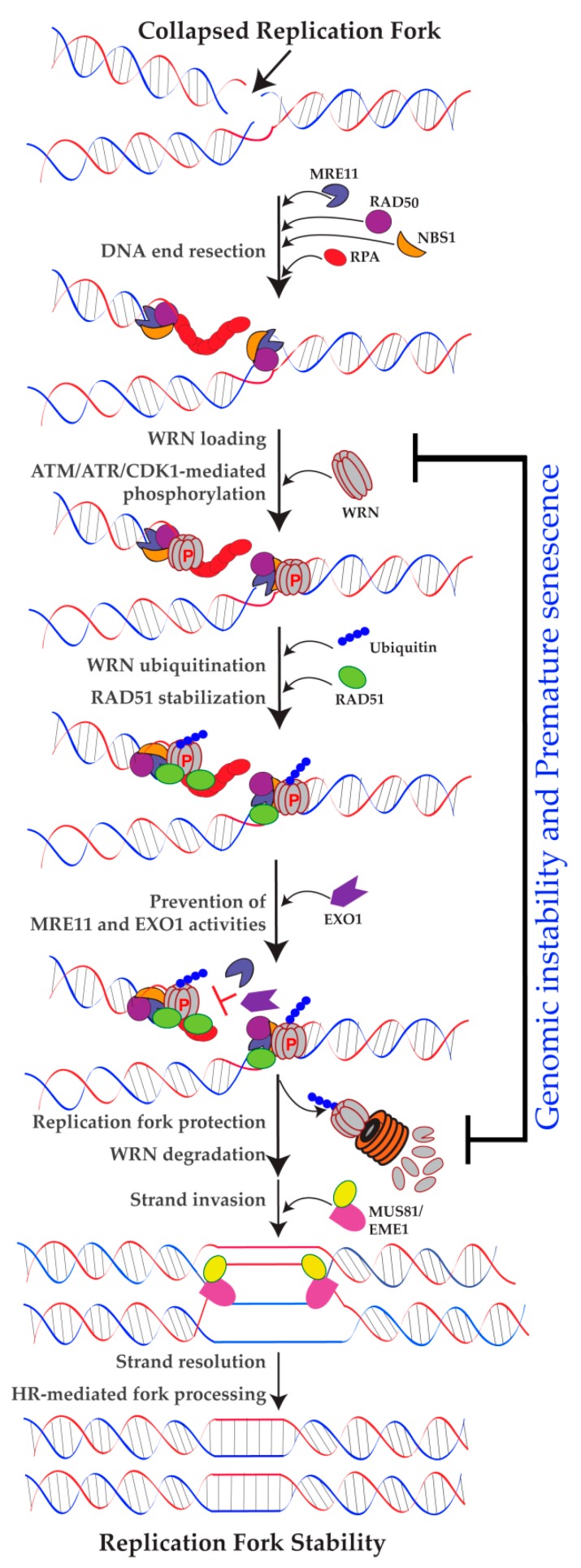
Werner Syndrome (WS) is an autosomal recessive disorder characterized by the premature development of aging features. Individuals with WS also have a greater predisposition to rare cancers that are mesenchymal in origin. Werner Syndrome Protein (WRN), the protein mutated in WS, is unique among RecQ family proteins in that it possesses exonuclease and 3' to 5' helicase activities. WRN forms dynamic sub-complexes with different factors involved in DNA replication, recombination and repair. WRN binding partners either facilitate its DNA metabolic activities or utilize it to execute their specific functions. Furthermore, WRN is phosphorylated by multiple kinases, including Ataxia telangiectasia mutated, Ataxia telangiectasia and Rad3 related, c-Abl, Cyclin-dependent kinase 1 and DNA-dependent protein kinase catalytic subunit, in response to genotoxic stress. These post-translational modifications are critical for WRN to function properly in DNA repair, replication and recombination. Accumulating evidence suggests that WRN plays a crucial role in one or more genome stability maintenance pathways, through which it suppresses cancer and premature aging. Among its many functions, WRN helps in replication fork progression, facilitates the repair of stalled replication forks and DNA double-strand breaks associated with replication forks, and blocks nuclease-mediated excessive processing of replication forks. In this review, we specifically focus on human WRN's contribution to replication fork processing for maintaining genome stability and suppressing premature aging. Understanding WRN's molecular role in timely and faithful DNA replication will further advance our understanding of the pathophysiology of WS.
Werner 综合征(WS)是一种常染色体隐性遗传病,其特征是过早出现衰老特征。WS 患者也更容易患上源于间充质的罕见癌症。WS 中突变的 Werner 综合征蛋白(WRN)在 RecQ 家族蛋白中是独一无二的,因为它具有核酸外切酶和 3' 到 5' 解旋酶活性。WRN 与参与 DNA 复制、重组和修复的不同因素形成动态亚复合物。WRN 的结合伙伴要么促进其 DNA 代谢活性,要么利用它来执行其特定功能。此外,WRN 可被多种激酶磷酸化,包括共济失调毛细血管扩张突变、共济失调毛细血管扩张和 Rad3 相关、c-Abl、细胞周期蛋白依赖性激酶 1 和 DNA 依赖性蛋白激酶催化亚基,以响应遗传毒性应激。这些翻译后修饰对于 WRN 在 DNA 修复、复制和重组中正常发挥功能至关重要。越来越多的证据表明,WRN 在一个或多个基因组稳定性维持途径中发挥着关键作用,通过这些途径抑制癌症和早衰。在其众多功能中,WRN 有助于复制叉的进展,促进停滞复制叉的修复以及与复制叉相关的 DNA 双链断裂的修复,并阻止核酶介导的复制叉过度加工。在这篇综述中,我们特别关注人类 WRN 对复制叉加工的贡献,以维持基因组稳定性和抑制过早衰老。了解 WRN 在及时和忠实的 DNA 复制中的分子作用将进一步推进我们对 WS 病理生理学的理解。