Matías Andrés, Méndez Federico, Bautista Oscar
Facultad de Ingeniería, Departamento de Termofluidos, Universidad Nacional Autónoma de México (UNAM), México City 04510, Mexico.
SEPI-ESIME Azcapotzalco, Instituto Politécnico Nacional (IPN), México City 02250, Mexico.
Micromachines (Basel). 2017 Jul 27;8(8):232. doi: 10.3390/mi8080232.
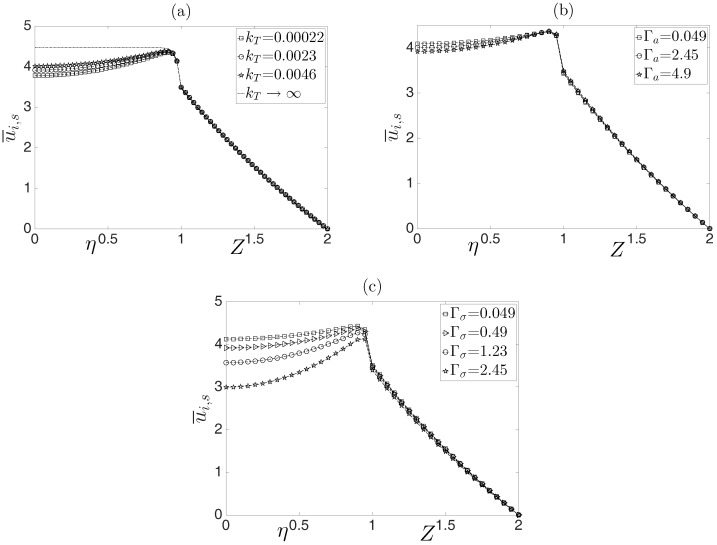
In this work, a non-isothermal electroosmotic flow of two immiscible fluids within a uniform microcapillary is theoretically studied. It is considered that there is an annular layer of a non-Newtonian liquid, whose behavior follows the power-law model, adjacent to the inside wall of the capillary, which in turn surrounds an inner flow of a second conducting liquid that is driven by electroosmosis. The inner fluid flow exerts an interfacial force, dragging the annular fluid due to shear and Maxwell stresses at the interface between the two fluids. Because the Joule heating effect may be present in electroosmotic flow (EOF), temperature gradients can appear along the microcapillary, making the viscosity coefficients of both fluids and the electrical conductivity of the inner fluid temperature dependent. The above makes the variables of the flow field in both fluids, velocity, pressure, temperature and electric fields, coupled. An additional complexity of the mathematical model that describes the electroosmotic flow is the nonlinear character due to the rheological behavior of the surrounding fluid. Therefore, based on the lubrication theory approximation, the governing equations are nondimensionalized and simplified, and an asymptotic solution is determined using a regular perturbation technique by considering that the perturbation parameter is associated with changes in the viscosity by temperature effects. The principal results showed that the parameters that notably influence the flow field are the power-law index, an electrokinetic parameter (the ratio between the radius of the microchannel and the Debye length) and the competition between the consistency index of the non-Newtonian fluid and the viscosity of the conducting fluid. Additionally, the heat that is dissipated trough the external surface of the microchannel and the sensitivity of the viscosity to temperature changes play important roles, which modify the flow field.
在这项工作中,理论研究了均匀微毛细管内两种不混溶流体的非等温电渗流。认为在毛细管内壁附近存在一层遵循幂律模型的非牛顿液体环形层,该环形层又包围着由电渗驱动的第二种导电液体的内部流动。内部流体流动施加界面力,由于两种流体之间界面处的剪切应力和麦克斯韦应力而拖动环形流体。由于电渗流(EOF)中可能存在焦耳热效应,沿微毛细管会出现温度梯度,使得两种流体的粘度系数以及内部流体的电导率都与温度有关。上述情况使得两种流体中流场的变量,即速度、压力、温度和电场,相互耦合。描述电渗流的数学模型的另一个复杂之处在于由于周围流体的流变行为而具有非线性特征。因此,基于润滑理论近似,对控制方程进行无量纲化和简化,并通过考虑扰动参数与温度效应引起的粘度变化相关,使用正则摄动技术确定渐近解。主要结果表明,显著影响流场的参数是幂律指数、一个电动参数(微通道半径与德拜长度之比)以及非牛顿流体的稠度指数与导电流体粘度之间的竞争。此外,通过微通道外表面耗散的热量以及粘度对温度变化的敏感性起着重要作用,它们会改变流场。