Department of Developmental Neuroscience, IRCCS Fondazione Stella Maris, Viale del Tirreno 331, 56128 Calambrone, Pisa, Italy.
The BioRobotics Institute, Polo Sant'Anna Valdera, Viale Rinaldo Piaggio 34, 56026 Pontedera, Pisa, Italy.
J Neuroeng Rehabil. 2018 Nov 6;15(1):94. doi: 10.1186/s12984-018-0447-y.
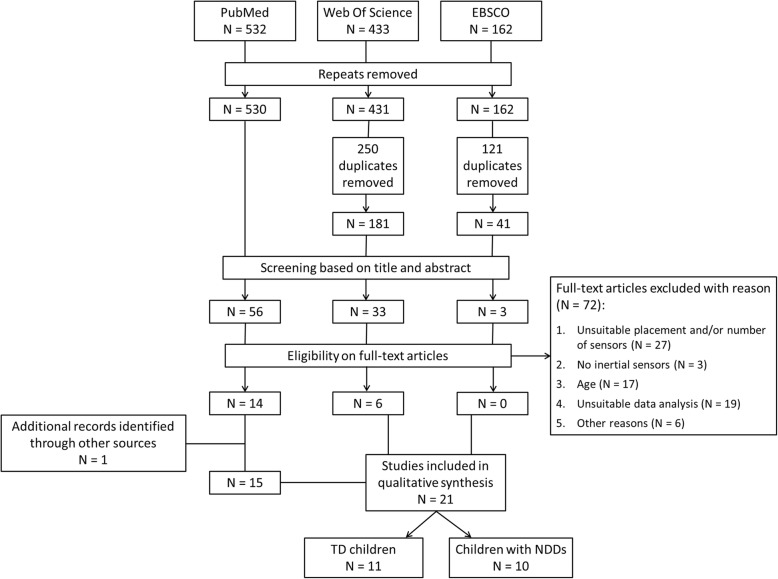
Understanding development of bimanual upper limb (UL) activities in both typical and atypical conditions in children is important for: i) tailoring rehabilitation programs, ii) monitoring progress, iii) determining outcomes and iv) evaluating effectiveness of treatment/rehabilitation. Recent technological advances, such as wearable sensors, offer possibilities to perform standard medical monitoring. Body-worn motion sensors, mainly accelerometers, have shown very promising results but, so far, these studies have mainly focused on adults. The main aim of this review was to report the evidence of UL activity of both typically developing (TD) children and children with neurodevelopmental disorders (NDDs) that are reliably reported and comparable, using a combination of multiple wearable inertial sensors, both in laboratory and natural settings. Articles were selected from three research databases (PubMed, Web of Science and EBSCO). Included studies reported data on children aged 0-20 years old simultaneously wearing at least two inertial sensors on upper extremities. The collected and reported data were relevant in order to describe the amount of physical activity performed by the two ULs separately. A total of 21 articles were selected: 11 including TD, and 10 regarding NDDs. For each article, a review of both clinical and technical data was performed. We considered inertial sensors used for following aims: (i) to establish activity intensity cut-points; (ii) to investigate validity and reliability of specified markers, placement and/or number of inertial sensors; (iii) to evaluate duration and intensity of natural UL movements, defined motor tasks and tremor; and (iv) to assess efficacy of certain rehabilitation protocols. Our conclusions were that inertial sensors are able to detect differences in use between both hands and that all reviewed studies support use of accelerometers as an objective outcome measure, appropriate in assessing UL activity in young children with NDDs and determining intervention effectiveness. Further research on responsiveness to interventions and consistency with use in real-world settings is needed. This information could be useful in planning UL rehabilitation strategies.
了解儿童在正常和异常情况下双手上肢(UL)活动的发展对于以下方面非常重要:i)定制康复计划,ii)监测进展,iii)确定结果,iv)评估治疗/康复的效果。最近的技术进步,如可穿戴传感器,为进行标准医疗监测提供了可能性。穿戴式运动传感器,主要是加速度计,已经显示出非常有前景的结果,但到目前为止,这些研究主要集中在成年人身上。本综述的主要目的是报告使用多个可穿戴惯性传感器,在实验室和自然环境中可靠且可比较地报告和比较典型发育(TD)儿童和神经发育障碍(NDD)儿童 UL 活动的证据。文章从三个研究数据库(PubMed、Web of Science 和 EBSCO)中进行选择。纳入的研究报告了年龄在 0-20 岁之间的儿童同时在上肢佩戴至少两个惯性传感器的数据。收集和报告的数据与描述两个 UL 分别进行的身体活动量有关。共选择了 21 篇文章:11 篇包括 TD,10 篇涉及 NDD。对于每篇文章,都对临床和技术数据进行了审查。我们考虑了用于以下目的的惯性传感器:(i)确定活动强度的临界点;(ii)研究特定标记、放置和/或惯性传感器数量的有效性和可靠性;(iii)评估自然 UL 运动、定义的运动任务和震颤的持续时间和强度;(iv)评估某些康复方案的效果。我们的结论是,惯性传感器能够检测到双手使用之间的差异,并且所有综述研究都支持使用加速度计作为评估 NDD 幼儿 UL 活动和确定干预效果的客观结果测量方法。需要进一步研究干预的反应性和在现实环境中的一致性。这些信息对于规划 UL 康复策略可能很有用。