a Key Laboratory of Zoonosis of Liaoning Province, College of Animal Science and Veterinary Medicine, Shenyang Agricultural University , Shenyang , P.R. China.
Drug Deliv. 2018 Nov;25(1):1886-1897. doi: 10.1080/10717544.2018.1486473.
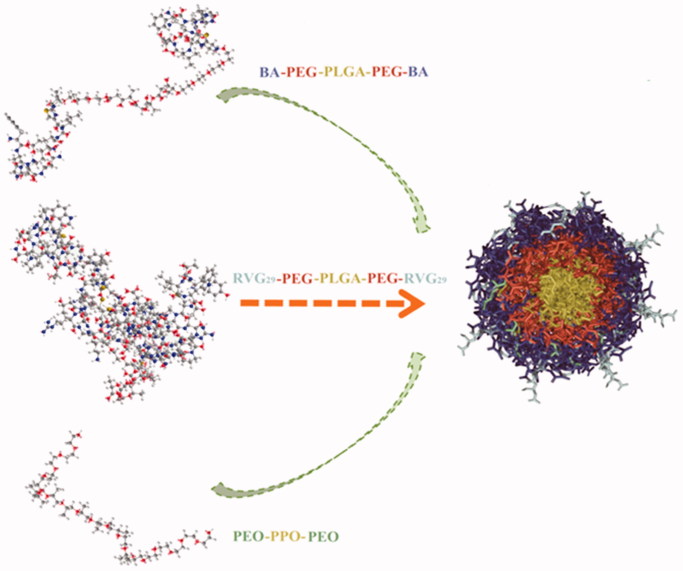
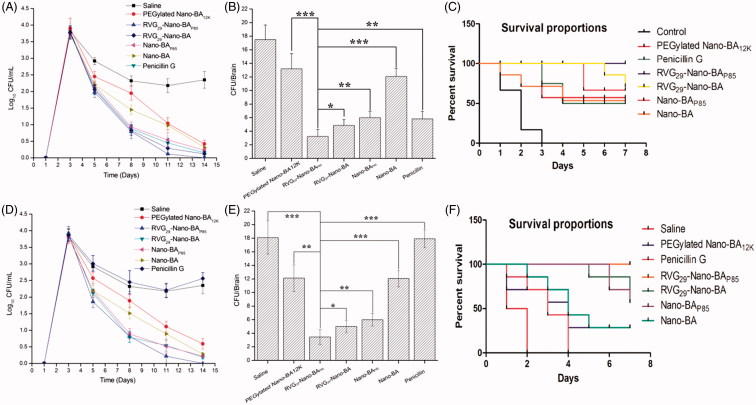
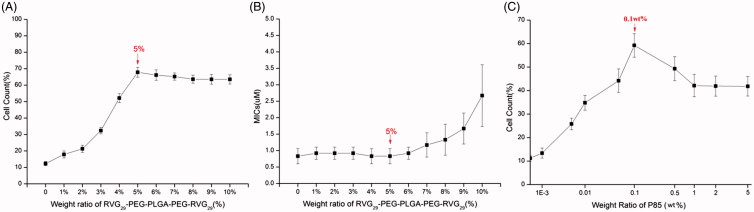
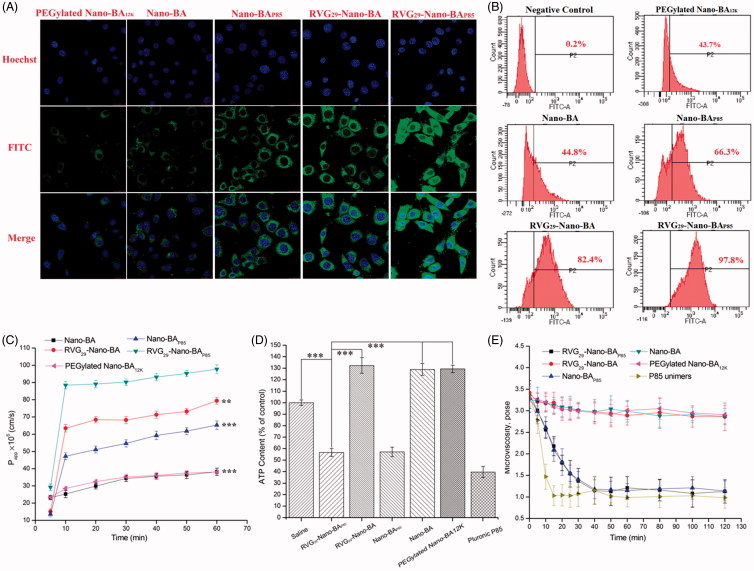
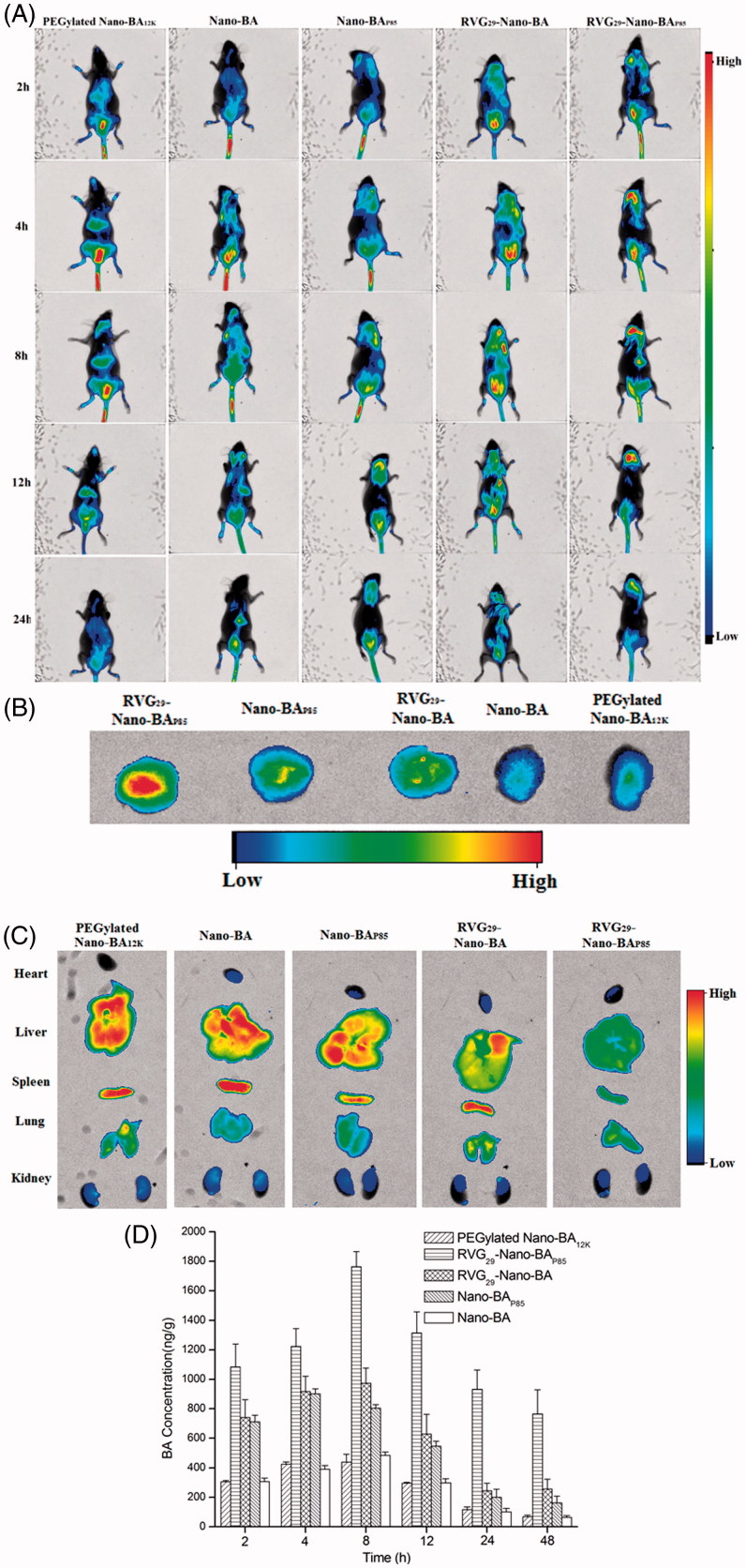
Pneumococcal meningitis (PM), caused by Streptococcus pneumonia, remains a high-burden disease in developing countries. Antibiotic therapy has been limited due to the inefficiency of drug transport across the blood-brain barrier (BBB) and the emergence of drug-resistant strains. In our preliminary study, PEGylated nano-self-assemblies of bacitracin A (PEGylated Nano-BA) demonstrated a strong antibacterial potency against S. pneumonia. In this study, the potential application of this micelle for the treatment of both Penicillin-sensitive and -resistant PM was studied. To address BBB-targeting and -crossing issues, PEGylated Nano-BA was formulated with a specific brain-targeting peptide (rabies virus glycopeptide-29, RVG) and a P-glycoprotein inhibitor (Pluronic P85 unimers) to construct a mixed micellar system (RVG-Nano-BA). RVG-Nano-BA demonstrated a strong antibacterial potency against 13 clinical isolates of S. pneumonia, even higher than that of Penicillin G, a conventional anti-PM agent. RVG-Nano-BA had more cellular uptake in brain capillary endothelial cells (BCECs) and higher BBB-crossing efficiency than single formulated Nano-BAs as shown in an in vitro BBB model. The enhanced BBB-permeability was attributed to the synergetic effect of RVG and P85 unimers through receptor-mediated transcytosis, exhaustion of ATP, and reduction in membrane microviscosity. In vivo results further demonstrated that RVG-Nano-BA was able to accumulate in brain parenchyma as confirmed by in vivo optical imaging. In addition, RVG-Nano-BA exhibited high therapeutic efficiencies in both Penicillin-sensitive and -resistant PM mouse models with negligible systemic toxicity. Collectively, RVG-Nano-BA could effectively overcome BBB barriers and suppressed the growth of both drug-sensitive and -resistant S. pneumonia in the brain tissues, which demonstrated its potential for the treatment of PM.
肺炎球菌性脑膜炎(PM)由肺炎链球菌引起,在发展中国家仍是一种高负担疾病。由于药物穿过血脑屏障(BBB)的效率低下以及耐药菌株的出现,抗生素治疗受到限制。在我们的初步研究中,杆菌肽 A 的聚乙二醇化纳米自组装体(聚乙二醇化纳米-BA)对肺炎链球菌表现出很强的抗菌效力。在这项研究中,研究了这种胶束治疗青霉素敏感和耐药 PM 的潜力。为了解决 BBB 靶向和穿透问题,将聚乙二醇化纳米-BA 与特定的脑靶向肽(狂犬病病毒糖肽-29,RVG)和 P 糖蛋白抑制剂(Pluronic P85 单聚体)一起构建了混合胶束系统(RVG-纳米-BA)。RVG-纳米-BA 对 13 株临床分离的肺炎链球菌表现出很强的抗菌效力,甚至高于传统的抗 PM 药物青霉素 G。RVG-纳米-BA 在体外 BBB 模型中具有更高的脑毛细血管内皮细胞(BCEC)摄取率和更高的 BBB 穿透效率。增强的 BBB 通透性归因于 RVG 和 P85 单聚体通过受体介导的胞吞作用、ATP 耗尽和膜微粘度降低的协同作用。体内结果进一步表明,RVG-纳米-BA 能够在脑实质中积累,这一点通过体内光学成像得到了证实。此外,RVG-纳米-BA 在青霉素敏感和耐药 PM 小鼠模型中均表现出很高的治疗效率,且全身毒性可忽略不计。总之,RVG-纳米-BA 可以有效地克服 BBB 障碍,并抑制大脑组织中敏感和耐药的肺炎链球菌的生长,这表明其在 PM 治疗方面的潜力。