Neuroscience and Trauma Centre, Blizard Institute, Barts and The School of Medicine and Dentistry, Queen Mary University of London, 4 Newark Street, London, City of London, Greater London, E1 2AT, UK.
Proteome Sciences plc, Hamilton House, Mabledon Place, London, UK.
Mol Neurodegener. 2018 Nov 7;13(1):60. doi: 10.1186/s13024-018-0292-2.
It is unclear to what extent pre-clinical studies in genetically homogeneous animal models of amyotrophic lateral sclerosis (ALS), an invariably fatal neurodegenerative disorder, can be informative of human pathology. The disease modifying effects in animal models of most therapeutic compounds have not been reproduced in patients. To advance therapeutics in ALS, we need easily accessible disease biomarkers which can discriminate across the phenotypic variants observed in ALS patients and can bridge animal and human pathology. Peripheral blood mononuclear cells alterations reflect the rate of progression of the disease representing an ideal biological substrate for biomarkers discovery.
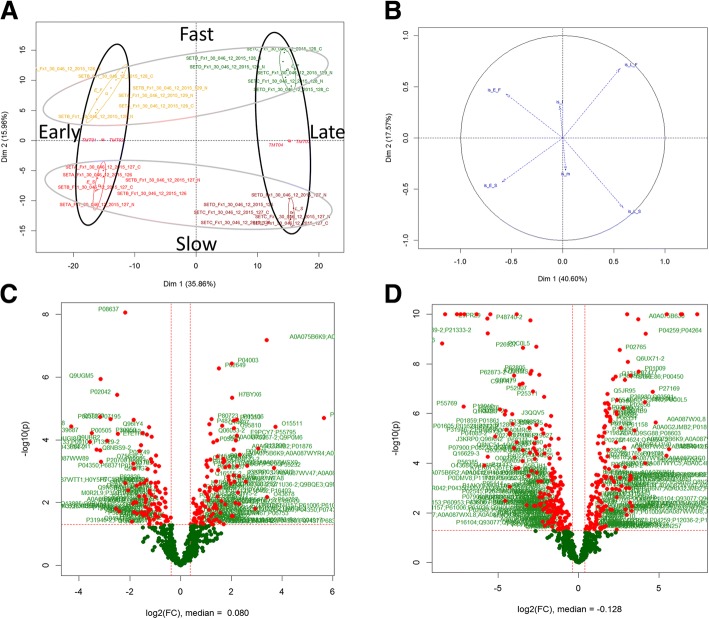
We have applied TMTcalibrator™, a novel tissue-enhanced bio fluid mass spectrometry technique, to study the plasma proteome in ALS, using peripheral blood mononuclear cells as tissue calibrator. We have tested slow and fast progressing SOD1G93A mouse models of ALS at a pre-symptomatic and symptomatic stage in parallel with fast and slow progressing ALS patients at an early and late stage of the disease. Immunoassays were used to retest the expression of relevant protein candidates.
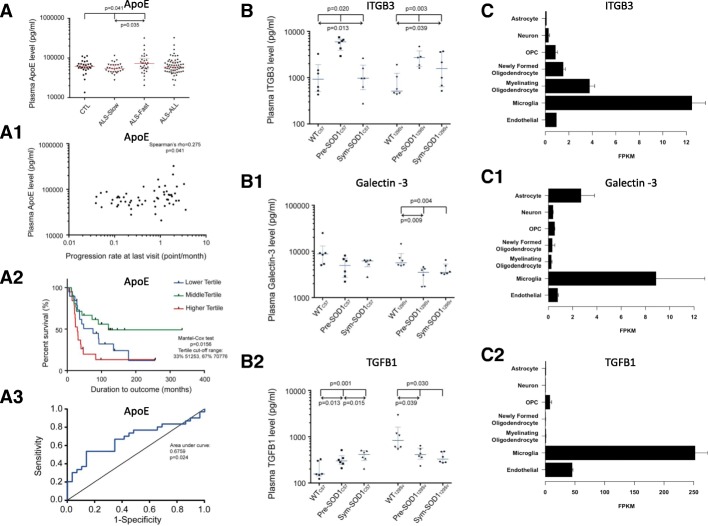
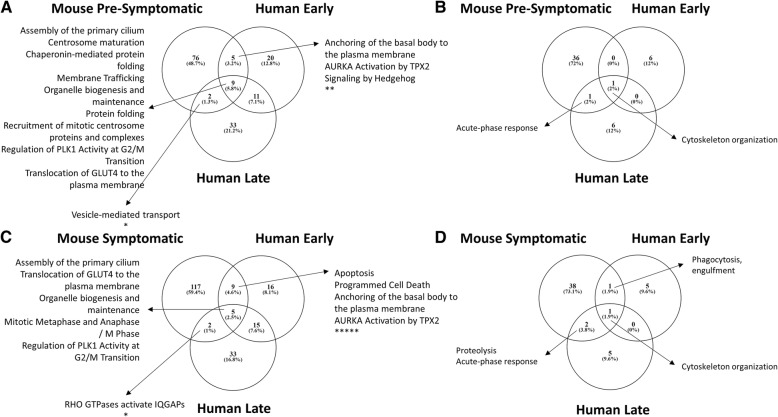
The biological features differentiating fast from slow progressing mouse model plasma proteomes were different from those identified in human pathology, with only processes encompassing membrane trafficking with translocation of GLUT4, innate immunity, acute phase response and cytoskeleton organization showing enrichment in both species. Biological processes associated with senescence, RNA processing, cell stress and metabolism, major histocompatibility complex-II linked immune-reactivity and apoptosis (early stage) were enriched specifically in fast progressing ALS patients. Immunodetection confirmed regulation of the immunosenescence markers Galectin-3, Integrin beta 3 and Transforming growth factor beta-1 in plasma from pre-symptomatic and symptomatic transgenic animals while Apolipoprotein E differential plasma expression provided a good separation between fast and slow progressing ALS patients.
These findings implicate immunosenescence and metabolism as novel targets for biomarkers and therapeutic discovery and suggest immunomodulation as an early intervention. The variance observed in the plasma proteomes may depend on different biological patterns of disease progression in human and animal model.
在遗传性均一的肌萎缩侧索硬化症(ALS)动物模型中进行的临床前研究在多大程度上可以为人类病理学提供信息尚不清楚。大多数治疗化合物的动物模型中的疾病修饰作用并未在患者中重现。为了在 ALS 中推进治疗,我们需要易于获得的疾病生物标志物,这些标志物可以区分 ALS 患者观察到的表型变异,并可以连接动物和人类病理学。外周血单核细胞的改变反映了疾病的进展速度,是生物标志物发现的理想生物基质。
我们应用了 TMTcalibrator™,一种新型的组织增强生物流体质谱技术,使用外周血单核细胞作为组织校准物来研究 ALS 患者的血浆蛋白质组。我们平行地测试了 SOD1G93A 慢进展和快进展的 ALS 小鼠模型在预症状和症状阶段,以及快进展和慢进展的 ALS 患者在疾病的早期和晚期阶段。免疫测定用于重新测试相关蛋白候选物的表达。
区分快速进展和缓慢进展的小鼠模型血浆蛋白质组的生物学特征与在人类病理学中识别的特征不同,只有包含 GLUT4 易位的膜转运、固有免疫、急性期反应和细胞骨架组织的过程在两种物种中都有富集。与衰老、RNA 处理、细胞应激和代谢、主要组织相容性复合物-II 相关的免疫反应性和细胞凋亡(早期阶段)相关的生物学过程仅在快速进展的 ALS 患者中富集。免疫检测证实了免疫衰老标志物半乳糖凝集素-3、整合素β3 和转化生长因子β-1 在转基因动物的无症状和有症状动物中的调节,而载脂蛋白 E 的差异血浆表达为快速进展和缓慢进展的 ALS 患者提供了良好的分离。
这些发现表明免疫衰老和代谢是生物标志物和治疗发现的新靶点,并表明免疫调节是早期干预措施。在人类和动物模型中,血浆蛋白质组的变化可能取决于疾病进展的不同生物学模式。