The Ragon Institute of MGH, MIT and Harvard, Cambridge, Massachusetts, United States of America.
Division of Gastroenterology, Massachusetts General Hospital, Boston, Massachusetts, United States of America.
Sci Rep. 2018 Nov 7;8(1):16471. doi: 10.1038/s41598-018-34576-4.
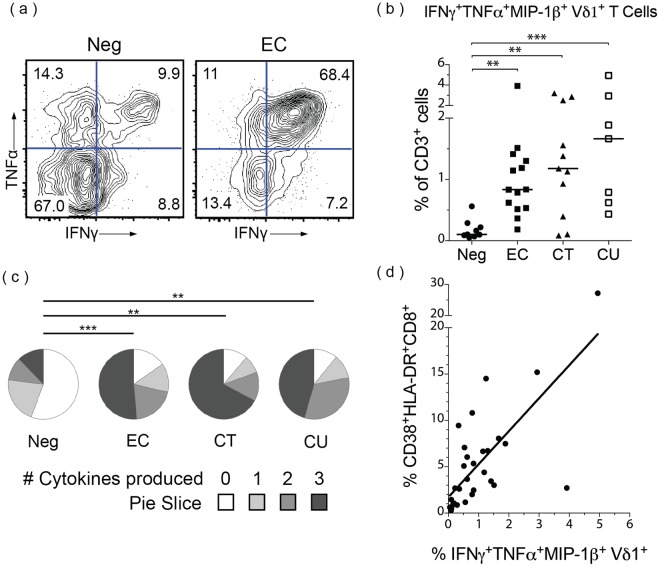
γδ T cells predominate in the intestinal mucosa and help maintain gut homeostasis and mucosal immunity. Although HIV infection significantly alters these cells, what drives these perturbations is unclear. Growing evidence suggests that impaired intestinal immune function in HIV leads to chronic immune activation and disease progression. This occurs even in HIV controllers - individuals with undetectable HIV viremia without antiretroviral therapy (ART). We show that Vδ1 cells, a subset of γδ T cells described as being important in intestinal barrier function, increase in frequency in HIV-infected individuals, including HIV controllers. These cells resemble terminally differentiated effector memory cells, producing the pro-inflammatory cytokines IFNγ, TNFα, and MIP-1β upon stimulation. Importantly, pro-inflammatory Vδ1 cell frequency correlates with levels of HIV RNA in intestinal tissue but not in plasma. This study supports a model in which local viral replication in the gut in HIV controllers disrupts the phenotype and function of Vδ1 cells, a cell type involved in the maintenance of epithelial barrier integrity, and may thereby contribute to systemic immune activation and HIV disease progression.
γδ T 细胞在肠道黏膜中占优势,有助于维持肠道内环境稳态和黏膜免疫。尽管 HIV 感染显著改变了这些细胞,但导致这些改变的原因尚不清楚。越来越多的证据表明,HIV 导致的肠道免疫功能受损会导致慢性免疫激活和疾病进展。即使在 HIV 感染者中也会发生这种情况,这些人未经抗逆转录病毒治疗(ART)就实现了 HIV 病毒载量不可检测。我们发现,Vδ1 细胞(γδ T 细胞的一个亚群,被认为对肠道屏障功能很重要)在 HIV 感染者(包括 HIV 控制者)中的频率增加。这些细胞类似于终末分化的效应记忆细胞,在受到刺激后会产生促炎细胞因子 IFNγ、TNFα 和 MIP-1β。重要的是,促炎 Vδ1 细胞的频率与肠道组织中的 HIV RNA 水平相关,但与血浆中的 HIV RNA 水平无关。这项研究支持了一种模型,即 HIV 控制者肠道内的局部病毒复制会破坏 Vδ1 细胞的表型和功能,而 Vδ1 细胞是维持上皮屏障完整性的细胞类型,可能会导致全身性免疫激活和 HIV 疾病进展。